
Video Library
Athens and the Owl Coin
One silver coin paid for the Parthenon, a navy, and an empire. The story of how Athens invented trusted money — and what happened when the trust broke.
2026-10-03 · 11 min read · Invest Money
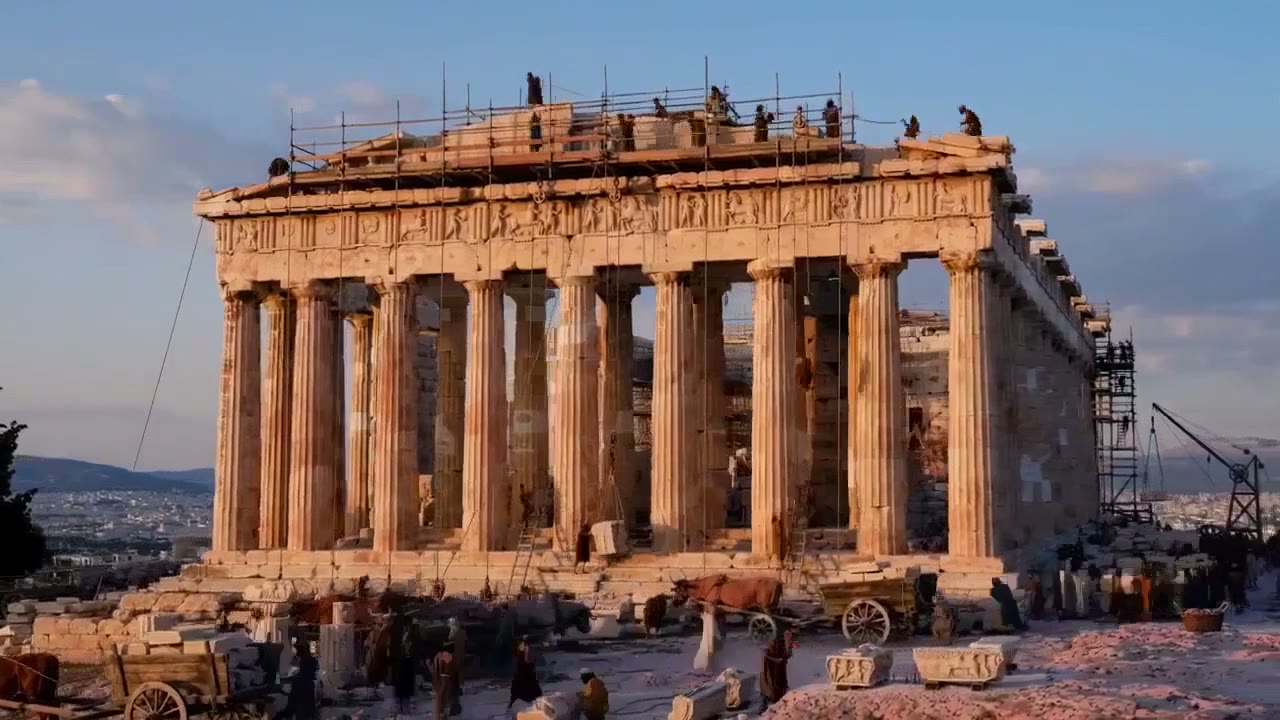
One silver coin paid for the Parthenon, a navy, and an empire. But that coin is the end of a very long story — one that starts way back before money existed at all, with a simple trade. Picture it: tens of thousands of years ago, two tribes meet at a river crossing. The people on one side lay down animal skins, a carved antler, a bundle of dried fruit. The people on the other side offer woven baskets and a handful of berries. They point, they argue with their hands, they nod. A deal.
This was the entire economy of the human race for most of our history. My rock for your deer antler, your animal skin for my fruit, person to person, tribe to tribe. It worked, but it had a flaw, and the flaw was simple. What if you have fruit, and I want your skins, but you don't want my fruit? Then there's no deal. Trade could only happen when two people wanted exactly what the other had, at exactly the same moment. Economists call it the coincidence of wants, and it kept the human economy small.
The first money
Then humans found something everybody wanted: shells. Along the coast, they were everywhere — smooth, beautiful, glowing with colors you couldn't find anywhere inland. So the coastal people started carrying shells inland, and something strange happened. People started accepting shells, not because they needed another shell, but because they knew the next person would take them too. The shell had become money — the first money. Not because a king declared it, but because everybody wanted it, and everybody knew everybody wanted it.
That's the secret of money, and it was true on day one: money is whatever everybody believes everybody else will accept. But shells had limits — try buying a shipload of grain with seashells. So traders turned to something denser: metal. Copper, silver, gold. Little nuggets, little rings, little lumps. But metal brought a new problem: how do you know the nugget is real, and how much it's worth?
The answer was the scale. In Babylon and Sumer, 4,000 years ago, a merchant would set a standard stone weight on one side of a bronze balance scale and pile your silver on the other side. The beam would swing and settle. Level — deal. For centuries, this was money: metal, weighed out, every single time, in every single trade. But scales can be rigged. A shaved weight, a thumb pressed on the beam when nobody's looking. Cheating the scales became one of the oldest crimes on earth, because when money is weighed by hand, trust is weighed by hand too.
The stamp replaces the scale
Then someone had the obvious idea. If we're all agreeing on standard weights anyway, why weigh it every time? Why not make little standardized pieces of metal, all the same weight, and stamp them so everyone knows they're good? Around 600 BC, the kings of Lydia — in what's now Turkey — did exactly that. Little beans of electrum, a natural mix of gold and silver, stamped with the king's lion. The stamp said: this weight is guaranteed by the king. No scale, no argument, no thumb on the beam. And just like that, coinage was born. The stamp replaced the scale. Trust, instead of being negotiated in every trade, was manufactured once at the mint.
The Greeks saw the Lydian idea and did what the Greeks did: they took it bigger. And Athens had something Lydia didn't — a mountain of silver. Twenty-five miles south of the city, in the hills of Laurion, miners chasing lead broke into one of the richest silver strikes of the ancient world. Hundreds of shafts, some plunging 400 feet straight down. The state owned the ground, leased it to private operators, and the silver poured in — a river of wealth flowing straight into the city's hands. Athens didn't just have money. It had the mine.
The decision that made Athens
And then came the decision that made Athens. In 483 BC, a rich new vein was struck at Laurion, and every citizen was about to receive a cash handout — free silver in every pocket. A statesman named Themistocles stood before the assembly and said no. Spend it all, he argued, on 200 warships: triremes, long narrow galleys with three rows of oarsmen. The people voted yes — and just in time. In 480 BC, the Persian Empire sent a massive fleet to conquer Greece, and at the narrow straits of Salamis, those Athenian triremes smashed the Persian navy and saved the Greek world. Silver from a hole in the ground had become ships. Ships had become victory. And victory was about to become something much bigger.
The owl brand
Because after Salamis, Athens made a second decision — quieter, and in the long run, bigger. They didn't just mint coins. They built a brand: the Athenian tetradrachm. About 17 grams of silver, a thick heavy disk. On one side, Athena, goddess of the city, wearing her crested helmet. On the other side, her owl, staring straight out at you, with three letters stamped beside it — alpha, theta, epsilon: 'of the Athenians.' Same design, same weight, year after year, decade after decade, for centuries. No redesigns, no debasement, no surprises.

Ask yourself: when was the last time money stayed exactly the same for centuries? A merchant in Egypt, a trader in Phoenicia, a ship captain from Sicily — none of them needed to weigh an owl or bite it to test it. They knew the owl, and the owl never changed, so the owl was trusted. Owl coins turned up everywhere: the Aegean, Asia Minor, Arabia, the eastern Mediterranean. They became the ancient world's reserve currency — the dollar of antiquity. At the height of its power, the city forbade its allied cities from minting their own coins. One money, one measure, from the Black Sea to Sicily. Two and a half thousand years before the euro, a single city built a single currency zone across the sea.
What the money bought
And Athens spent those owls directly on its citizens. Jurors paid in coin for a day's service. Rowers drawing wages in owls. For the first time at this scale, money wasn't just the king's treasure — it was the people's wage. And where did it all go? Look up at the Acropolis: the Parthenon, paid for by this machine. The philosophers, the playwrights, the early scientists — the minds we still quote twenty-five centuries later — lived in a city whose wealth gave them the freedom to think. Silver dug from the earth became ships. Ships became an empire. And the empire's money funded a golden age of the human mind.
When the money broke
It didn't last forever. Athens overreached. The long war with Sparta drained the treasury. And in 406 BC came the unthinkable: Athens debased the owl. Cheap bronze coins, plated to look like silver. Imagine holding your savings in those owls — four days of pay in your palm — and watching each new coin come out cheaper than the last. The trust that took centuries to build broke in a moment. And here is the lesson this whole story keeps teaching: when the money breaks, the empire follows.
The irony is that the owls kept circulating anyway — because trust, once earned across centuries, outlives the government that minted it. The coin outlasted the empire. Think about that the next time someone tells you a currency is only as strong as the state behind it.
The lesson
So here's what Athens carved into history. Money is trust made physical. Barter needed coincidence. Shells needed beauty. Weighed metal needed honest scales. The stamped coin needed only one thing: that everyone believed. The more people believed, the more useful it became. And the more useful it became, the more people believed. The original network effect — two and a half thousand years before anyone had the phrase for it. And it's still spinning today, every time a shopkeeper in a foreign country accepts a US dollar.