
Alternatives and Commodities
School 04 — Security Analysis and Portfolio Design
School 5 · Security Analysis and Portfolio Design · About 15 minutes
So far in School 5 you have learned to analyze stocks (AP-201 through AP-205) and bonds (AP-206 through AP-208) — the core of almost every portfolio. But there is a third family of investments that does not fit neatly into either bucket: alternatives. These are assets like gold, oil, wheat, real estate, and private funds. They march to a different drummer than stocks and bonds, which is exactly why investors use them. We will now teach you about gold, commodities, private assets, liquidity, fees, and the rightful role of alternatives in your portfolio.
Gold: The Crisis Asset
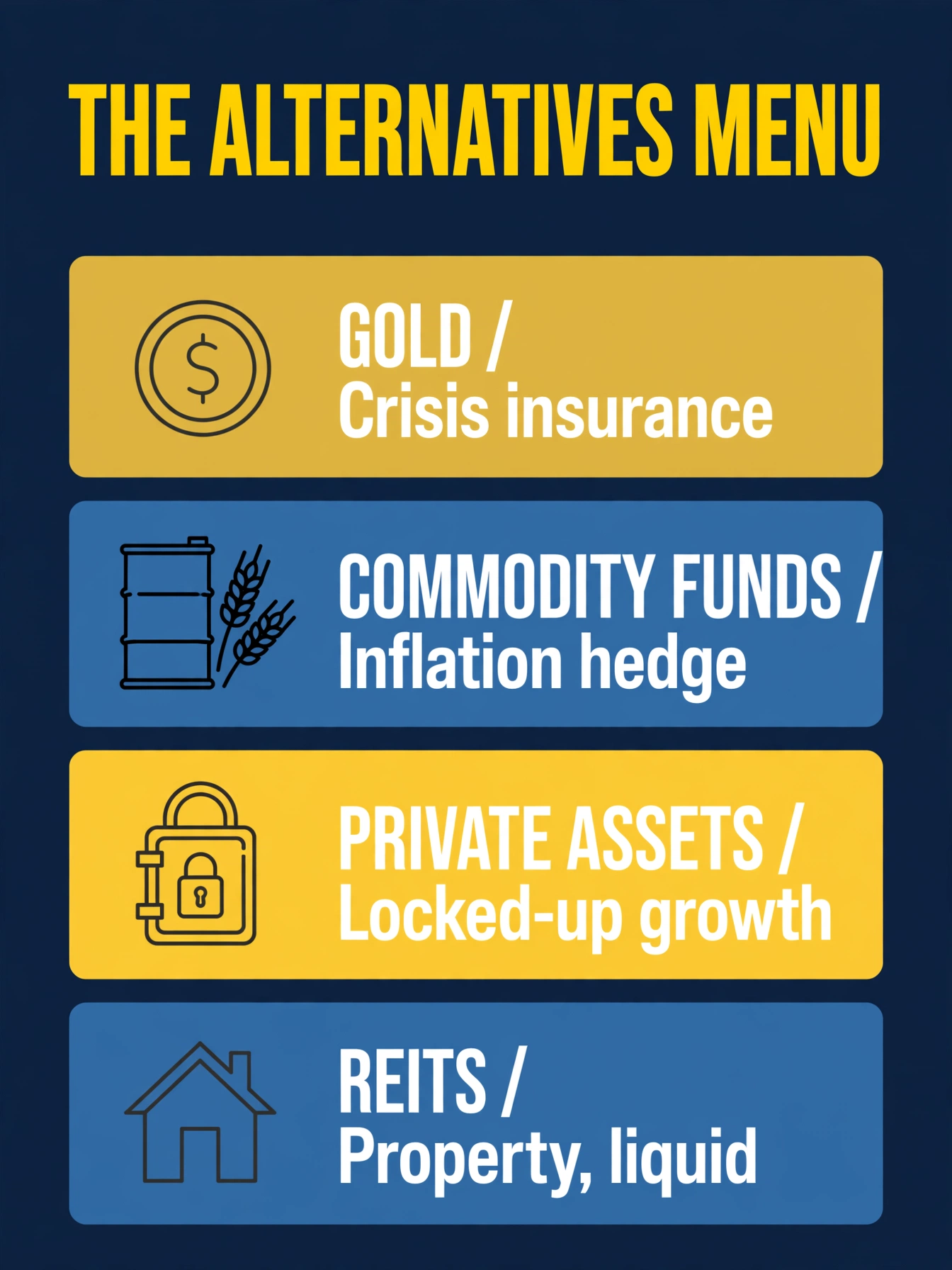
Gold is the world's oldest investment — people have hoarded it for five thousand years, and they do it for a reason. Gold tends to shine when everything else looks shaky: in market panics, inflation scares, and currency crises, frightened money runs toward gold. That makes it a crisis asset — something that often rises, or at least holds its value, when stocks are falling. It is insurance, not an engine: it does not pay dividends, it does not grow earnings, and it does not pay you rent. You hold it hoping you never need it, and you are glad to have it when you do.
The simplest way to own gold is a gold ETF — a fund that tracks the price of gold and trades on the stock exchange like a stock. It is cheap, liquid, and requires no vault. Physical gold — coins and bars — is the romantic option, but it brings real costs: dealer markups when you buy, storage and insurance while you hold, and a painful spread when you sell. For most investors, the ETF captures nearly all of the benefit at a fraction of the hassle.
Know gold's limits. Over very long stretches, gold has merely kept pace with inflation while stocks have grown wealth far more. And gold's price is driven by fear and fashion — it can sit flat or fall for a decade when confidence returns. Own a modest slice for the insurance value; never bet the farm on it.
Commodities: Oil, Wheat, and Copper
Commodities are the raw materials of civilization — energy like oil and natural gas, metals like copper and aluminum, and agriculture like wheat, corn, and coffee. Every price you see at the grocery store or the gas pump starts with a commodity. And commodities have their own rhythm: when inflation rises, commodity prices usually rise with it, often faster than anything else in your portfolio. That makes them the natural inflation hedge.
Owning commodities directly — barrels of oil in your garage — is impractical for obvious reasons. Instead, investors use commodity funds: ETFs or mutual funds that hold a basket of commodity-linked assets. A broad commodity fund spreads your money across energy, metals, and agriculture so no single crop failure or oil shock decides your fate. This is the sensible beginner vehicle, and it is the only commodity product most investors should touch.
A warning: stay away from leveraged commodity products — the funds with names like "2X Oil" or "3X Natural Gas." They are designed for day-traders, and their compounding mechanics eat away at your money every single day you hold them. Beginners buying leveraged commodity funds is one of the most reliable ways to lose money in all of investing. If it says leveraged, inverse, 2X, or 3X — walk away.
Private Assets: Real Estate and Beyond
Private assets are investments that are not traded on a public stock exchange: direct ownership of rental real estate, private equity funds that buy whole companies, and venture funds that back startups. Their selling point is returns — historically, top private investments have beaten the stock market, and real estate gives you both rental income and property appreciation, two ways to get paid at once.
But privacy comes at a steep price, and it has a name: illiquidity. There is no sell button on a rental house or a private equity fund. Selling a property takes months and a stack of fees; private equity funds commonly lock up your money for seven to ten years with no early exit. During those years you cannot rebalance, you cannot panic-sell, and you cannot grab the money for an emergency. Only commit money to private assets that you are certain you will not need for a very long time.
There is a middle road. REITs — real estate investment trusts — are companies that own income-producing property and trade on the stock exchange like stocks. A REIT index fund gives you real estate exposure with daily liquidity and tiny fees, which is why it is the beginner-friendly route. Treat direct property and private funds as advanced territory: fine once you are experienced and wealthy, dangerous before.
Liquidity: How Fast Can You Sell?
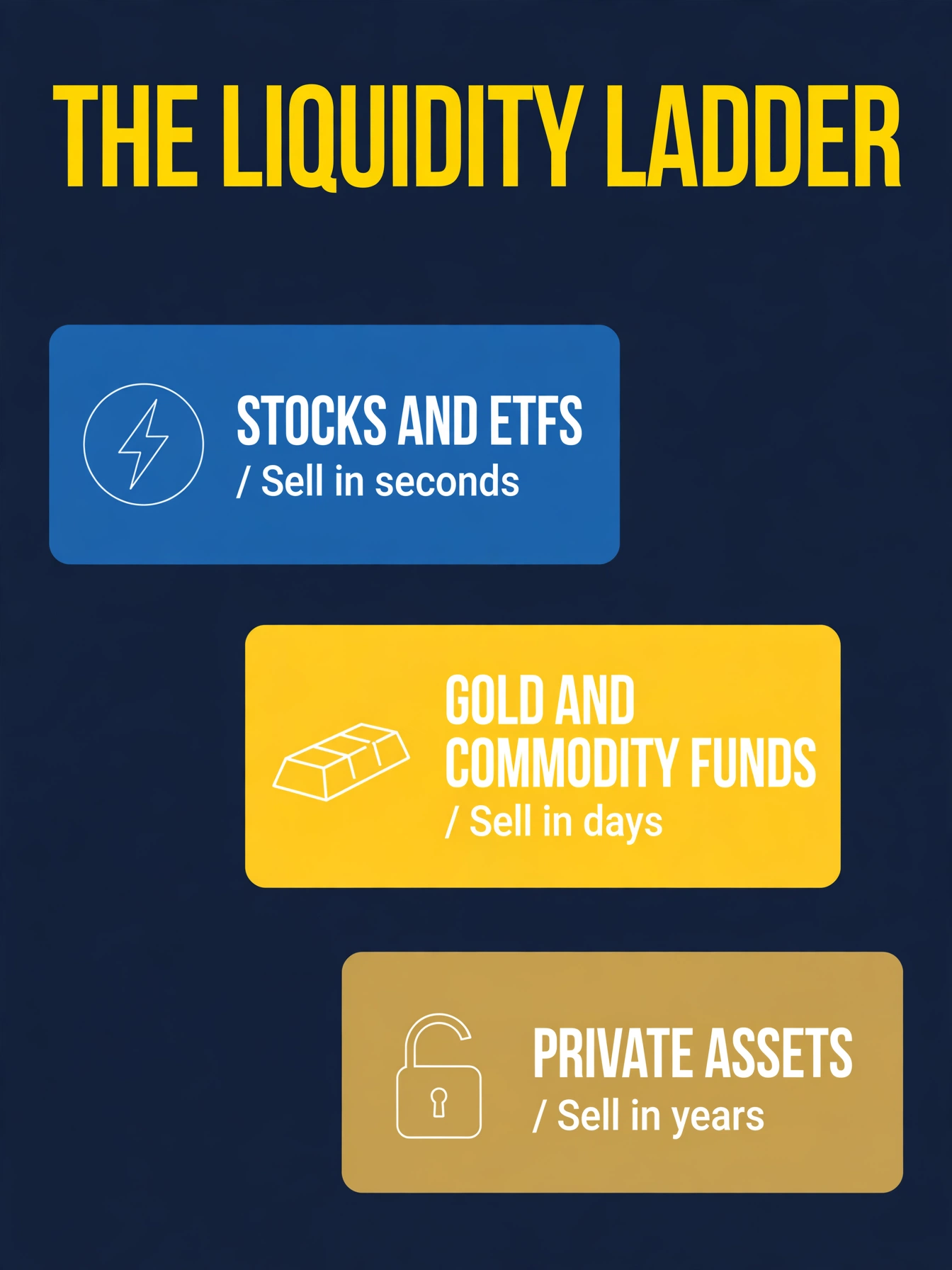
Liquidity is one of the most underappreciated qualities in investing: how quickly and cheaply you can turn an asset back into cash. Stocks and ETFs are the champions — sell in seconds, at a known price, for nearly zero cost. Gold ETFs and commodity funds are nearly as good: sell in days at most. Private assets are the extreme opposite: selling can take months or years and cost you a fortune in fees and discounts.
Here is why it matters. Life does not ask permission before it hands you an emergency — a job loss, a medical bill, a roof that fails in a storm. The money you might need within the next few years should live only in liquid assets. Illiquid investments are for money with a distant horizon, money that can stay locked away no matter what happens this year or next.
A simple rule: rank every investment you consider on a liquidity ladder before you buy. Seconds to sell (stocks, ETFs) at the top; years to sell (private equity, direct property) at the bottom. Never put more than a small fraction of your net worth in the bottom rungs — the ladder should get wider as it gets more liquid, not the reverse.
Fees: The Silent Partner
Every investment has a silent partner taking a cut: fees. And fees hit alternatives hardest. A broad stock index fund can cost you almost nothing per year — a fee so small it barely registers. Gold and commodity funds cost more, but still modestly. Private equity and hedge funds, though, charge famously rich fees: often a management fee of around two percent of your money every year plus a slice of the profits. Two percent a year sounds small until you compound it over a decade — it quietly devours a huge share of your gains.
Fees are the one return you can predict with certainty, which makes them the first thing to compare. Before buying any alternative, ask two questions: what is the expense ratio — the fund's annual cost as a percentage of your money — and what is the total fee load, including performance cuts and hidden charges? An investment that must beat the market by three percent a year just to break even on its own fees starts every race in last place.
The beginner's edge here is simplicity: cheap, plain-vanilla funds beat expensive, exotic ones far more often than the industry admits. When two products offer similar exposure, pick the cheaper one every time. Your future self, counting compounded gains, will thank you.
Portfolio Role: Seasoning, Not the Main Course
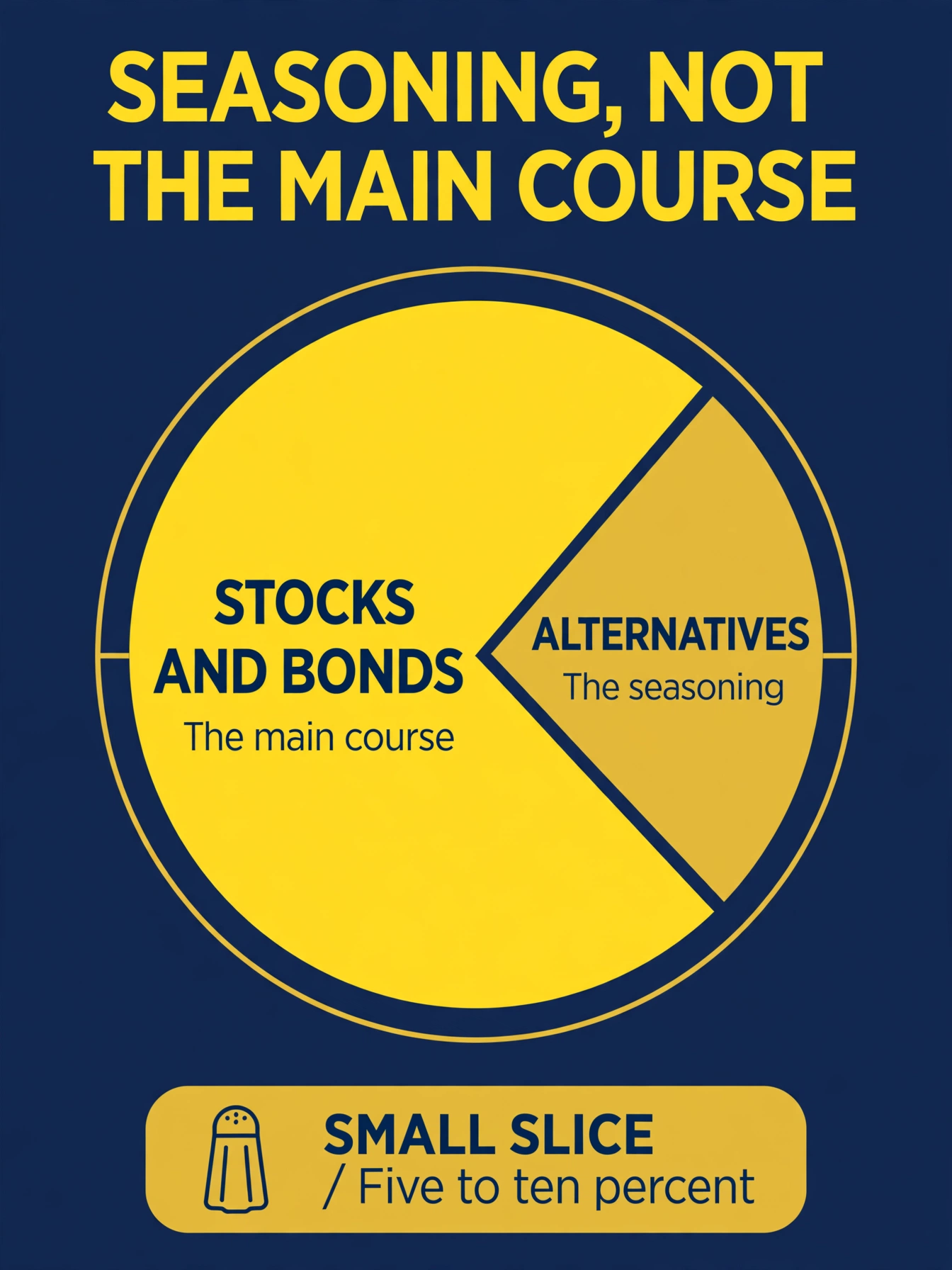
Now the big picture: where do alternatives belong in your portfolio? Think of stocks and bonds as the main course — they provide growth and stability, and they carry nearly all the weight. Alternatives are the seasoning: a modest allocation that improves the whole dish — smoothing returns, softening inflation shocks, and cushioning panics — without becoming the meal. Most professional portfolios keep alternatives to a modest slice of the total, roughly five to ten percent for beginners. Enough to matter when crises strike; small enough to ignore when they underperform for years.
That underperformance will test you. Alternatives shine in bursts — gold in a panic, commodities in an inflation wave — and drift in between. There will be long stretches where your alternative slice is the worst performer in the portfolio, and friends' stock-heavy portfolios leave yours in the dust. That is the price of insurance, and it is normal. You do not cancel your fire insurance because the house did not burn down this year.
So the complete alternatives playbook: a small slice of gold for crisis insurance, a broad commodity fund as an inflation hedge, real estate through REITs if you want property exposure, liquid assets for money you might need, and the cheapest funds you can find. Seasoning, not the main course — and your portfolio is better seasoned for it.
Key terms
- Alternatives
- investments outside stocks and bonds, such as gold, commodities, real estate, and private funds.
- Crisis asset
- an asset that tends to hold or gain value when markets panic, like gold.
- Gold ETF
- an exchange-traded fund that tracks the price of gold without requiring physical storage.
- Commodities
- raw materials like oil, natural gas, copper, wheat, and coffee.
- Commodity funds
- ETFs or mutual funds holding a basket of commodity-linked assets.
- Broad commodity fund
- a fund spread across energy, metals, and agriculture for diversified commodity exposure.
- Leveraged commodity products
- funds promising multiples of daily commodity moves; compounding decay makes them toxic for holding.
- Private assets
- investments not traded on public exchanges, like direct real estate and private equity.
- Private equity
- funds that buy whole companies, typically locking up investor money for seven to ten years.
- Illiquidity
- the inability to sell an asset quickly or cheaply.
- REITs
- real estate investment trusts: property-owning companies that trade on the stock exchange like stocks.
- Liquidity
- how quickly and cheaply an asset can be converted back into cash.
- Fees
- the annual costs an investment charges you, its silent partner.
- Expense ratio
- a fund's annual cost expressed as a percentage of your money.
- Total fee load
- the full annual cost including management fees, performance cuts, and hidden charges.
- Seasoning
- the role of alternatives in a portfolio: a modest slice that improves the whole, not the main course.
What's next
Alternatives complete the investment menu of School 5; AP-210 "Portfolio Policy and Scorecard" turns to the master plan — objectives, constraints, allocation bands, benchmarks, and review rules.
The quiz
Alternatives and Commodities — Quiz
3 questions · pass with 3 correct
1.Why do investors hold gold?
2.Why should beginners stay away from leveraged commodity products?
3.Which investment is the LEAST liquid?