
Portfolio Policy and Scorecard
School 04 — Security Analysis and Portfolio Design
School 5 · Security Analysis and Portfolio Design · About 15 minutes
You now know the full investment menu: stocks (AP-201 through AP-205), bonds (AP-206 through AP-208), and alternatives (AP-209). What you need now is the master plan that turns those ingredients into a coherent portfolio — a written portfolio policy. Professional money managers run every dollar by one, and so should you. Without a policy, every market swing becomes a fresh emotional decision; with one, your calm self has already decided what your panicked self should do. We will now teach you about objectives, constraints, allocation bands, benchmarks, and review and sell rules.
Objectives: What Is the Money For?
Every portfolio exists for a reason, and naming the reason is the first step. An objective is the goal your money is working toward, stated plainly: retirement in twenty years, a house down payment in five, college for the kids in ten. The objective determines nearly everything else — a goal twenty years away can ride out stock market storms, while money needed next year cannot afford a single bad month. The number one question in portfolio design is always: when do I need this money, and what must it do by then?
Objectives also set the return you need. There is a world of difference between "grow as fast as possible" and "grow a little faster than inflation with minimal drama." The first objective points toward stocks; the second toward a calmer mix. Be honest here: an objective of maximum growth sounds exciting, but it comes with maximum stomach-churning drops. Write down the goal, the time horizon, and the return you truly need — not the return you wish for. Wishes make bad portfolios.
One portfolio, one objective. Money saved for retirement and money saved for a house down payment should not share a portfolio, because their horizons and needs are different. Give each goal its own account or its own mental bucket, each with its own policy. Mixing goals in one pot is how retirement money ends up in a panic sale because the house fund got nervous.
Constraints: Your Personal Boundaries
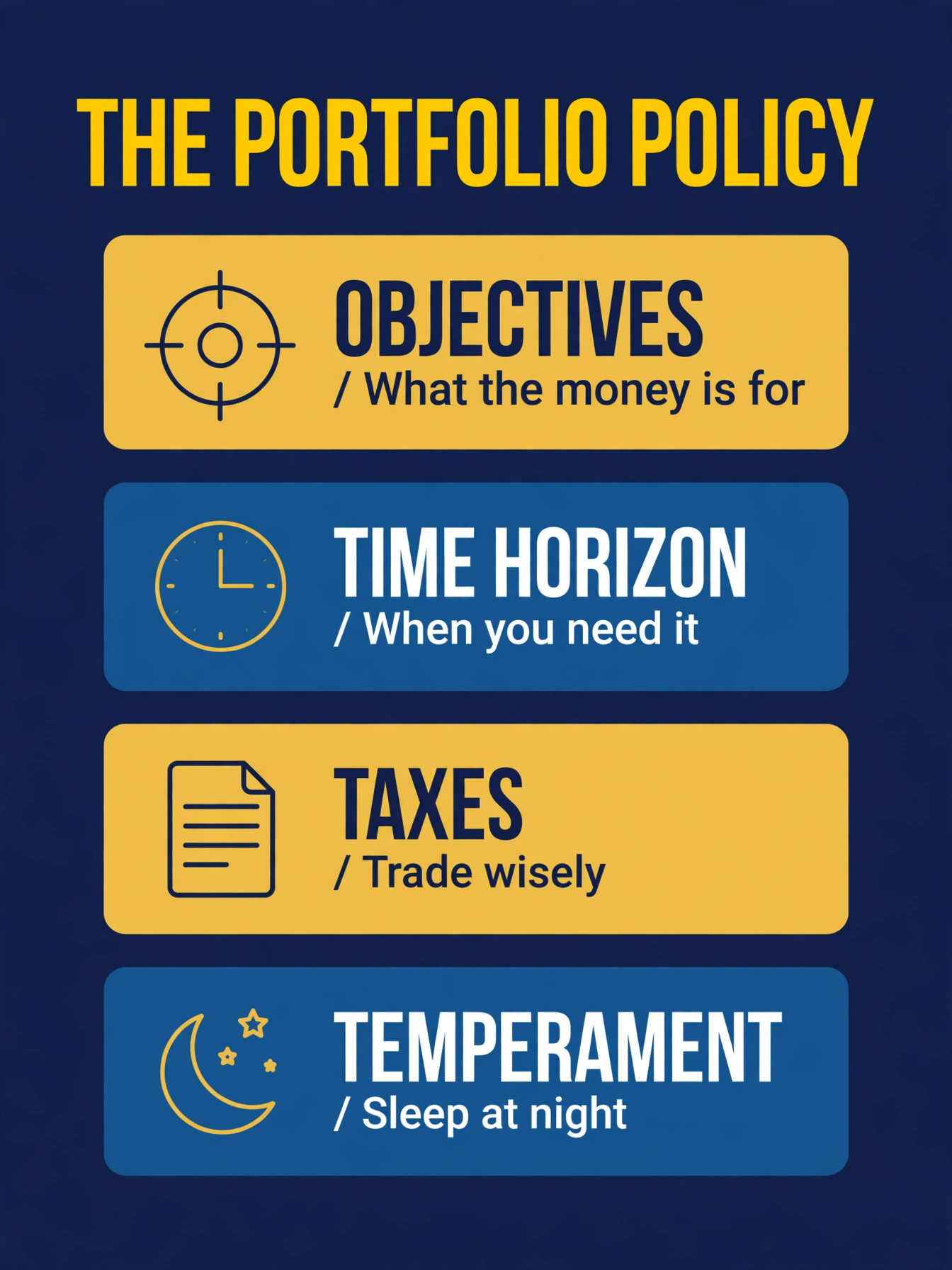
If objectives are what you want, constraints are what you must respect along the way — the personal boundaries your portfolio cannot cross. Every investor has them, and naming them in advance keeps you from discovering them in a crisis. The big three are time, taxes, and temperament.
The time horizon is when you need the money, and it is the hardest constraint of all. Money needed within a few years belongs in safe, stable assets — it cannot wait out a bear market. Money with decades ahead can endure deep drops for the sake of higher long-run growth. Your tax situation shapes choices too: selling winners triggers taxes, so patient holding is tax-efficient, and certain accounts reward certain assets (the details vary, but the principle is universal — keep taxes in mind before you trade).
Temperament — your ability to sleep at night — is the constraint beginners ignore and later regret. If a twenty percent drop would make you sell everything in a panic, then a portfolio built for someone braver is wrong for you, no matter what the math says. The best portfolio is not the one with the highest expected return; it is the one you can actually hold through the worst year. Write your constraints down next to your objectives. They are not weaknesses — they are the walls that keep your plan standing when the storm hits.
Allocation Bands: Guardrails, Not Guesswork
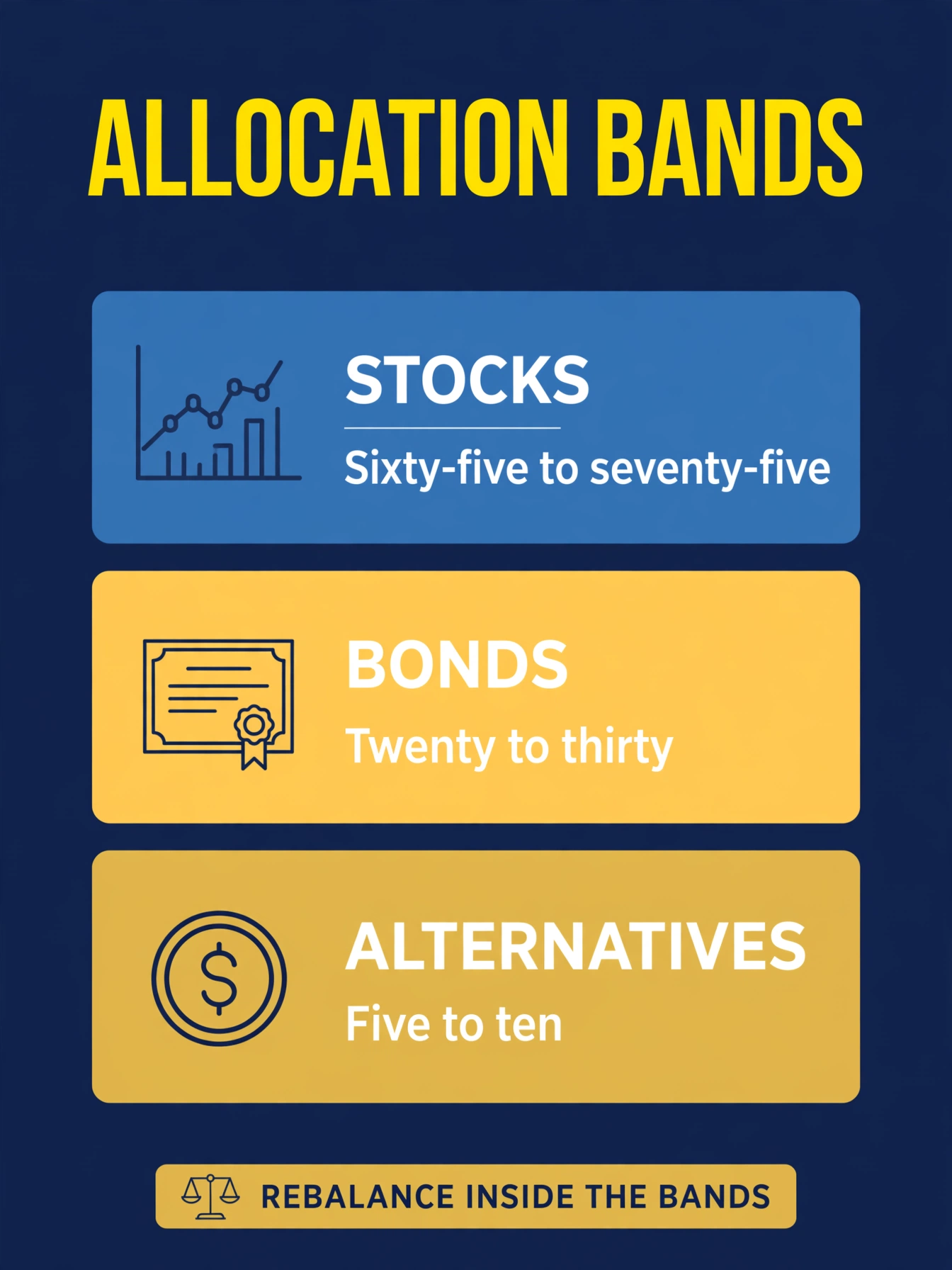
Your policy's engine room is the target allocation — the mix of stocks, bonds, and alternatives you aim to hold, written as percentages. A classic beginner example: 70% stocks, 25% bonds, 5% alternatives. Those numbers are not guesses; they flow from your objectives and constraints. Long horizon and strong stomach: more stocks. Short horizon or nervous temperament: more bonds. The allocation is your plan's fingerprint — no two investors' should be identical.
But markets move, and your mix will drift. When stocks surge, your 70% might become 80% without you touching a thing — and now you are carrying more risk than your policy allows. Allocation bands solve this: instead of a single number, each asset gets a range, like stocks 65% to 75%. As long as you stay inside the band, do nothing. When an asset drifts outside its band, you rebalance — sell a little of what grew, buy a little of what lagged, and restore the mix. Bands turn rebalancing from guesswork into a rule.
Rebalancing feels backwards, which is why the rule matters. It forces you to sell winners and buy losers — the exact opposite of what your emotions want in the moment, and the exact discipline that keeps risk in line. Check your bands on a schedule, not on a whim: once a quarter is plenty. A policy with bands is a portfolio on autopilot; a portfolio without them slowly drifts into whatever the market dictates.
Benchmark: The Scoreboard
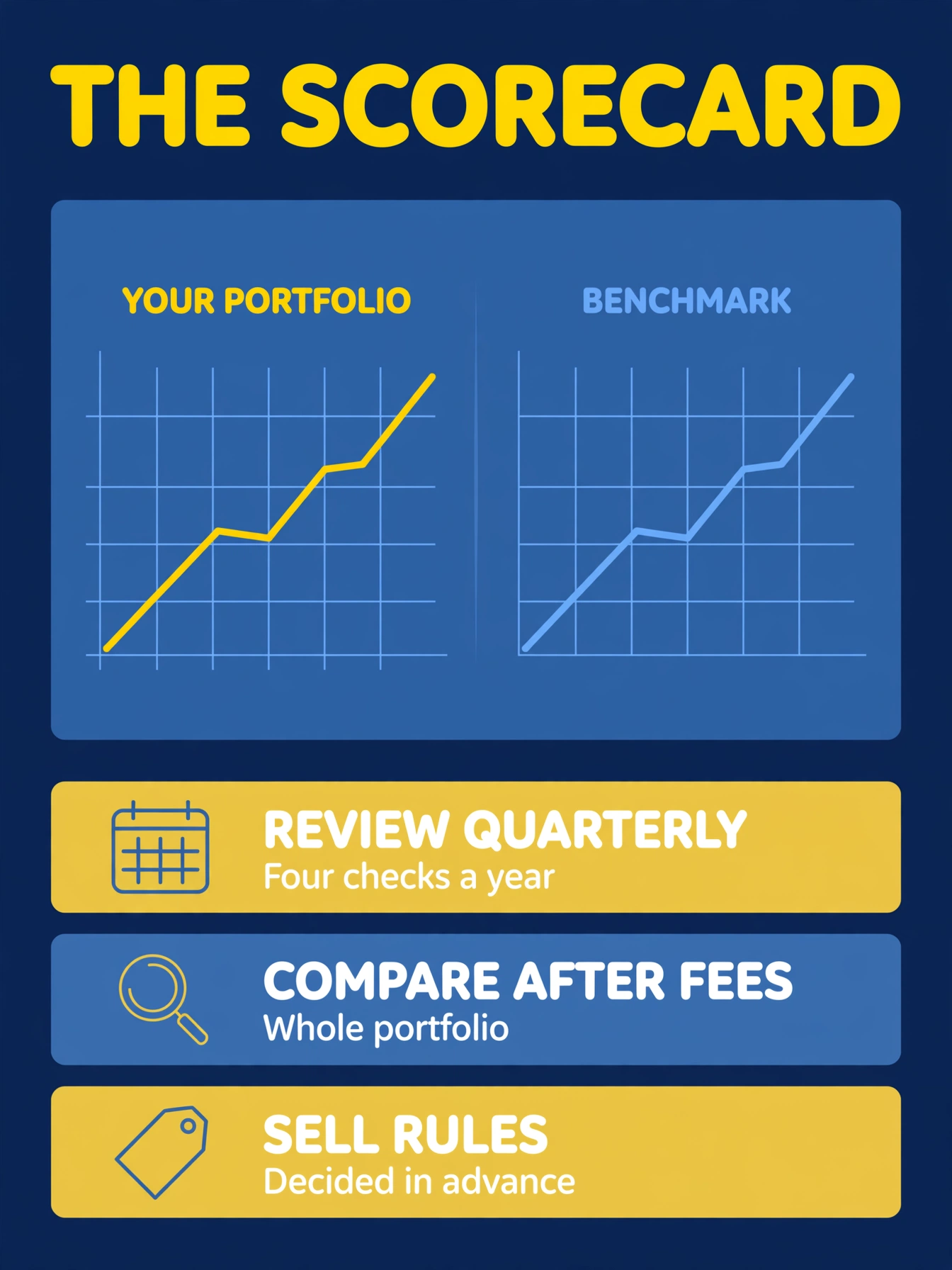
How do you know if your portfolio is doing well? You need a benchmark — a scoreboard to measure against. A benchmark is a standard index or mix of indexes that represents "the market" for what you own: a stock-heavy portfolio might benchmark against a broad stock market index, a balanced one against a blend of stock and bond indexes. The benchmark is not your competition; it is your mirror. It tells you whether your results came from your choices or just from the market's mood.
Pick the benchmark when you write the policy, not after the fact — choosing it later is just cherry-picking the scoreboard that makes you look good. And keep the comparison honest: compare your whole portfolio, after fees, against a benchmark that matches your allocation. A 70% stock portfolio beating a pure bond index proves nothing except that stocks rose; that is the market talking, not your skill.
Use the scoreboard the way it is meant to be used: over years, not weeks. Any portfolio can beat or trail its benchmark for a quarter — noise. Over three to five years, a persistent gap tells you something real: either your strategy is working, or it is time to simplify into the benchmark itself. Many professionals end exactly there, holding the index — which is a perfectly honorable destination.
Review and Sell Rules
A policy is a living document, which means it needs a maintenance schedule. A portfolio review is a regular check-in — quarterly is the professional standard — where you ask four questions. One: am I still inside my allocation bands, or is it time to rebalance? Two: has anything changed about my objectives or constraints — a new job, a new baby, a nearer retirement? Three: how am I doing against my benchmark over a meaningful stretch? Four: is every holding still earning its place?
That fourth question leads to the sell rules — decided in advance, in calm ink, because selling in the moment is when emotions hijack the wheel. Good sell rules mirror the ones from your stock research workflow (AP-205): sell when the reason you bought is broken, when a clearly better opportunity appears, or when a holding has drifted so far from your policy that it no longer belongs. Add one portfolio-level rule: sell (or trim) whatever pushes you outside your allocation bands.
Write the review dates into your calendar the day you write the policy. A review you schedule happens; a review you intend does not. Ten minutes, four times a year, plus a rebalance when the bands say so — that is the entire maintenance burden of a well-built portfolio. The policy does the thinking; you just do the checking.
Key terms
- Portfolio policy
- the written master plan for a portfolio: objectives, constraints, allocation, benchmark, and rules.
- Objective
- the goal the money is working toward, with its time horizon and required return.
- Time horizon
- when you need the money; the hardest constraint in portfolio design.
- Constraints
- the personal boundaries a portfolio must respect: time, taxes, and temperament.
- Tax situation
- how taxes shape your choices; selling winners triggers taxes, so patience is tax-efficient.
- Temperament
- your ability to sleep at night through market drops; the portfolio must fit it.
- Target allocation
- the mix of stocks, bonds, and alternatives you aim to hold, in percentages.
- Allocation bands
- the acceptable range around each target allocation; drift outside the band triggers action.
- Rebalance
- selling what grew and buying what lagged to restore the target allocation.
- Benchmark
- a standard index or mix used as the scoreboard for measuring portfolio performance.
- Portfolio review
- a regular (usually quarterly) check-in on bands, objectives, benchmark, and holdings.
- Sell rules
- pre-decided conditions for selling: thesis broken, better opportunity, or policy drift.
What's next
The portfolio policy closes School 5 — you can now design and maintain a complete portfolio. Next, MC-201 "Market Climate Indicator" opens the Market Climate school, where you will learn to read the market's weather before you invest a dollar.
The quiz
Portfolio Policy and Scorecard — Quiz
4 questions · pass with 4 correct
1.What is the main purpose of a written portfolio policy?
2.What are the big three constraints every portfolio policy should name?
3.Your target is 70% stocks with a 65–75% band, and stocks have drifted to 82%. What does your policy say to do?
4.What is a benchmark for?