
Weekly Report and Scorecard Lab
School 06 — Market Climate Lab
School 6 · Market Climate Lab · About 15 minutes
Everything in this school converges on one weekly habit: write the read down, then check it against reality. An indicator you never score is a story you tell yourself; an indicator you score honestly — wins and misses, in public — is a tool you can trust. This final class gives you the lab notebook: the weekly report format, the scorecard, and the disclosure discipline that keeps the whole framework honest. Luke's own standard, applied to every backtest he has ever run, is the rule here: keep score going forward, and say so openly if it stops working.
Write the Read Before the Week
Memory lies; paper does not. Each week, before the market renders its verdict, write down five things:
- Date — stamp the week, so every read is anchored in time.
- The three lights — green or yellow on each: expected growth, trailing expansion, price momentum.
- The climate read — one sentence. Not a paragraph, not a hedge: "Expectations expanding but trailing earnings decelerating — warm hopes, cooling reality."
- What happened — after the week: what price did, what earnings did.
- Match or miss — did the read hold?
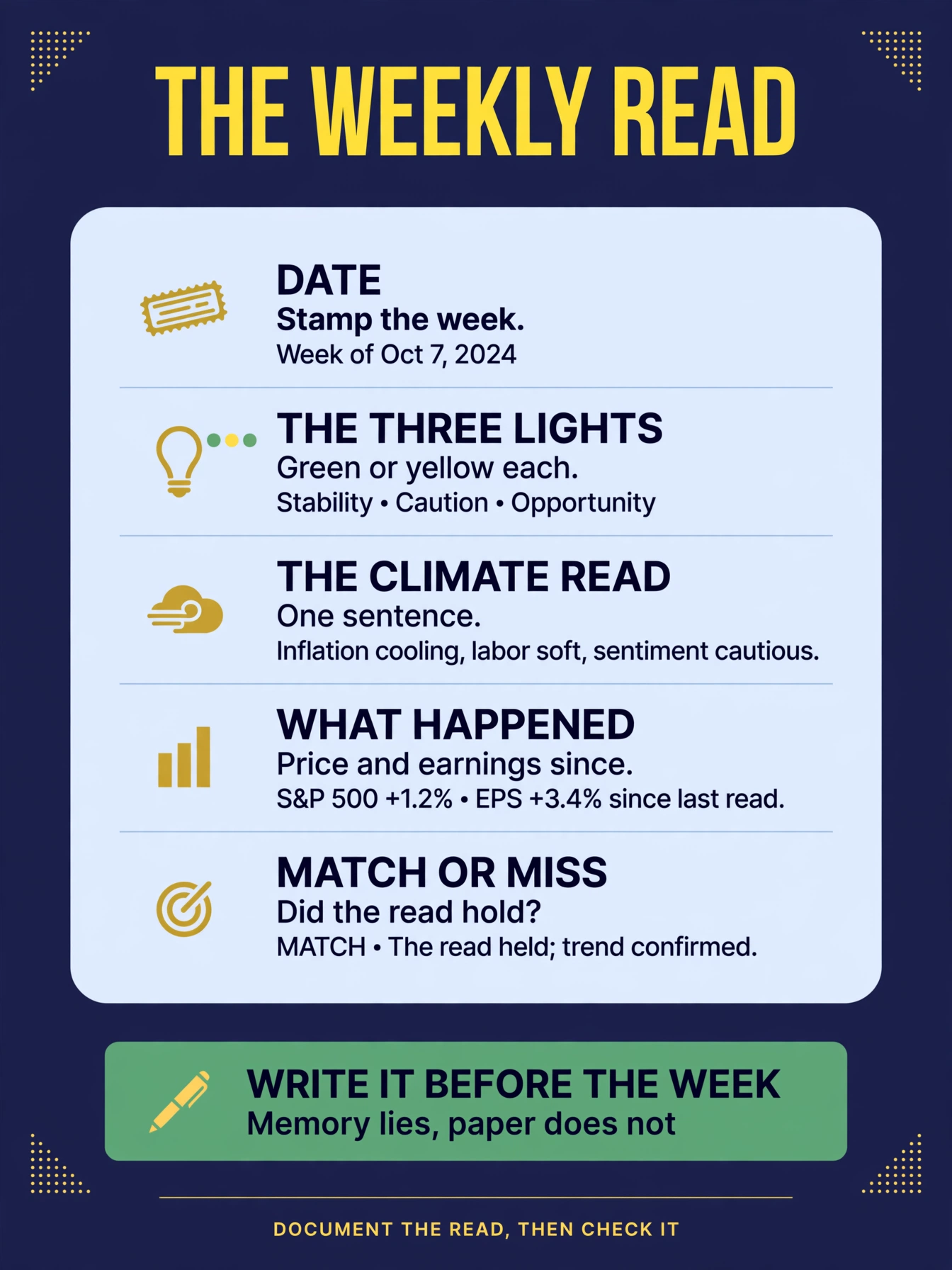
The template above shows a filled-in sample entry: the week of Oct 7, 2024, the three lights logged, a one-sentence read ("Inflation cooling, labor soft, sentiment cautious"), the outcome recorded as S&P 500 +1.2% and EPS +3.4% since the last read, and the verdict stamped MATCH — the read held, trend confirmed. Yours will look like this, week after week, in your own words and with the real numbers. The format never changes; only the weather does. That sameness is the point — a year of identically-structured reads is a dataset, and a dataset is what separates a framework from a feeling.
This is also the shape of the Academy's own Weekly Market Report: the free email that carries the climate read to subscribers each week, with the light-touch climate section linking back to the dashboard. The report you write for yourself and the report the Academy publishes are the same discipline at two scales.
Compare With Outcomes
The check step is where most people quit, because it is where the ego gets bruised. After the week closes, go back to your read and ask the blunt question: did it hold? Compare what you wrote against what happened — price action and earnings developments, not just price. A read can be right about direction and wrong about magnitude; it can be right about earnings and wrong about price; it can be early, which in markets is a polite word for wrong.
Grade on the read you actually wrote, not the read you wish you had written. If your one sentence said "cooling" and the week rallied on hot earnings revisions, that is a miss — even if some other interpretation of your words could be twisted into a win. The scorecard only works on strict grading. Generous grading is how frameworks quietly become unfalsifiable, and an unfalsifiable framework is a horoscope.
The Scorecard
Keep a running tally, visible and unedited: wins — reads that held — and misses — reads that failed. Count both out loud. A scorecard with no misses is not a perfect record; it is evidence that the grading is rigged. Every real framework misses sometimes, because markets are moved by things no earnings dashboard can see — geopolitics, panics, policy surprises, plain randomness.
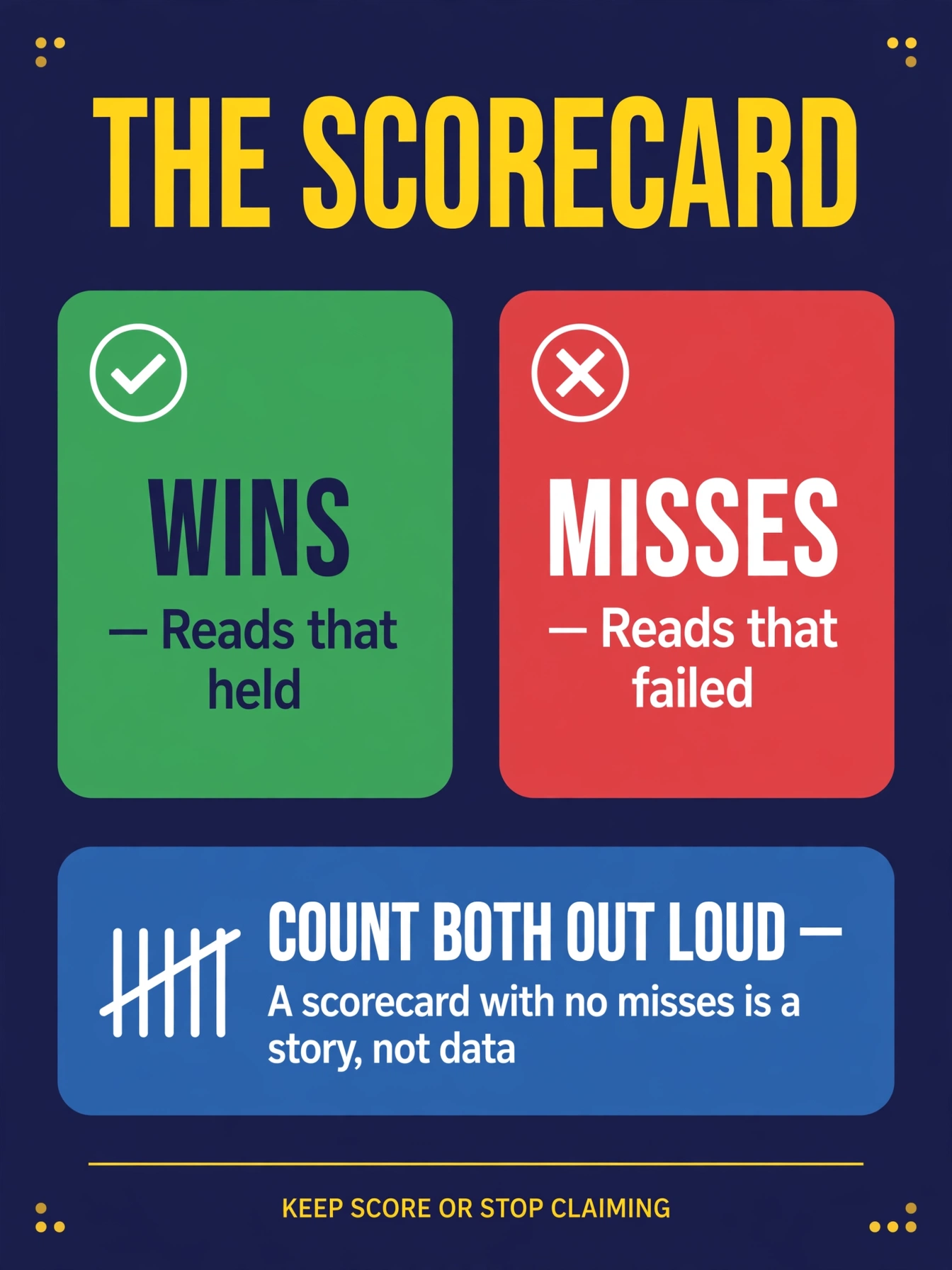
Over months, the scorecard becomes the most valuable thing you own in this school: an honest track record. It tells you whether the climate read actually earns its keep, in which weathers it shines (often the slow, grinding trends) and in which it stumbles (often the fast, news-driven shocks). That knowledge — specific, earned, written down — is worth more than any single correct call.
Disclose the Misses
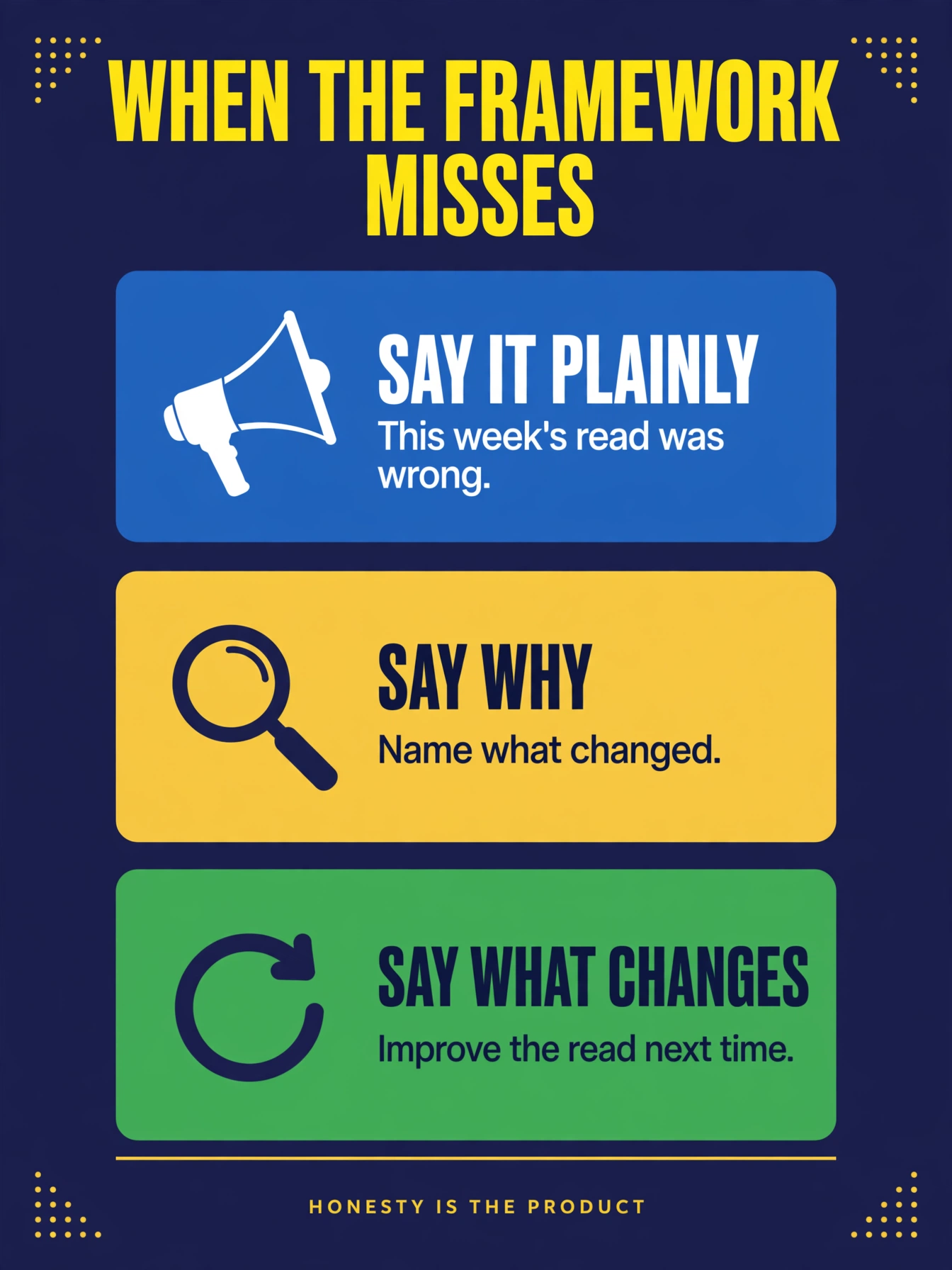
When the framework misses, say so — plainly, promptly, and in the same place you published the read. The disclosure has three parts:
- Say it plainly. "This week's read was wrong." No hedging, no jargon, no burying it three paragraphs deep.
- Say why. Name what changed that the read did not see — the data revision, the surprise event, the assumption that broke.
- Say what changes. How does the read improve next time? A better input, a wider uncertainty band, an earlier warning sign to watch.
The dashboard models this honesty in its own data: when one-time items distorted the second quarter of 2026, the team annotated the anomaly instead of smoothing it away. Your scorecard should work the same way — the miss stays on the record, with the explanation attached. Deleting misses is how you end up believing your own marketing; annotating them is how the framework gets smarter.
Honesty Is the Product
Step back and notice what this school has really been teaching. Not a magic indicator — there is no such thing, and anyone selling you one is selling the story, not the tool. What you have is a documented way to read earnings weather, a posture framework for sizing risk to that weather, and now a lab discipline for proving — to yourself, in writing — whether any of it works.
That discipline is also the Academy's promise to its audience. The Weekly Market Report goes out with the read; the dashboard stays free and labeled with its sources; the scorecard, kept honestly, is what lets Luke stand behind the framework the way he stands behind his backtests — "we probably have something here, and we'll say so openly if it stops working." Carry that standard into everything you do with the climate from here on.
Key terms
- Climate read
- the one-sentence weekly summary of what the three lights, the charts, and the fear gauge say together.
- Weekly report
- the dated, five-part record: date, the three lights, the climate read, what happened, match or miss.
- Scorecard
- the running tally of reads that held (wins) versus reads that failed (misses), graded strictly.
- Match / miss
- the verdict on a past read: MATCH if it held, MISS if it did not — no partial credit, no reinterpretation.
- Disclosure
- saying a miss plainly, naming why it happened, and stating what changes; published where the read was published.
- Anomaly annotation
- noting unusual data (like Q2 2026's one-time items) openly instead of smoothing it away.
What's next
School 6 is complete — you can read the market's weather, set your risk posture to it, and keep honest score. The next school turns from reading markets to the instruments of leverage itself: OD-101 "Calls and Puts" opens School 9, Options and Derivatives, with the rights, obligations, and risks of options contracts.
The quiz
Weekly Report and Scorecard Lab — Quiz
4 questions · pass with 3 correct
1.What are the five parts of the weekly report?
2.Why must the scorecard be graded strictly?
3.What are the three parts of disclosing a miss?
4.What does a scorecard with zero misses most likely prove?