
Climate-Based Risk Posture
School 06 — Market Climate Lab
School 6 · Market Climate Lab · About 15 minutes
Reading the weather is only useful if it changes what you do. This class turns the climate read into posture — the stance you take toward risk. The core idea is Luke's: the climate system is a leverage-management tool. It answers "how much?" — how much risk to carry, how much leverage to use — not "when?" and never "what to buy?" Think of it as the difference between checking the forecast and choosing your sails: the forecast does not pick your destination, but it absolutely decides how much canvas you fly.
The Climate Sets the Size, Not the Trade
Every position has two decisions hiding inside it: what to do and how big to do it. Most beginners obsess over the first and neglect the second. The climate framework flips that: it stays completely silent on what to buy — no stock picks, no entry signals — and speaks only to size.
The dashboard's own language gives you the two anchor postures. When the lights are green — expectations expanding, actual earnings accelerating, price up on the week — "the climate favors putting money to work." When the lights turn yellow — expectations being cut, earnings decelerating, price down on the week — "the climate favors caution, smaller size, and protection." Between those anchors sits the everyday reality of mixed lights, where the honest posture is simply normal size and steady hands.
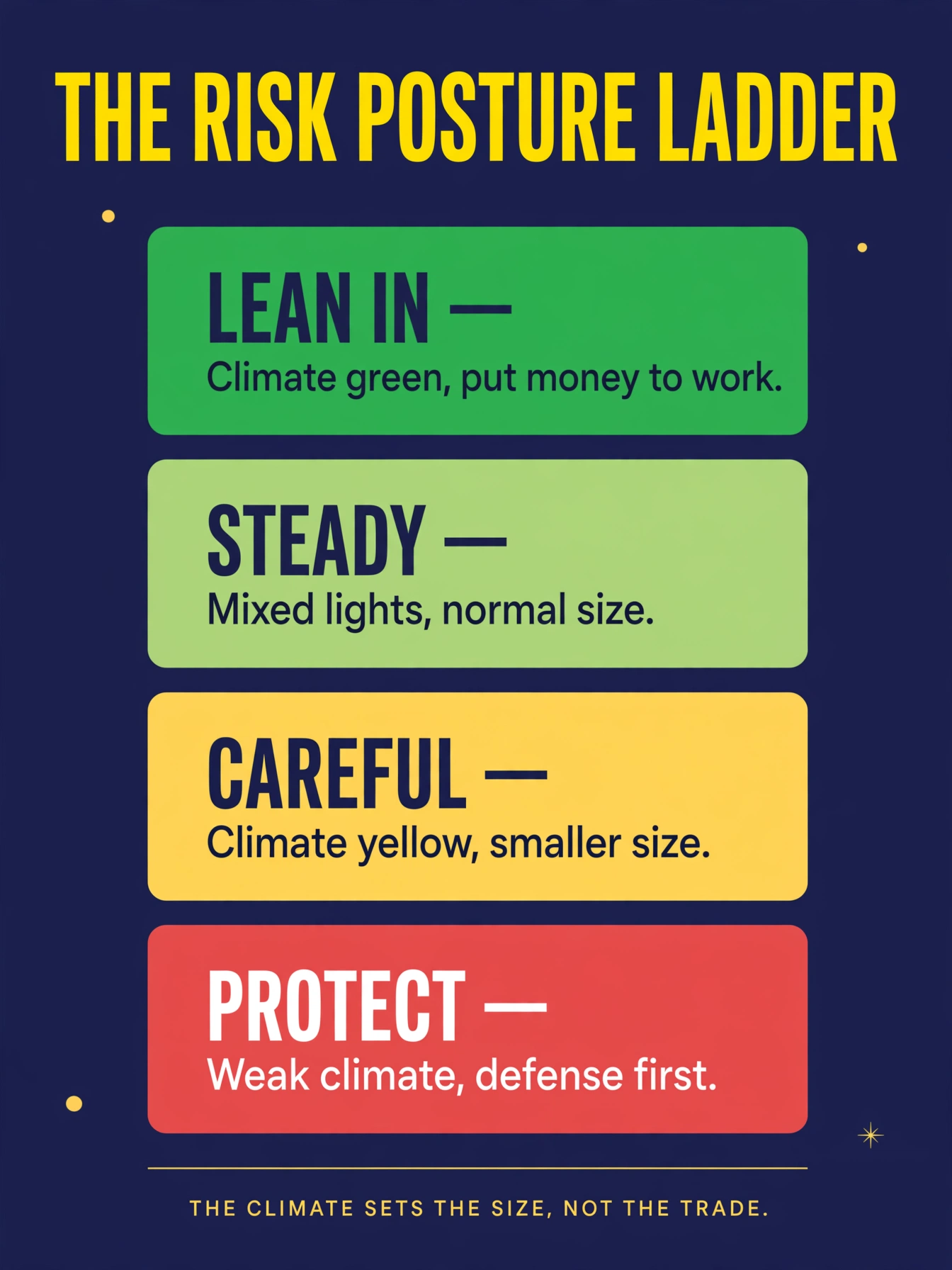
A plain-English way to hold the four postures in your head: lean in when the climate is green and the wind is at your back; steady when the lights disagree and the weather is mixed; careful — smaller size, tighter risk — when the climate turns yellow; protect — defense first — when the read is broadly weak. Treat this ladder as the Academy's educational illustration of how to think about posture, not as Luke's calibrated formula: the exact position sizes and leverage levels he personally uses at each posture are part of the proprietary implementation this course does not document, and we have flagged that gap openly.
Leverage Follows the Weather
Leverage — borrowing to amplify a position, through margin, futures, or leveraged ETFs — is where the climate read matters most, because leverage turns small mistakes into large ones. The rule is simple to say and hard to follow: use more leverage when the climate is green, less when it is yellow.
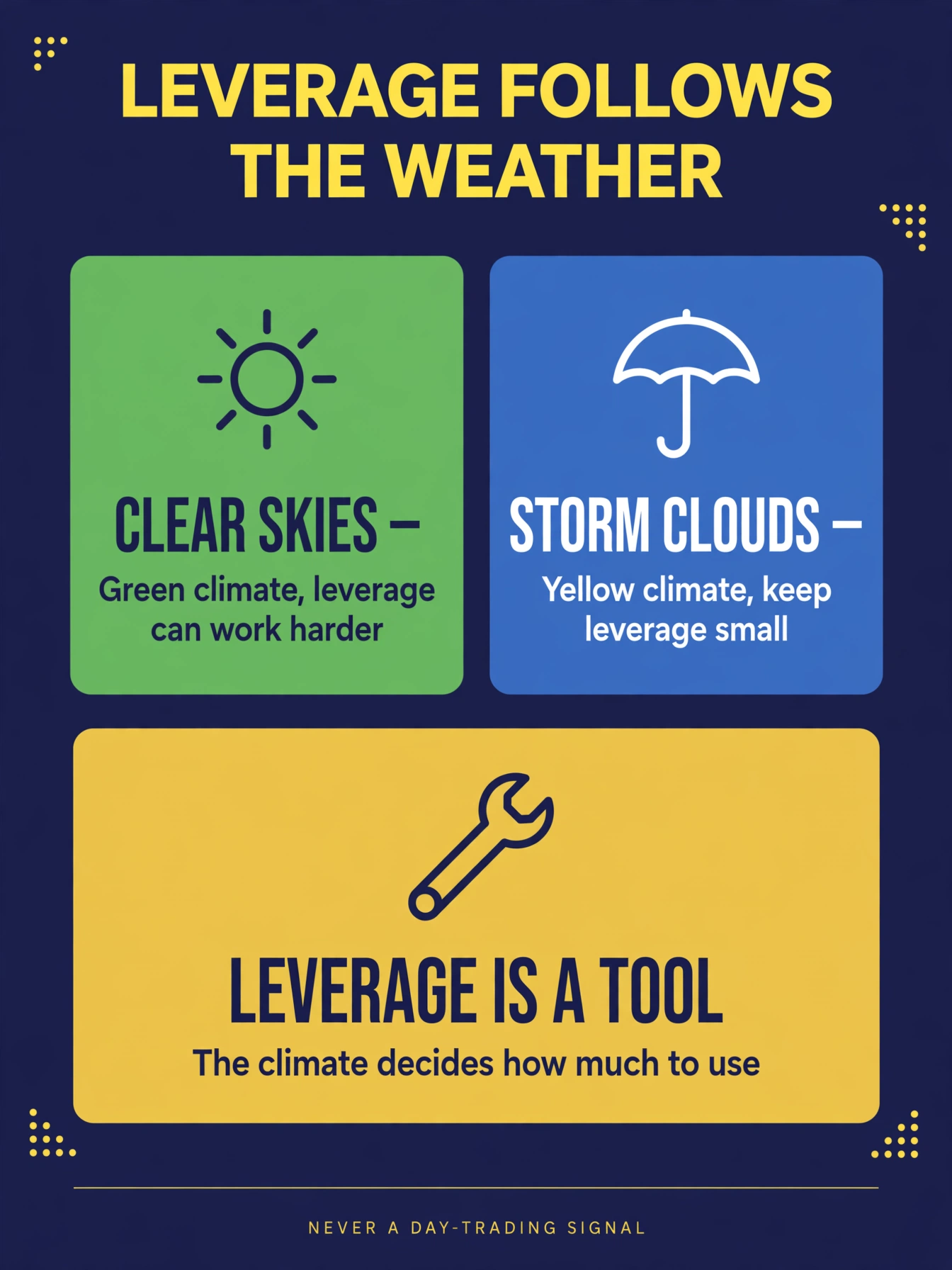
In clear skies — green lights, warming climate — leverage can work harder for you, because the fundamental wind is at your back. Under storm clouds — yellow lights, cooling climate — keep leverage small or off entirely, because the same leverage that multiplies gains multiplies losses, and drawdowns in a cold climate are deeper and longer. Leverage is a tool; the climate decides how much of it to pick up. This is the "when to lean in vs back off" heart of Luke's system: not a prediction machine, but a risk thermostat.
The Limits of Slow Data
Now the honest limits, because a tool you misunderstand is worse than no tool. The climate is built on slow data: real earnings arrive quarterly, estimates update weekly, and the lights turn on a weekly-to-monthly rhythm. Prices, meanwhile, move every second of every trading day. That mismatch sets three hard boundaries:
- The climate will not catch fast moves. A one-day panic or a two-week meltup can come and go while the earnings lights barely twitch. That is by design — the climate reads the weather system, not the gusts.
- The climate is not for timing entries. Luke is explicit about this: he deliberately does not use the indicator to time trade entries — not even the green shifts. Entries are a price-action job (structure, momentum, the chart in front of you); the climate's job is sizing what you put on once price gives you the entry.
- Yellow is caution, not a command. A yellow climate does not mean "sell everything." It means smaller size, more protection, less leverage — the posture ladder, not the panic button.
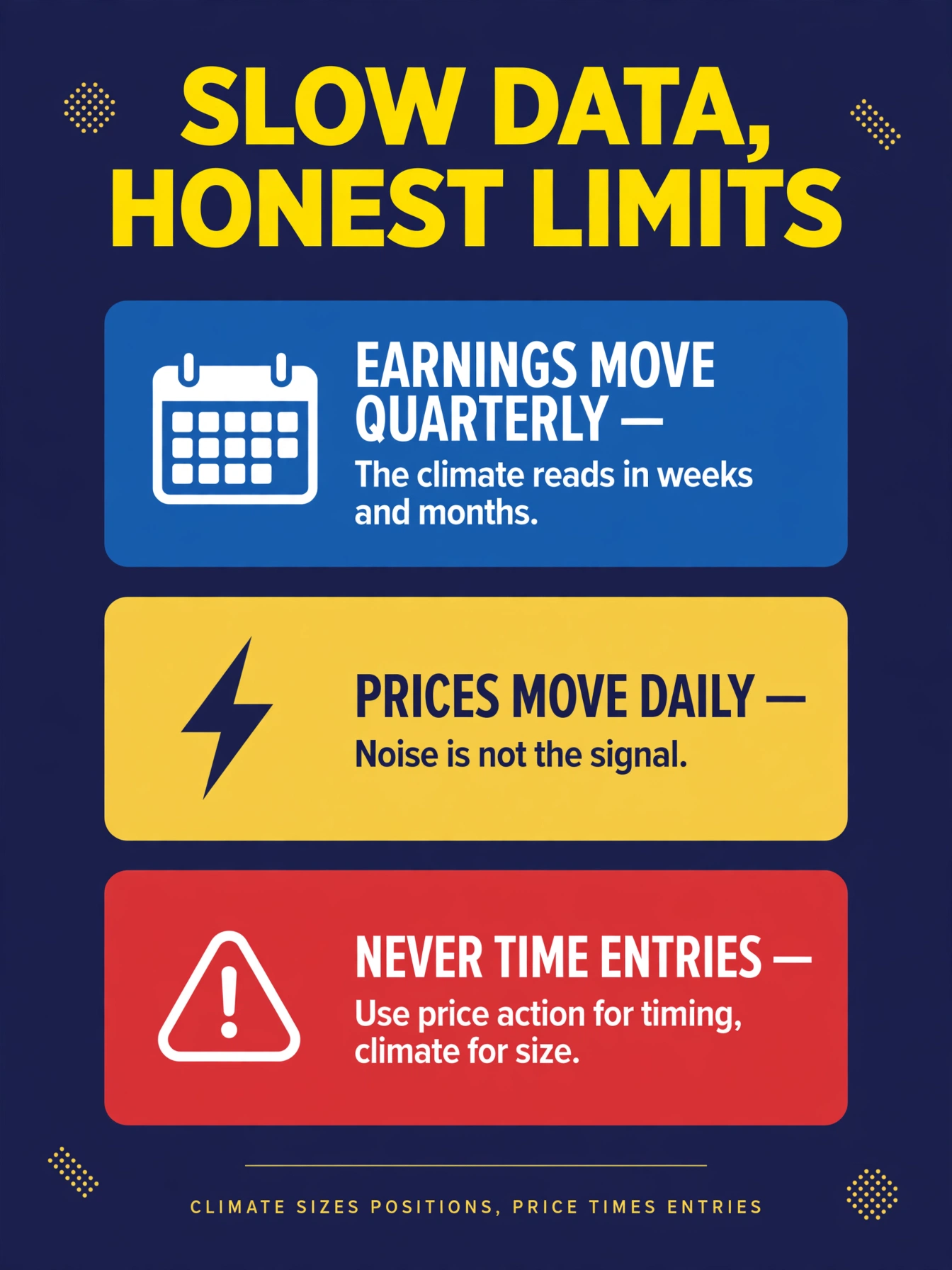
Hold the summary line: the climate sizes positions; price times entries. Mix those two jobs up — using a slow fundamental read to pick entry days, or using a fast chart pattern to decide your portfolio's risk level — and you get the worst of both instruments.
Not Financial Advice
This bears repeating in the class about acting on the read: nothing here is a recommendation. The dashboard calls itself "an educational weather report — not a recommendation to buy, sell, or hold any security, and not a trade signal," and this Academy echoes it. Posture is a framework for thinking about risk, demonstrated on a free educational dashboard. Your actual risk decisions belong to you and, where the stakes matter, to a qualified financial adviser who knows your situation.
Key terms
- Risk posture
- your stance toward risk: how much to carry, from leaning in to protecting.
- Leverage
- amplifying a position with borrowed money or leveraged instruments; multiplies gains and losses alike.
- Lean in / back off
- Luke's plain-English climate actions: carry more risk when the climate is green, less when it turns yellow.
- Position sizing
- deciding how big a position to take; the climate's job, distinct from picking entries.
- Slow data
- quarterly and weekly fundamental inputs (earnings, estimates) that turn gradually by design.
- Trade signal
- a specific instruction to buy or sell; the one thing the climate indicator explicitly is not.
What's next
You can read the weather and set your posture to it. MC-206 "Weekly Report and Scorecard Lab" closes the school with the discipline that makes it all real: writing the read down every week, checking it against what actually happened, and saying so openly when the framework misses.
The quiz
Climate-Based Risk Posture — Quiz
3 questions · pass with 3 correct
1.What is the climate system actually for?
2.The climate turns yellow. What posture does the dashboard prescribe?
3.Does Luke use the climate indicator to time his trade entries?