
Calls and Puts
School 09 — Options and Derivatives
School 9 · Options and Derivatives · About 15 minutes
A stock gives you ownership. An option gives you something different: a choice. For a price called the premium, an option contract lets you buy or sell a stock at a fixed price before a fixed date — without forcing you to. It is like paying a small reservation fee to lock in a price while you wait to see what happens. We will now teach you about calls and puts, rights and obligations, the strike and expiration, and the two parts of an option's price.
Rights and Obligations: Calls and Puts
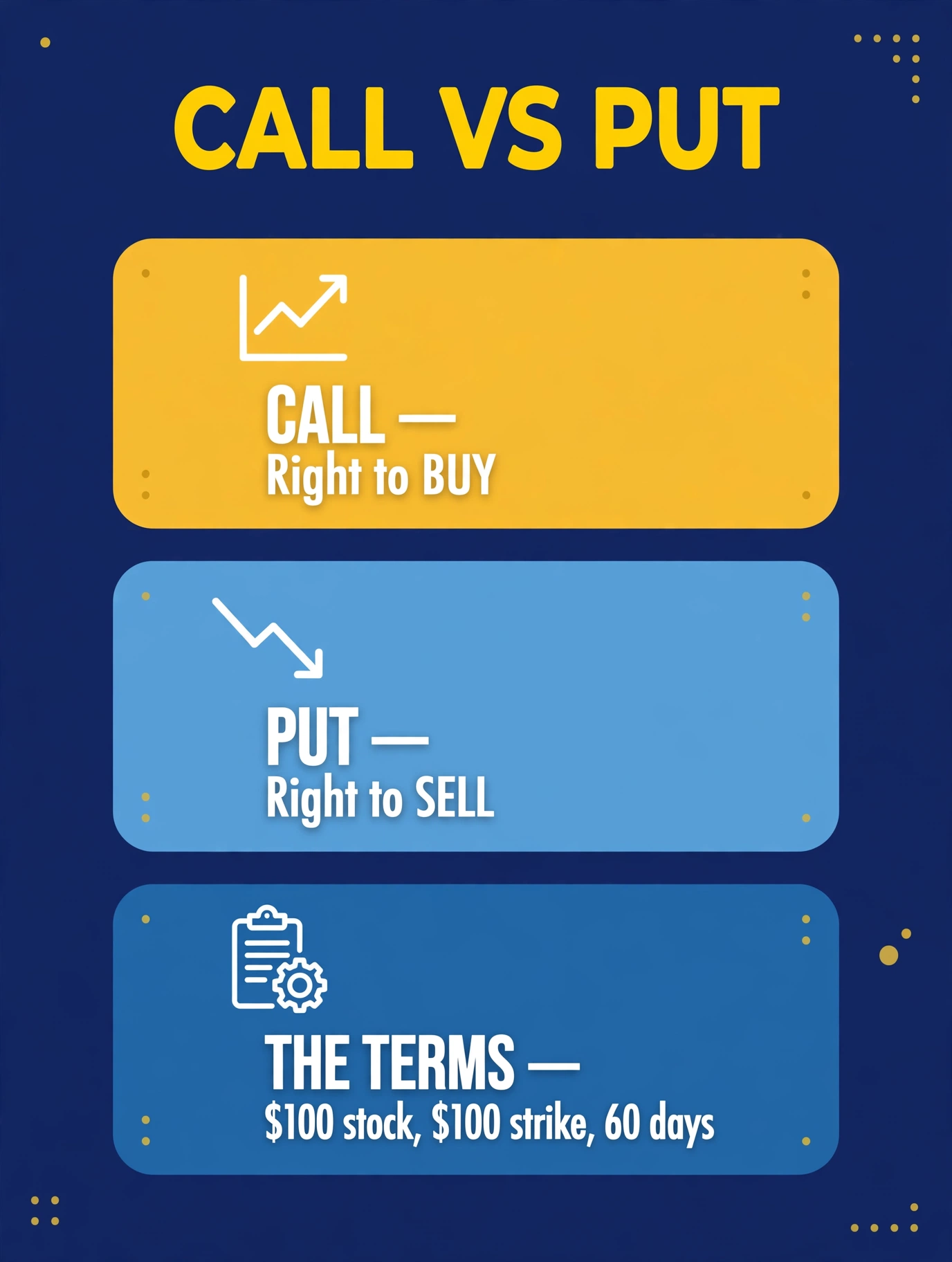
There are only two kinds of options. A call gives its buyer the right to buy a stock at a set price before a set date. A put gives its buyer the right to sell a stock at a set price before a set date. The key word is right: the buyer can walk away if the deal is no longer attractive. That is the whole appeal of options — you pay for the choice, not the commitment.
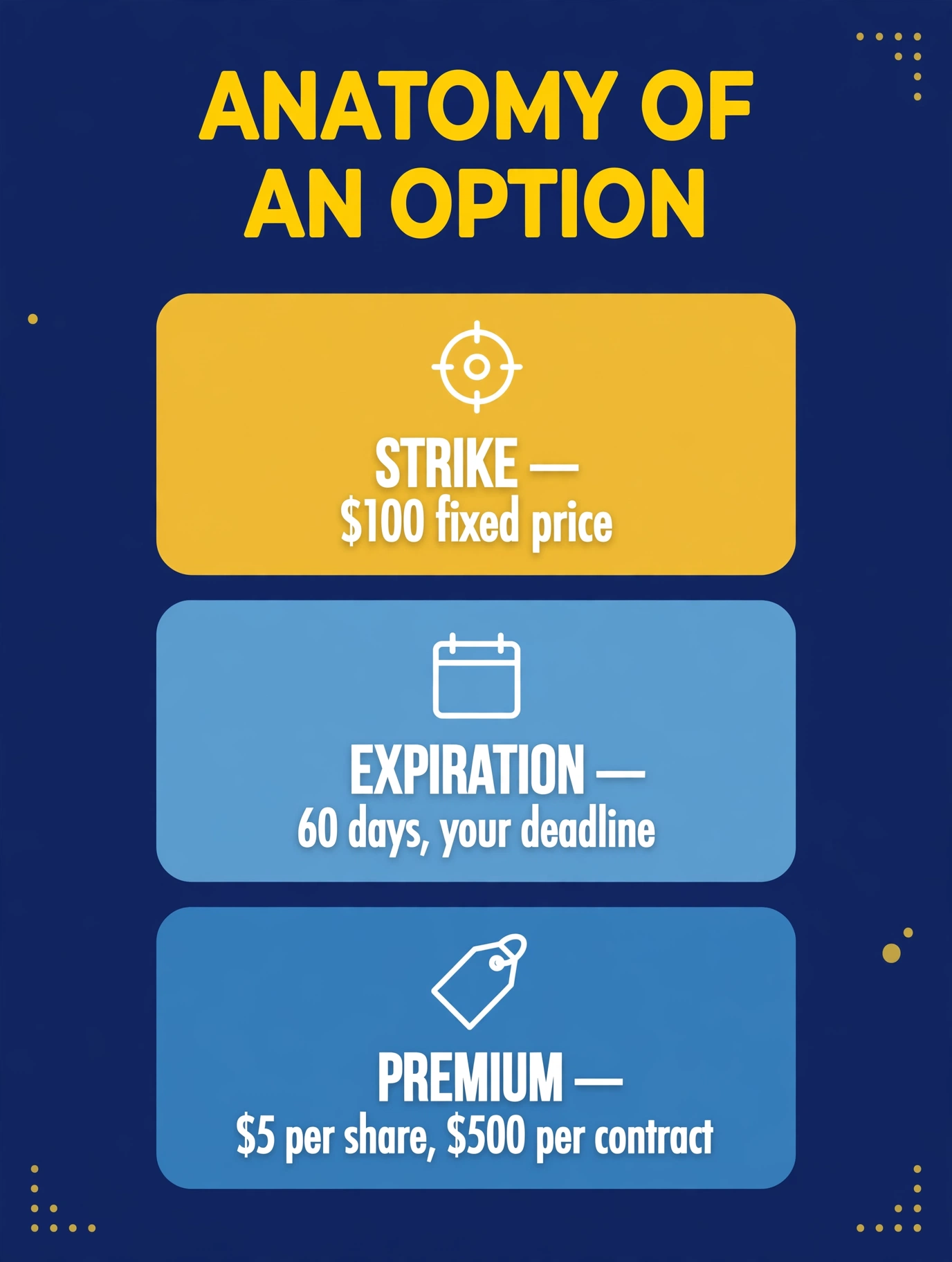
Here is a plain example. A stock trades at $100. You buy a call with a strike of $100 that expires in 60 days, paying a premium of $5 per share. Because one option contract controls 100 shares, that $5-per-share premium costs you $500 total. If the stock climbs to $120, you still get to buy at $100 — a sweet deal. If the stock falls to $80, you simply let the option expire and your loss is capped at the $500 you paid.
Every buyer needs a seller. The option seller (also called the writer) receives the premium but takes the obligation: if the buyer exercises, the seller must deliver (on a call) or buy (on a put) the stock at the strike price. Sellers get paid upfront and usually win small and often; buyers pay upfront and chase the occasional big win. Neither side is automatically better — the premium is the market's negotiated price for who carries the risk.
Strike and Expiration
Two numbers define every option. The strike price is the fixed price at which the option lets you buy or sell. The expiration date is the last day the choice exists — after it, the option is worthless. Strikes come in a ladder (90, 95, 100, 105, 110 for a $100 stock), and expirations range from days to years. Picking them is the first real decision in options trading.
Moneyness describes where the stock sits relative to the strike. An option is in the money when exercising it would already pay off: a $100-strike call is in the money with the stock at $110 (buy at $100, worth $110). It is at the money near the strike, and out of the money when exercising would be pointless — a $100-strike call with the stock at $90 has no reason to be exercised. Out-of-the-money options are cheaper because they need the stock to move before they pay.
Expiration is a deadline, and deadlines change behavior. A 60-day option costs more than a 30-day one on the same strike because more time means more chances for the stock to move your way. As expiration approaches, that extra value drains away — a process called time decay, which we will meet as theta in OD-102. Beginners often buy cheap short-dated options and learn this the expensive way: the stock moved the right direction, but not soon enough.
Intrinsic and Extrinsic Value
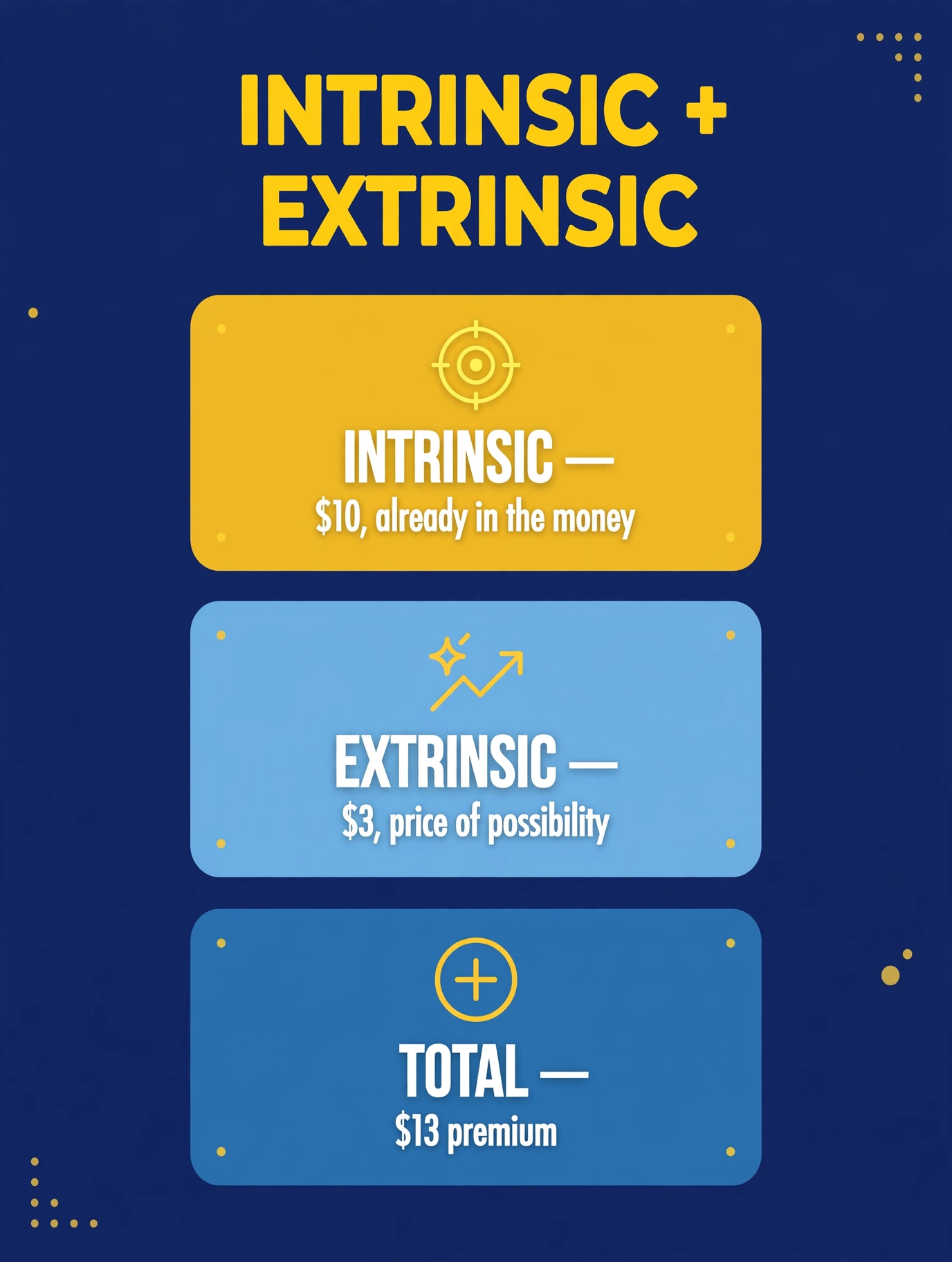
An option's price always has two parts. Intrinsic value is what the option is already worth if exercised today. For a call, it is the stock price minus the strike (never below zero); for a put, the strike minus the stock price (never below zero). With our $100-strike call and the stock at $110, the intrinsic value is $10 per share.
Extrinsic value (also called time value) is everything else — the price of the chance that things get better before expiration. If that $100-strike call costs $13 with the stock at $110, then $10 is intrinsic and $3 is extrinsic: the market's price for 60 days of possibility. Out-of-the-money options are 100% extrinsic value, which is why they can melt to zero even when you were "right" about direction.
Watch how the parts shift. If the stock rises to $120, intrinsic value grows to $20 while extrinsic value shrinks as expiration nears. On expiration day itself, extrinsic value is exactly zero — an option is worth only its intrinsic value, and anything out of the money expires worthless. That final convergence is why expiration week feels so dramatic: hope has a deadline, and the deadline prices it to zero.
Key terms
- Option
- a contract giving the buyer a choice (not a commitment) to buy or sell stock at a fixed price before a fixed date.
- Call
- an option giving its buyer the right to buy the stock at the strike price.
- Put
- an option giving its buyer the right to sell the stock at the strike price.
- Premium
- the price of the option, paid by the buyer to the seller.
- Option seller (writer)
- the party who receives the premium and takes the obligation to honor the contract.
- Strike price
- the fixed price at which the option lets you buy or sell the stock.
- Expiration date
- the last day the option's choice exists; afterward it is worthless.
- In the money
- an option that would already pay off if exercised today.
- At the money
- an option whose strike is near the current stock price.
- Out of the money
- an option that would pay nothing if exercised today.
- Intrinsic value
- what the option is worth if exercised now (stock price minus strike for a call; strike minus stock price for a put).
- Extrinsic value (time value)
- the rest of the premium: the price of the chance things improve before expiration.
What's next
You know what options are; OD-102 "The Greeks" shows you how their prices move — delta, gamma, theta, vega, and rho, explained in plain English.
The quiz
Calls and Puts — Quiz
3 questions · pass with 3 correct
1.What does owning a call option give you?
2.A $100-strike call costs $13 with the stock at $110. How much of that is intrinsic value?
3.What happens to an option's extrinsic value as expiration arrives?
Recommended Tools
Hand-picked resources that fit this lesson — a short list, and only when they're genuinely useful.
- Learn more
TradingView
The charting platform used throughout this program — build watchlists and mark up price structure as you learn it here.
- Learn more
TraderSync
A trading journal that records every trade, so your review sessions run on real numbers instead of memory.
Some links above are affiliate links, which means The Prosper Academy may earn a commission at no extra cost to you.