
The Greeks
School 09 — Options and Derivatives
School 9 · Options and Derivatives · About 15 minutes
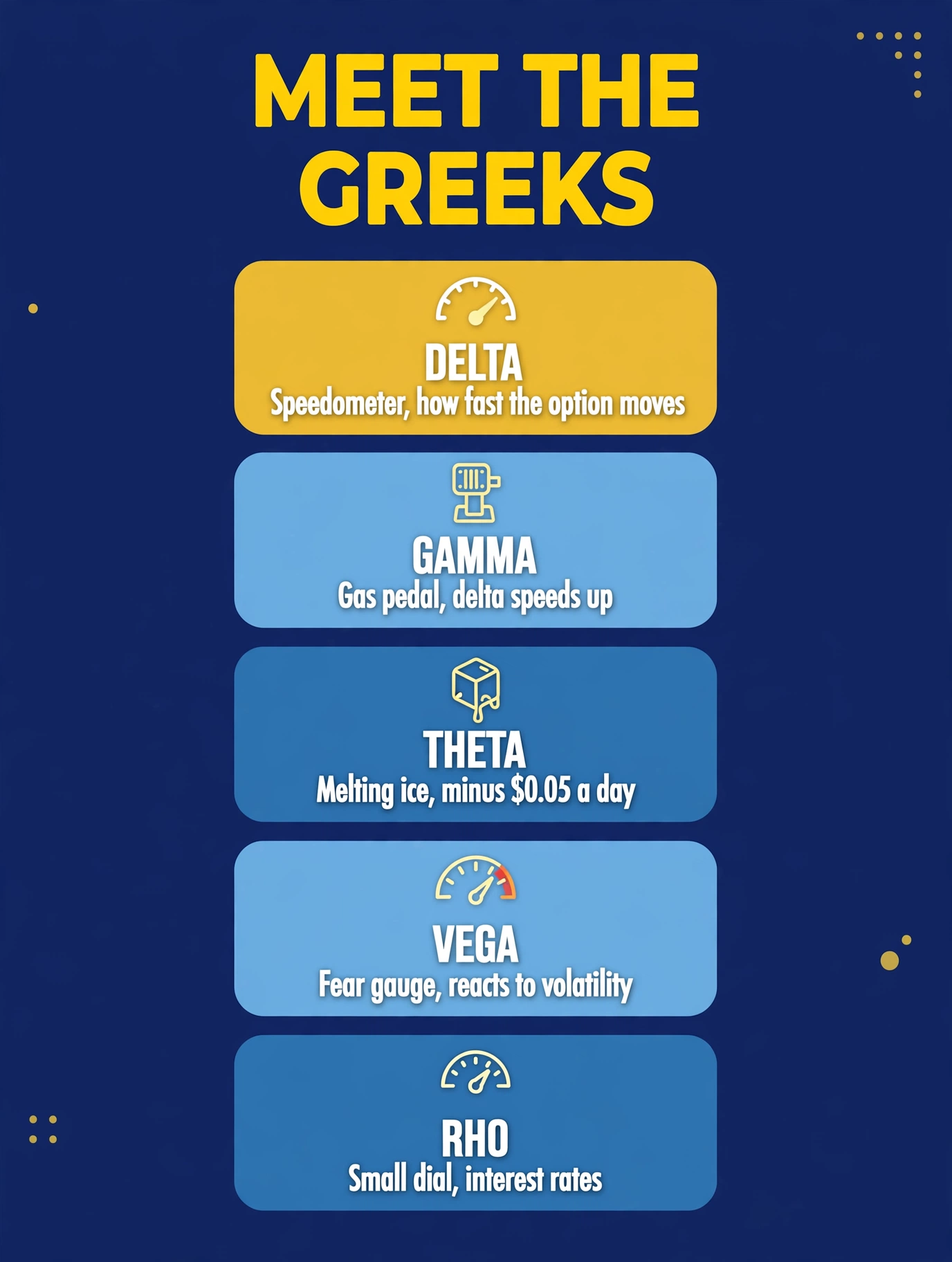
Option prices move for five separate reasons, and each one has a Greek nickname. Traders call them the Greeks: delta, gamma, theta, vega, and rho. They are not as scary as they sound. Think of each Greek as one dial on the option's dashboard, and you are the driver learning what each dial measures. We will now teach you what each Greek means in plain English and how your exposures change as the stock moves and time passes.
Delta: How Much the Option Moves
Delta measures how much the option's price moves when the stock moves $1. Our running example: a $100 stock, a $100-strike call worth $5. If its delta is 0.50, a $1 rise in the stock adds about $0.50 to the call's price (and a $1 fall costs about $0.50). Delta is the option's speedometer.
Deltas run on fixed scales. A call's delta runs from 0 to 1.00; a put's delta runs from −1.00 to 0. Deep-in-the-money options have deltas near ±1.00 (they behave almost like the stock); far-out-of-the-money options have deltas near 0 (they barely notice small moves). At-the-money options sit near ±0.50 — a coin flip's worth of stock-like behavior. So when someone says "I bought 0.50 deltas," they mean options that move about half as fast as the stock.
Gamma: How Fast Delta Itself Changes
Gamma measures how fast delta changes when the stock moves. It is delta's acceleration. Suppose our call's delta is 0.40 and its gamma is 0.08. The stock rises $1, and the delta climbs from 0.40 to about 0.48. Gamma tells you your speedometer is itself speeding up as the move goes your way.
Gamma matters most in two spots: at-the-money options (where the outcome is a genuine coin flip, so each stock move rewrites the odds) and near expiration (where a single day can flip an option from worthless to valuable). For buyers, high gamma is thrilling — your winners accelerate. For sellers, it is the danger dial: a short option's delta can run away from you exactly when the stock is running too. If delta is the speed, gamma is the gas pedal.
Theta: The Melting Ice Cube
Theta measures how much value the option loses each day just from time passing — time decay. Our $5 call with a theta of −0.05 loses about $0.05 per day, shrinking to $4.95 overnight even if the stock never moves. Theta is why option buyers say their position is "a melting ice cube": every sunrise costs money.
Theta is not flat — it accelerates near expiration. A 60-day option melts slowly; the same option with 5 days left melts fast, because each remaining day is a bigger fraction of the option's remaining life. This is the core of the buyer-vs-seller trade from OD-101: buyers fight theta, sellers collect it. Covered-call and cash-secured-put sellers (OD-104) are explicitly in the business of renting out time and letting theta pay them.
Vega and Rho: Volatility and Interest Rates
Vega measures how much the option's price moves when expected volatility rises by one point. Our $5 call with a vega of 0.30 gains about $0.30 if the market's volatility forecast climbs one point, and loses about $0.30 if it drops. More expected turbulence means a higher chance of big moves, and the market charges more for that chance. We will go deep on volatility in OD-103; for now, remember that vega is the fear gauge of your position.
Rho measures sensitivity to interest rates — and for most stock options, it barely matters. If rates rise one point, our $5 call might gain about $0.10 (calls get slightly more valuable because buying later on margin is pricier; puts move the other way). Rho only starts to matter with very long-dated options or big rate moves. Beginners can safely file rho under "know it exists, check it rarely."
How Exposures Change
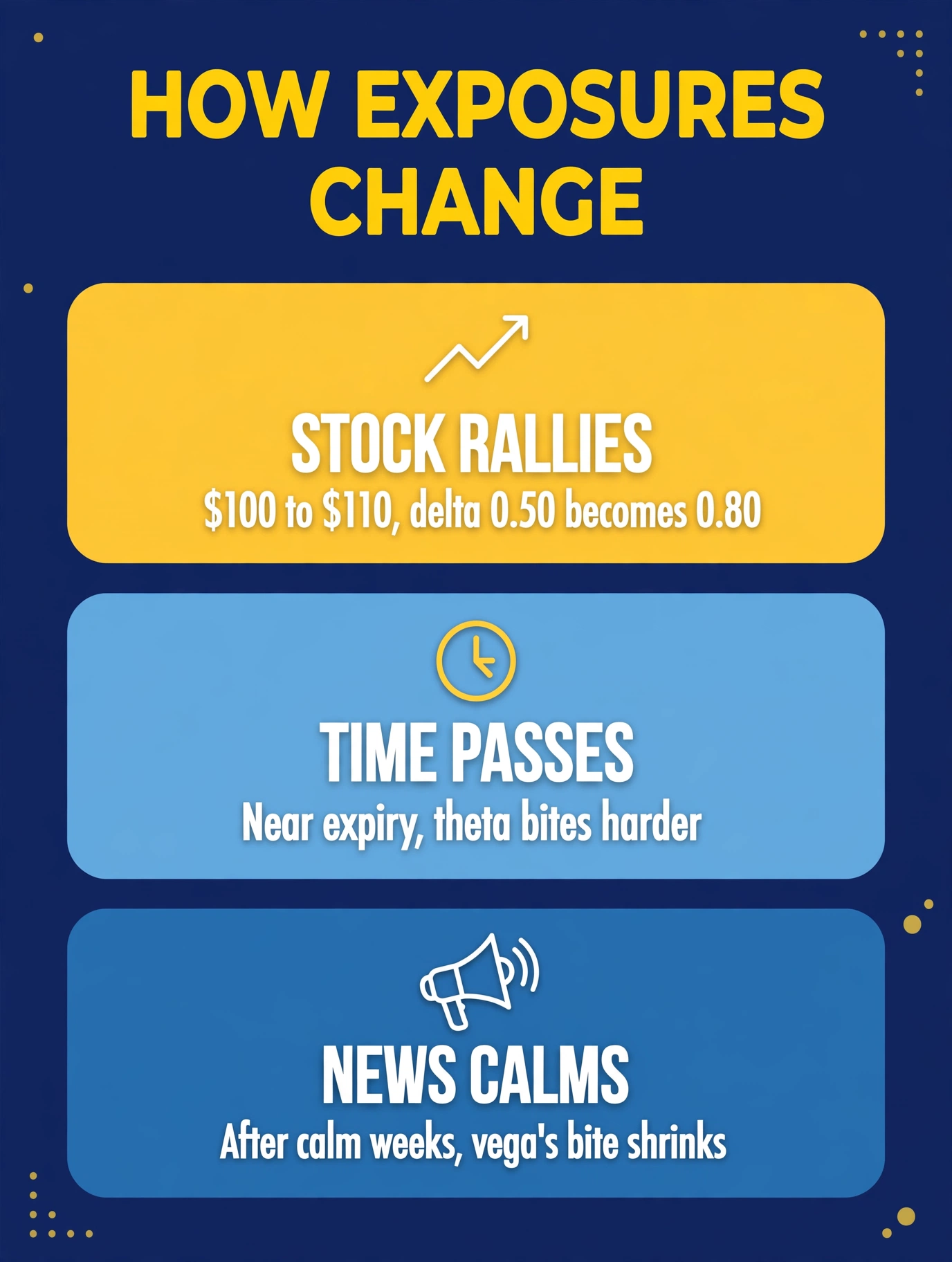
Here is the part most beginners miss: the Greeks move. Buy our $100-strike call at $5 with the stock at $100, and you own delta 0.50 and a pile of extrinsic value. If the stock rallies to $110, your delta might be 0.80 now — the option behaves far more like the stock than when you bought it. Your exposure to the next $1 move has grown even though you did nothing.
Time changes the dials too. As expiration nears, theta's daily bite grows, gamma spikes for at-the-money strikes, and extrinsic value evaporates — our $5 call's $3 of extrinsic value from OD-101 trends toward zero on expiration day no matter what the stock does. Volatility shifts rewrite vega's bite: after a calm month, the same option may barely react to volatility news. The practical lesson is simple: an option position is not a static bet. Re-read your Greeks whenever the stock has moved, a week has passed, or the news cycle has changed — the dashboard you bought is not the dashboard you own.
Key terms
- The Greeks
- the five measures of how an option's price responds: delta, gamma, theta, vega, rho.
- Delta
- how much the option's price moves per $1 stock move (0 to 1.00 for calls; −1.00 to 0 for puts).
- Gamma
- how fast delta itself changes when the stock moves; delta's acceleration.
- Theta
- how much value the option loses per day from time passing; time decay.
- Time decay
- the daily melt of an option's extrinsic value as expiration approaches.
- Vega
- how much the option's price moves when expected volatility rises one point.
- Rho
- how much the option's price moves when interest rates rise one point (usually small for stock options).
What's next
You can read the dashboard; OD-103 "Volatility and Pricing" goes deep on the fuel behind vega — implied versus realized volatility, skew, term structure, and event risk.
The quiz
The Greeks — Quiz
4 questions · pass with 4 correct
1.A $5 call has a delta of 0.50. The stock rises $1. About how much does the call gain?
2.What does gamma measure?
3.An option has a theta of −0.05. What does that mean?
4.Which Greek rises in value when the market's expected volatility climbs?
Recommended Tools
Hand-picked resources that fit this lesson — a short list, and only when they're genuinely useful.
- Learn more
TradingView
The charting platform used throughout this program — build watchlists and mark up price structure as you learn it here.
- Learn more
TraderSync
A trading journal that records every trade, so your review sessions run on real numbers instead of memory.
Some links above are affiliate links, which means The Prosper Academy may earn a commission at no extra cost to you.