
Rental Property Analysis
School 10 — Bonus
School 10 · Bonus · About 15 minutes
A rental property is a small business you can walk through. You buy it, a tenant pays you rent, and the money left over after the bills is your profit. But most beginners only look at the rent and the mortgage — and that is how they buy a property that quietly loses money every month. We will now teach you how to analyze a rental property the right way: acquisition costs, financing, cash flow, reserves, taxes, operations, and exit scenarios — using one example house all the way through.
What It Really Costs to Buy: Acquisition Costs
The price of the house is only the headline. The acquisition costs are everything you must pay to own the property, starting on day one. Miss one of them and your "great deal" needs thousands more than you planned.
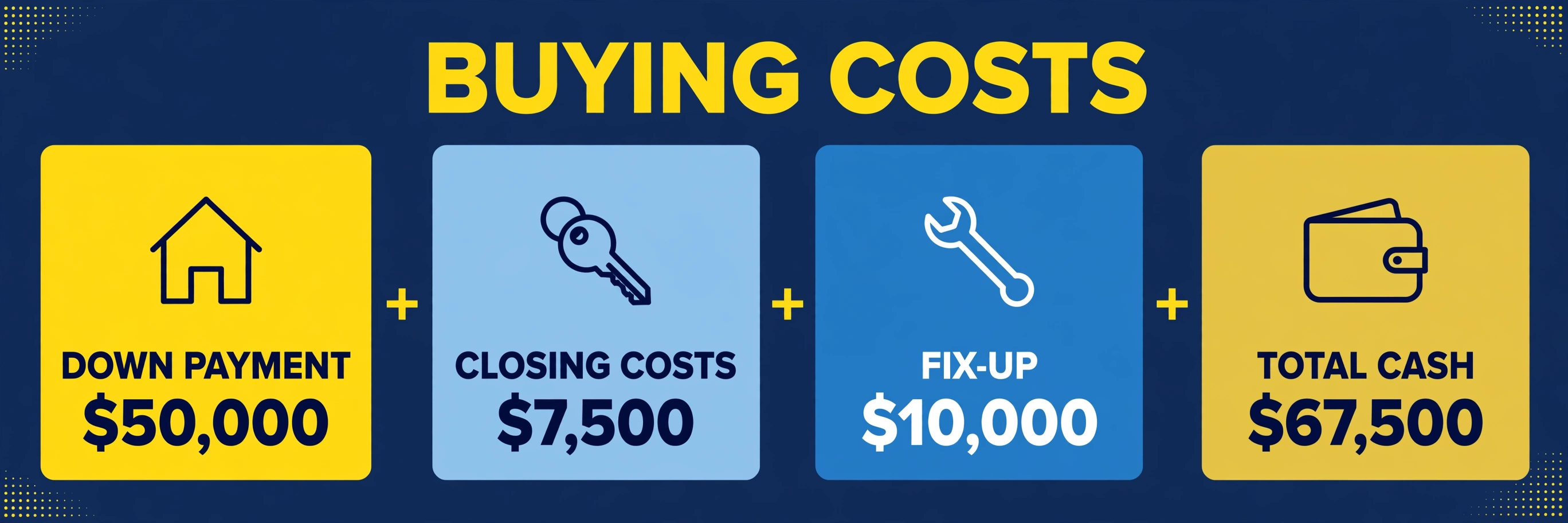
Take our example: a house listed at $250,000. First, the down payment — the chunk of the price you pay yourself, usually 20% for an investment property. That is $50,000 out of your pocket. Second, the closing costs — the fees for the loan, the title search, the paperwork, and recording the sale. A safe rule is 2–5% of the price; here we budget $7,500. Third, the fix-up costs — the repairs and cleanup needed before a tenant can move in: paint, locks, a new water heater, yard cleanup. We budget $10,000.
Add them up: $50,000 + $7,500 + $10,000 = $67,500 in total cash needed to buy. That number — not the $250,000 price tag — is the real cost of getting in the game. Every return you measure later gets divided by this number.
Financing the Deal: The Mortgage
Most investors do not pay cash for the whole house — they use financing, borrowing most of the purchase price with a mortgage. The mortgage is simply a loan secured by the property: the bank lends you money, and if you stop paying, the bank takes the house.
In our example, the $50,000 down payment covers 20% of the $250,000 price, so the mortgage is the other 80%: a $200,000 loan. That loan comes with a monthly payment — principal plus interest — of about $1,050 per month. Notice what financing does to your deal: it lets you control a $250,000 asset with only $50,000 of your own money. That is called leverage — using borrowed money to amplify what your cash can buy.
Leverage cuts both ways. If the property grows in value or the rent covers the payment comfortably, your $50,000 works hard. But the mortgage payment is owed every month whether the house is rented or empty — so your analysis must prove the rent covers it with room to spare. That proof is the next section.
Cash Flow: What Is Left at the End of the Month
Cash flow is the money left over after you pay every bill the property generates. It is the single most important number in rental analysis, because a property with no cash flow is not an investment — it is a hobby that charges you rent.
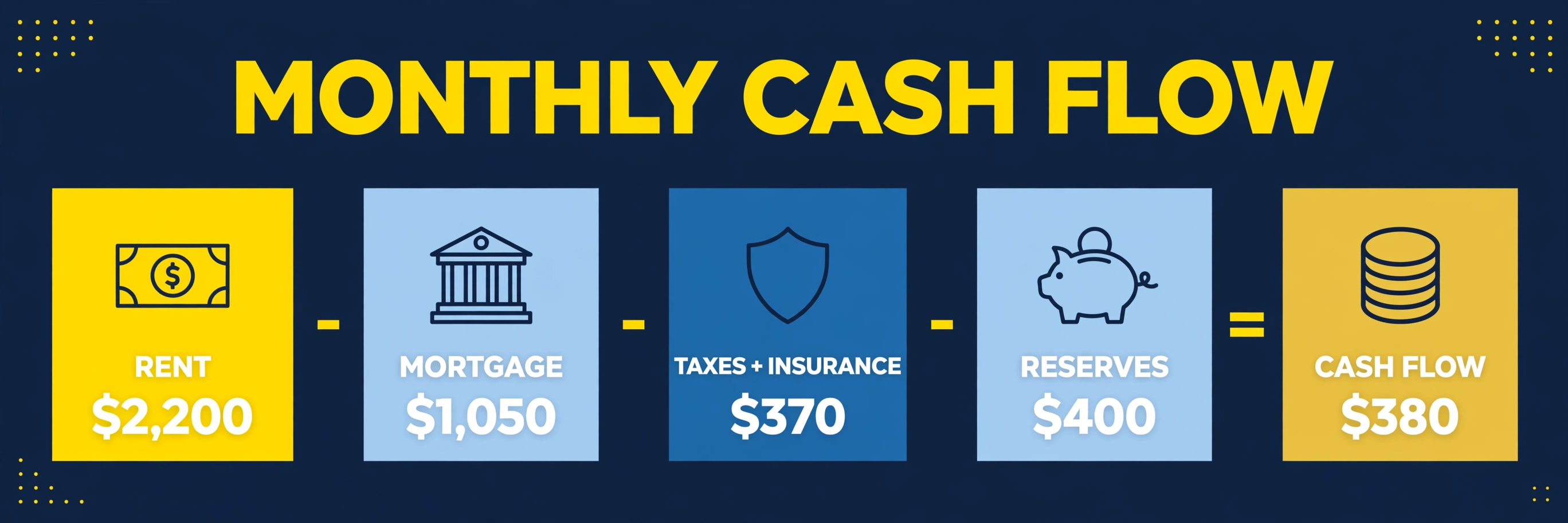
Here is the cash-flow math on our example house, every month. Rent coming in: $2,200. Then the money going out: mortgage payment $1,050, property taxes plus insurance $370, and reserves $400 (more on reserves next — they are real costs even in quiet months). Subtract it all: $2,200 − $1,050 − $370 − $400 = $380 in monthly cash flow.
That $380 a month — $4,560 a year — is the paycheck the property pays you. Compare it to the $67,500 total cash you put in to buy: $4,560 ÷ $67,500 = about 7%. That percentage is your cash-on-cash return — the yearly cash return on the cash you invested. Positive cash flow means the property pays you to own it; negative means you are paying for the privilege.
Reserves: The Bills You Cannot See Yet
Every rental has expenses that do not show up every month — and the month they do show up, they are large. A roof leaks. A tenant moves out and the house sits empty for six weeks. The furnace dies in January. Reserves are money you set aside every month for these irregular costs, so a bad month never becomes a crisis.
Think of reserves as two buckets. The maintenance reserve covers repairs: appliances, plumbing, paint, landscaping. A common rule is about 8% of rent — here, roughly $175 of our $400. The vacancy reserve covers empty months: no tenant means no rent, but the mortgage still gets paid. Another ~8% of rent — another $175 or so. We round up to $400 total per month in our example.
The beginner's mistake is treating reserves as optional — "I'll deal with repairs when they happen." That turns every surprise into debt or panic. The professional sets the $400 aside every single month, in a separate account if possible, and never counts it as profit. When the furnace dies, the money is already there. Reserves are not money you spend today; they are insurance you pay to yourself.
Taxes and Operations: Running the Business
Owning a rental means running a small business, and every business has taxes and daily operations.
On taxes, two things matter most at this level. First, property taxes are owed to the local government every year, whether the property makes money or not — in our example they run about $250 of the $370 monthly taxes-plus-insurance line. Second, the tax deduction side: the IRS lets landlords deduct real costs like mortgage interest, property taxes, insurance, repairs, and a yearly paper expense called depreciation (spreading the building's cost over 27.5 years). Deductions do not make a bad deal good, but they do lower the tax bill on your rental income — a real benefit you should know exists.
On operations, the daily reality is simple: finding tenants, collecting rent, handling repairs, and keeping the place legal. You can do this yourself (self-management) or hire a property manager, who typically charges about 10% of the rent. Doing it yourself saves money but costs your time and your evenings when the toilet leaks at 9 PM. Whichever you choose, budget for it honestly — a property manager is an expense to include in your analysis, and your own time has value too. The best operation is boring: good tenants, quick repairs, rents collected on time, nothing dramatic.
Exit Scenarios: Know How You Get Out Before You Get In
Before you buy any property, you should know how you might sell it — or never sell it. Exit scenarios are your three main ways out, and each one changes what a "good deal" looks like.
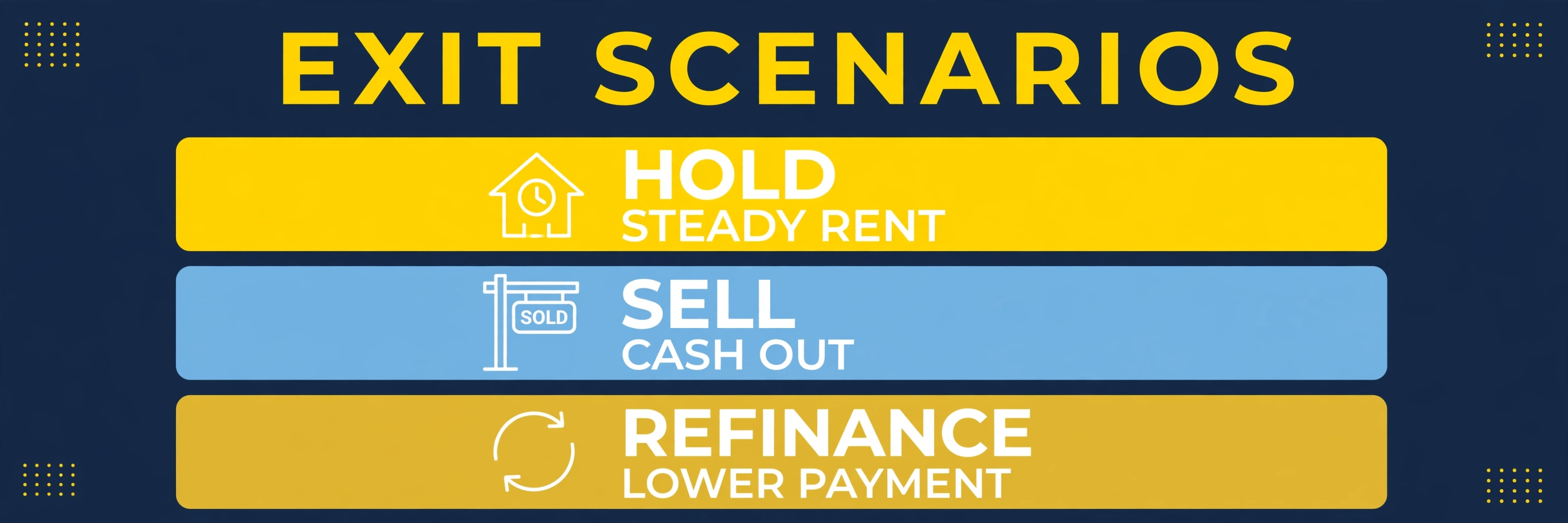
The hold scenario: you keep the property for decades, collecting rent and letting the tenant's payments slowly pay down your mortgage. This is the classic landlord path — steady income that grows as rents rise and the loan shrinks. Our example's $380 monthly cash flow is a hold-play number.
The sell scenario: you buy, improve the property, and sell it for more — or simply sell when the market has risen enough. The profit is the sale price minus what you still owe on the mortgage, minus selling costs (agent commissions and fees run roughly 8–10% of the sale price). Selling is how you cash out a big gain, but it ends the monthly income.
The refinance scenario: after the property grows in value or rates drop, you replace your mortgage with a new, cheaper one — a lower payment means more cash flow, or you can pull cash out of the new loan to fund your next property. Refinancing lets you recycle your $67,500 into a second house without selling the first.
No scenario is right for everyone. But the rule is the same: decide your exit before you buy, because the exit determines what numbers you need on day one.
Key terms
- Acquisition costs
- everything you pay to own the property on day one: down payment, closing costs, and fix-up.
- Down payment
- the chunk of the price you pay yourself; usually 20% for an investment property.
- Closing costs
- the fees for the loan, title search, and paperwork; budget 2–5% of the price.
- Mortgage
- a loan secured by the property; the bank lends you most of the price and takes the house if you stop paying.
- Leverage
- using borrowed money to control a bigger asset than your cash could buy alone.
- Cash flow
- the money left over after paying every bill the property generates each month.
- Cash-on-cash return
- yearly cash flow divided by the cash you put in, expressed as a percentage.
- Reserves
- money set aside monthly for irregular costs like repairs and empty months.
- Property taxes
- yearly taxes owed to local government; due whether the property makes money or not.
- Depreciation
- a yearly paper tax deduction spreading the building's cost over 27.5 years.
- Property manager
- a hired professional who handles tenants, rent, and repairs; typically about 10% of rent.
- Exit scenarios
- your main ways out: hold for income, sell to cash out, or refinance to a better loan.
What's next
You can now read a rental property like a small business; BON-102 "Business Acquisition" applies the same lens to buying a company — customers, cash flow, and price.
Go deeper
Want the full entrepreneurship playbook?
This lesson covered the foundations. The Entrepreneurship Masterclass takes you the whole way — starting a business, buying an existing one, valuing it, real-estate investing, winning customers, hiring your first employee, LLC paperwork, and using AI to research and automate it all faster.
See the Entrepreneurship Masterclass — $197The quiz
Rental Property Analysis — Quiz
3 questions · pass with 3 correct
1.
2.
3.