
Business Acquisition
School 10 — Bonus
School 10 · Bonus · About 15 minutes
Most people think starting a business means starting from zero — a blank page, a big idea, and a long hard climb. But there is a second path that skips the blank page entirely: buying a business that already works. Every day, owners of profitable small businesses — plumbing companies, bakeries, auto shops, landscaping crews — are ready to retire or move on, and they would rather hand their life's work to a good buyer than shut it down. Buying an existing business means buying customers, income, and a reputation on day one. In this class, you will learn how to find those deals, check them honestly, pay for them, and make the handoff stick. We will follow one example deal all the way through: a small plumbing company for sale at $600,000 that earns its owner $150,000 a year in cash flow.
Finding Deals: Where Businesses for Sale Actually Live
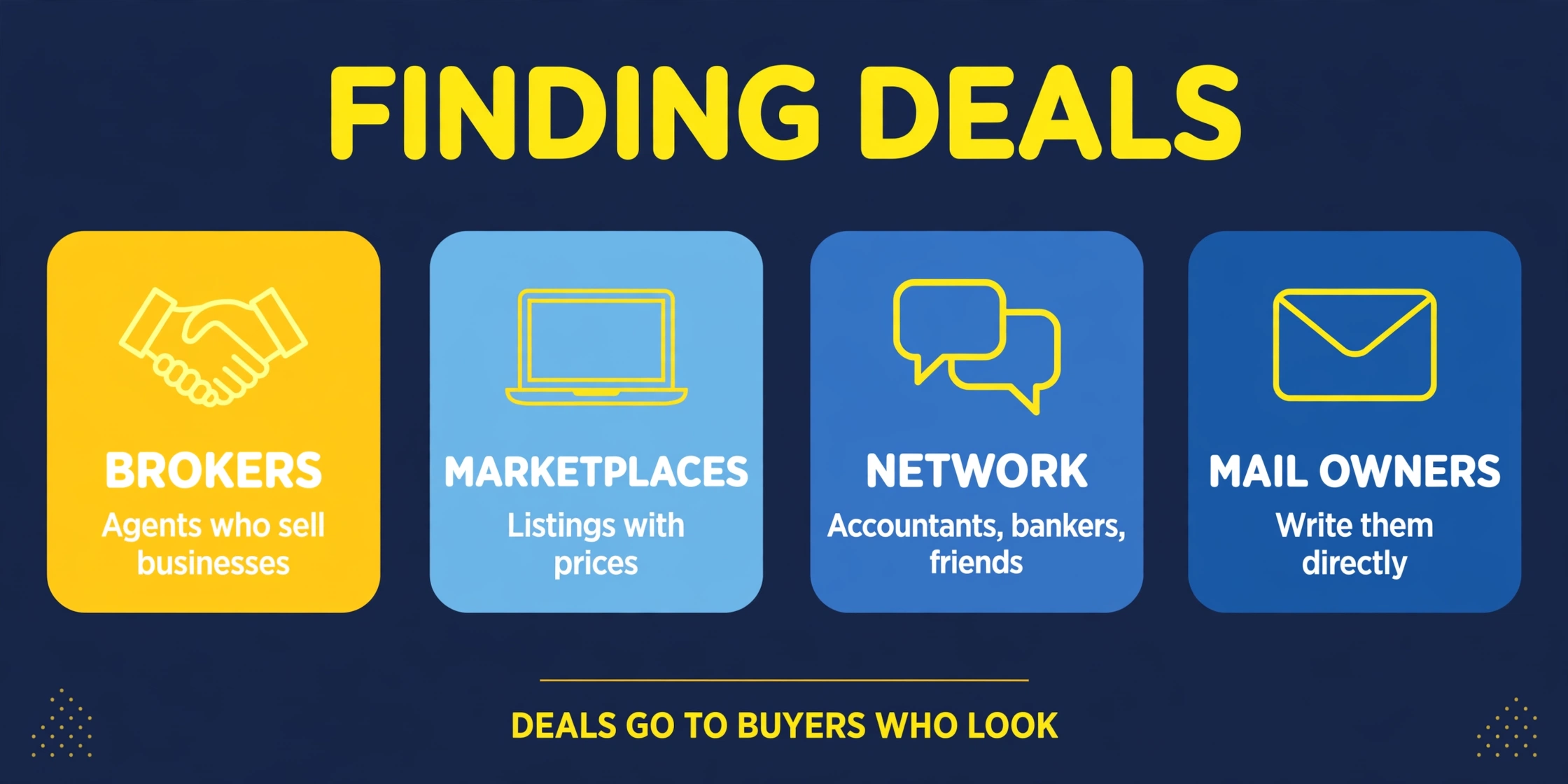
Businesses for sale are not advertised on billboards. They change hands quietly, and the best ones go to buyers who know where to look. Start with business brokers — agents who specialize in selling small businesses, the way real estate agents sell houses. A good broker knows which owners are quietly ready to sell before the business is ever listed publicly.
Second, look at online marketplaces built for this exact purpose, where owners list businesses for sale with prices and basic financials. You can filter by industry, location, and price — it is like house hunting, but for income. Third, and most powerful, is your network: tell everyone you know — accountants, lawyers, bankers, suppliers — that you are looking to buy a business. Most deals happen through a conversation, not a listing, because owners often tell their accountant they want out years before they tell anyone else.
Finally, try direct outreach: make a list of businesses you admire in your area and write the owners a simple letter — "If you ever think about selling, I would love to talk." It feels old-fashioned, and that is exactly why it works. Owners sell to people they trust, and a respectful letter starts that trust.
Due Diligence: Trust, Then Verify
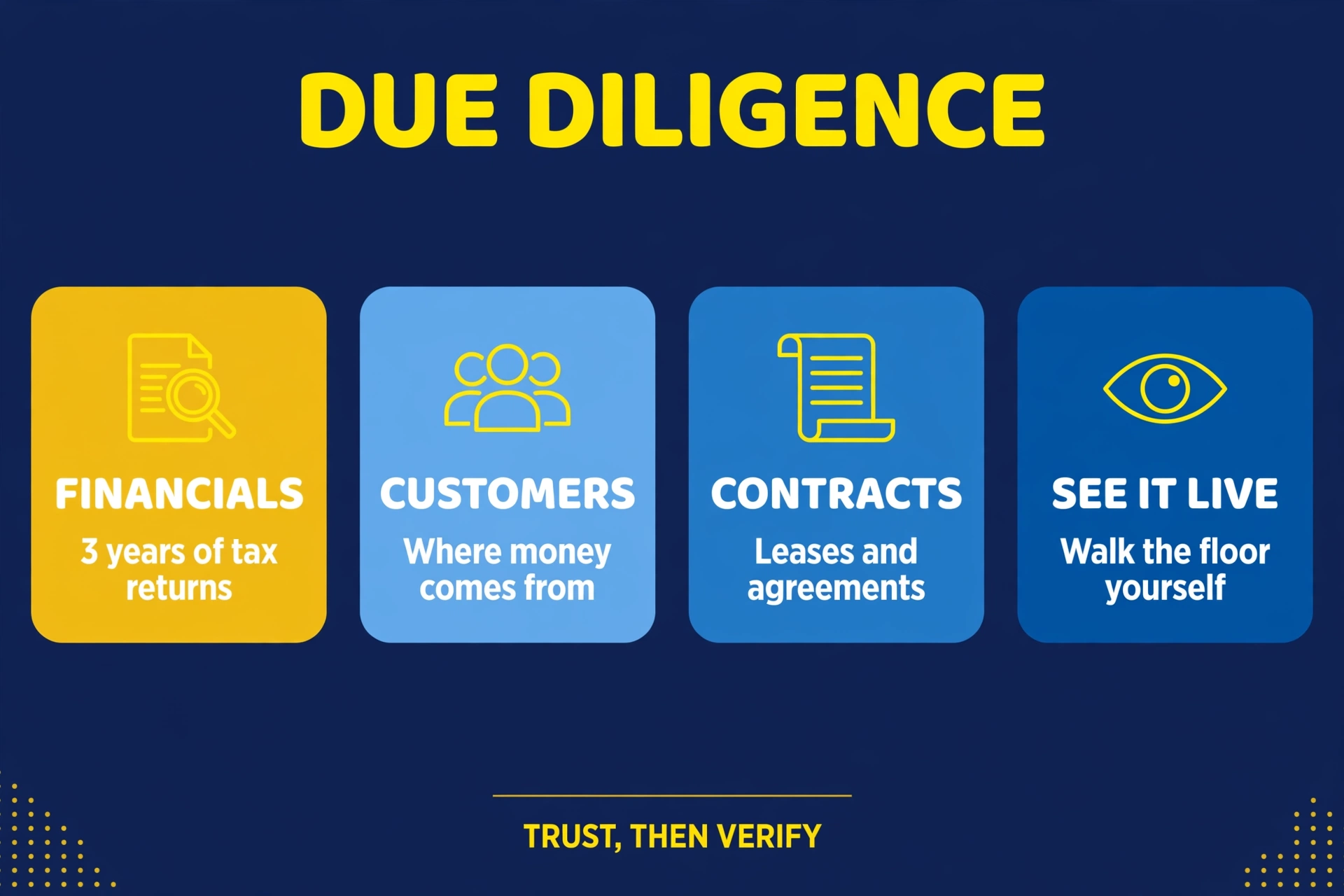
When you find a business you like, the seller will tell you a story: growing sales, loyal customers, easy to run. Some of that story is true and some is salesmanship. Due diligence is the process of checking every claim before your money is on the line — trust, then verify.
Start with the financials: ask for at least three years of tax returns and bank statements, not just the spreadsheet the seller hands you. Tax returns are hard to fake, and they show the real money coming in and going out. If the seller says the plumbing company earns $150,000 a year, the tax returns should agree. Next, study the customers: where does the money actually come from? If half the revenue comes from one big client, that client leaving could sink you — that is a risk you need to see before you buy, not after.
Then read the contracts: the lease on the building, the supplier agreements, the employee arrangements. A business whose lease ends next month is a very different purchase than one with five secure years. And finally, walk the floor: visit the business unannounced at different times, talk to employees, watch how customers are treated. The books tell you the numbers; your eyes tell you whether the business is healthy.
If anything in due diligence does not add up, slow down or walk away. There will always be another deal — there will not always be another chance to get your money back.
Paying for It: Financing the Purchase
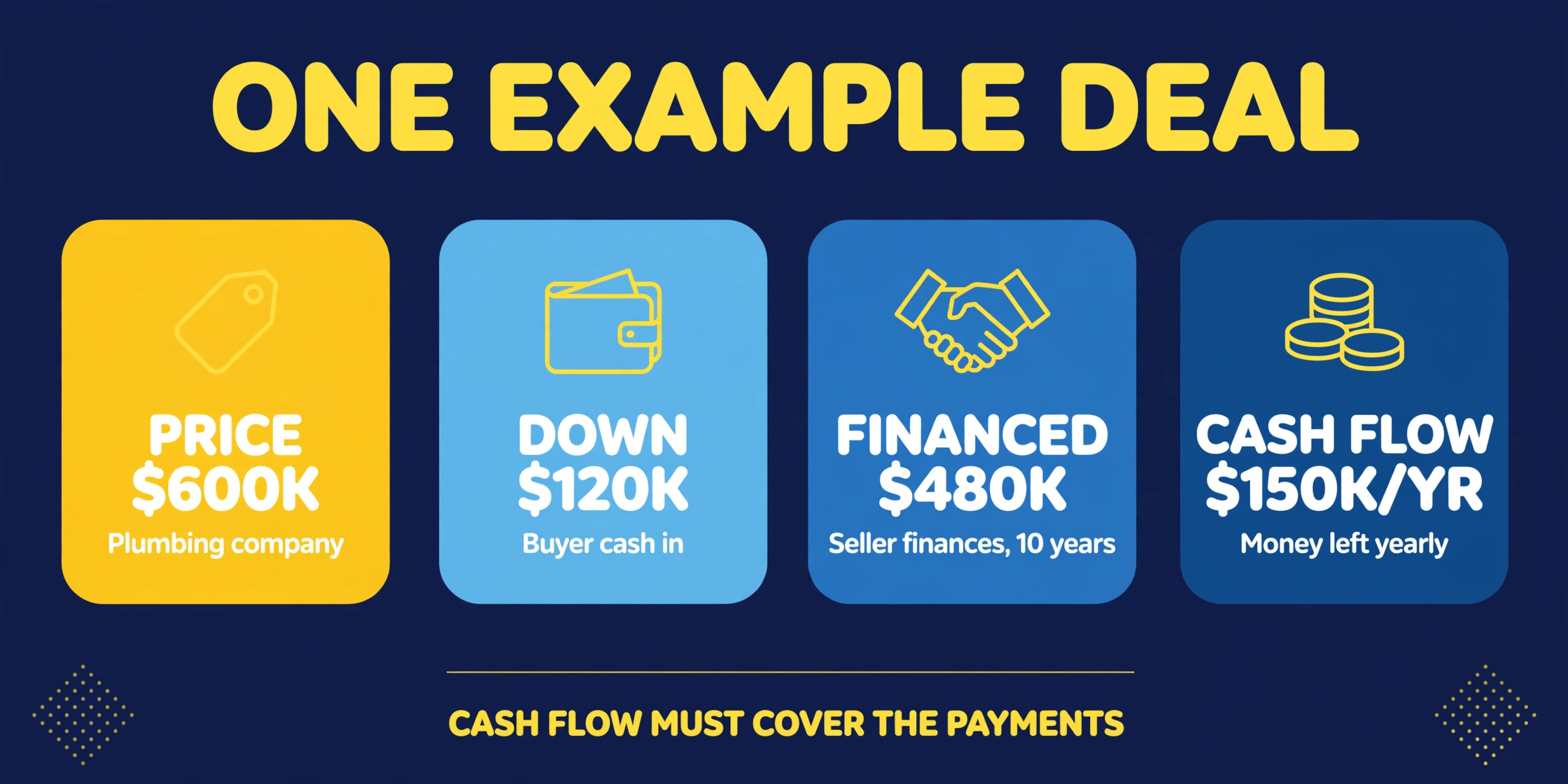
Few buyers write a check for the full price. Most business purchases are financed — put together from several sources like pieces of a puzzle. The first piece is your down payment: your own cash into the deal. In our example, the plumbing company costs $600,000 and the buyer puts down $120,000 of savings.
The second piece is often a bank loan — banks lend for business purchases when the business has a track record of steady cash flow, which our $150,000-a-year plumbing company does. The third piece is seller financing: the seller acts as your lender for part of the price. Here, the seller finances the remaining $480,000, paid back monthly over ten years. Sellers agree to this more often than you would think — it gives them steady income in retirement and a friendly way to receive the money over time.
Seller financing also keeps the seller honest. If the business falls apart the month after you buy it, the seller stops getting paid too — so they have every reason to tell you the truth during due diligence and to help you succeed afterward. A deal where the seller finances a large share is a deal where the seller believes in the business. When a seller demands all cash and runs, ask yourself why.
Cash Flow: The Number That Decides Everything
Price gets the headlines, but cash flow decides whether the deal works. Cash flow is the money left in the till after every bill is paid — wages, rent, supplies, taxes. It is what the business actually hands you each year. Our plumbing company earns $150,000 a year in cash flow, and that single number must cover two jobs: paying back the $480,000 the buyer financed, and paying the buyer a living.
This is the arithmetic of the whole deal, and it is simple: the annual cash flow must be bigger than the annual loan payments plus what you need to live on. If the loan payments eat everything, you have bought yourself a stressful job with no paycheck. That is why buyers care less about what a business could earn someday and more about what it does earn right now — cash flow is the engine, and everything else is decoration.
Before you sign anything, write the numbers down and check them against a bad year, not a good one. Businesses have slow seasons and surprise repairs. If the deal only works when everything goes perfectly, it does not work. Buy the business that pays for itself in an ordinary year, and the good years become your bonus.
Operator Risk: Can YOU Run It?
A business is not a stock certificate — it does not run itself while you watch. Operator risk is the risk that the business depends on you being good at running it, and that you might not be. Before buying, ask the uncomfortable question: can I actually do this job?
Start with the owner's role: how much of the business is the current owner personally? If the owner is the master plumber, the star salesperson, and the bookkeeper, you are not buying a business — you are buying a job that used to be his. Look for businesses with systems and staff: employees who know the work, a manager who runs the day-to-day, written procedures anyone can follow. Our plumbing company works as a purchase because it has a crew and an office manager — the buyer manages the business, not every wrench turn.
Then be honest about your skills: do you know the industry, or can you learn it fast? Can you lead people, handle an angry customer, read a profit-and-loss statement? Nobody is born ready, but the gap between what the business needs and what you bring is the risk. The smaller the gap, the safer the deal — and the first year is when you close it, by learning the business from the inside.
The Handoff: Making the Transition Stick
The deal is signed, the money moved — now the real test begins. Most failed acquisitions do not fail because the numbers were wrong; they fail because the transition was mishandled. Customers and employees were loyal to the old owner, and they are watching to see what changes.
The smartest move is a transition period: have the seller stay involved for three to six months, introducing you to key customers, showing you the unwritten rules, and lending you their credibility while you earn your own. In our example deal, the seller's agreement to finance $480,000 makes this natural — they are invested in your success, so they introduce you around like a partner, not a stranger.
Change slowly. In the first year, fix what is broken but keep what works — the employees, the suppliers, the way the phones get answered. Every change you make before people trust you feels like a threat; every change you make after feels like improvement. Earn the trust first. Then make it yours.
Key terms
- Business acquisition
- buying an existing business instead of starting one from scratch; you get customers, income, and reputation on day one.
- Business broker
- an agent who specializes in selling small businesses, like a real estate agent for companies.
- Deal sourcing
- the work of finding businesses for sale: brokers, marketplaces, networks, and direct outreach.
- Due diligence
- checking every claim the seller makes before your money is on the line; trust, then verify.
- Down payment
- your own cash put into the deal; in our example, $120,000 of the $600,000 price.
- Seller financing
- the seller lends you part of the purchase price; in our example, $480,000 paid back monthly over ten years.
- Cash flow
- the money left after every bill is paid; in our example, $150,000 a year, which must cover the loan payments and the owner's living.
- Operator risk
- the risk that the business depends on your ability to run it, and on how much it depended on the old owner.
- Key-man risk
- a form of operator risk where the business depends heavily on one person, like the owner being the star salesperson.
- Transition period
- the months after the sale when the seller helps introduce you to customers, employees, and the unwritten rules.
What's next
BON-103 "Philanthropy and Legacy" asks what your wealth is for — giving back, building something that outlasts you, and writing the final chapter of your money story.
Go deeper
Want the full entrepreneurship playbook?
This lesson covered the foundations. The Entrepreneurship Masterclass takes you the whole way — starting a business, buying an existing one, valuing it, real-estate investing, winning customers, hiring your first employee, LLC paperwork, and using AI to research and automate it all faster.
See the Entrepreneurship Masterclass — $197The quiz
Business Acquisition — Quiz
4 questions · pass with 3 correct
1.In the lesson's example deal, the plumbing company costs $600,000 and earns $150,000 a year in cash flow. Why is cash flow the number that decides whether the deal works?
2.What is due diligence?
3.What is seller financing?
4.According to the lesson, why do most failed acquisitions fail?