
Options Strategy Lab
School 09 — Options and Derivatives
School 9 · Options and Derivatives · About 15 minutes
You have met the building blocks — calls, puts, spreads, calendars, straddles — and the forces that move them: time, volatility, and the stock's path. This final lab turns knowledge into a process. Trading is not collecting strategies; it is running a loop: match the structure to your thesis, check the trade before you place it, practice with paper money, and review every trade afterward. We will now teach you how to match structure to thesis, the pre-trade checklist, paper trading, and the post-trade review.
Match Structure to Thesis
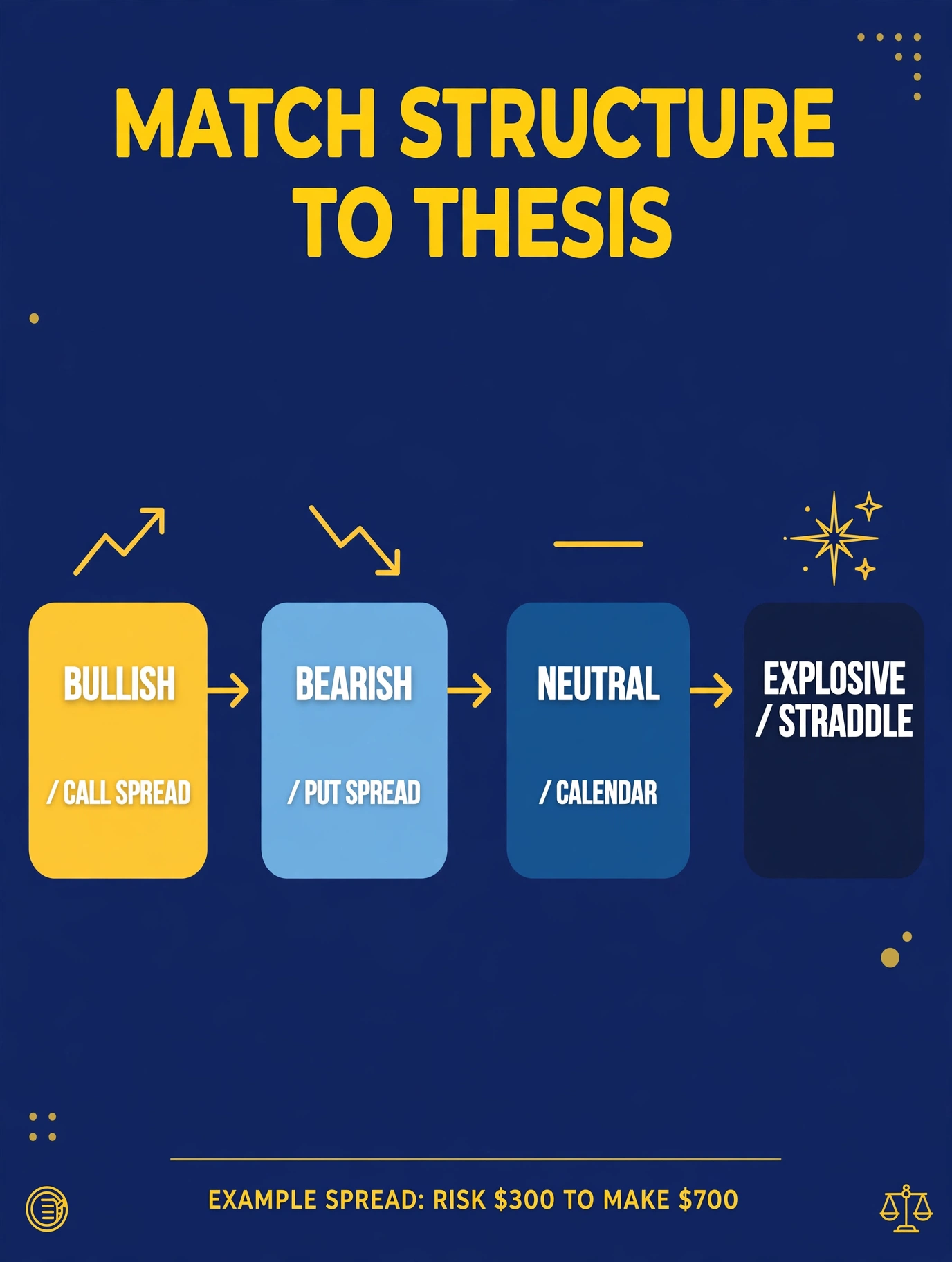
Every options trade starts with a thesis — a plain-English statement of what you think will happen. "The stock will drift upward over the next two months." "The stock will sit still through earnings." "A huge move is coming, but I do not know which direction." Your thesis is the lock; the options structure is the key. A bullish thesis does not want a calendar spread (OD-106) any more than a neutral thesis wants a bull call spread — wrong key, wrong lock.
Map your view to a structure. Bullish, moderately and with a timeframe? A bull call spread fits: buy the $100 call, sell the $110 call. Our example costs $3 per share — a $300 max loss — and can pay up to $7 per share, a $700 max gain. Bearish? Mirror it with a put spread. Expecting stillness? A calendar profits when the stock sits near the strike. Expecting an explosive move either way? A long straddle wins if the move is big enough to cover both premiums.
Two checks keep the match honest. First, does the trade's best case line up with your thesis? A calendar's best case is the stock parked at the strike — if your thesis says "breakout," it is the wrong trade. Second, does the worst case fit your budget? The $300 spread risk must sit under your risk-per-trade limit — in our $50,000 example account, risking 1% per trade means never risking more than $500 on any single idea. Structure follows thesis; size follows budget. Both, every time.
The Pre-Trade Checklist
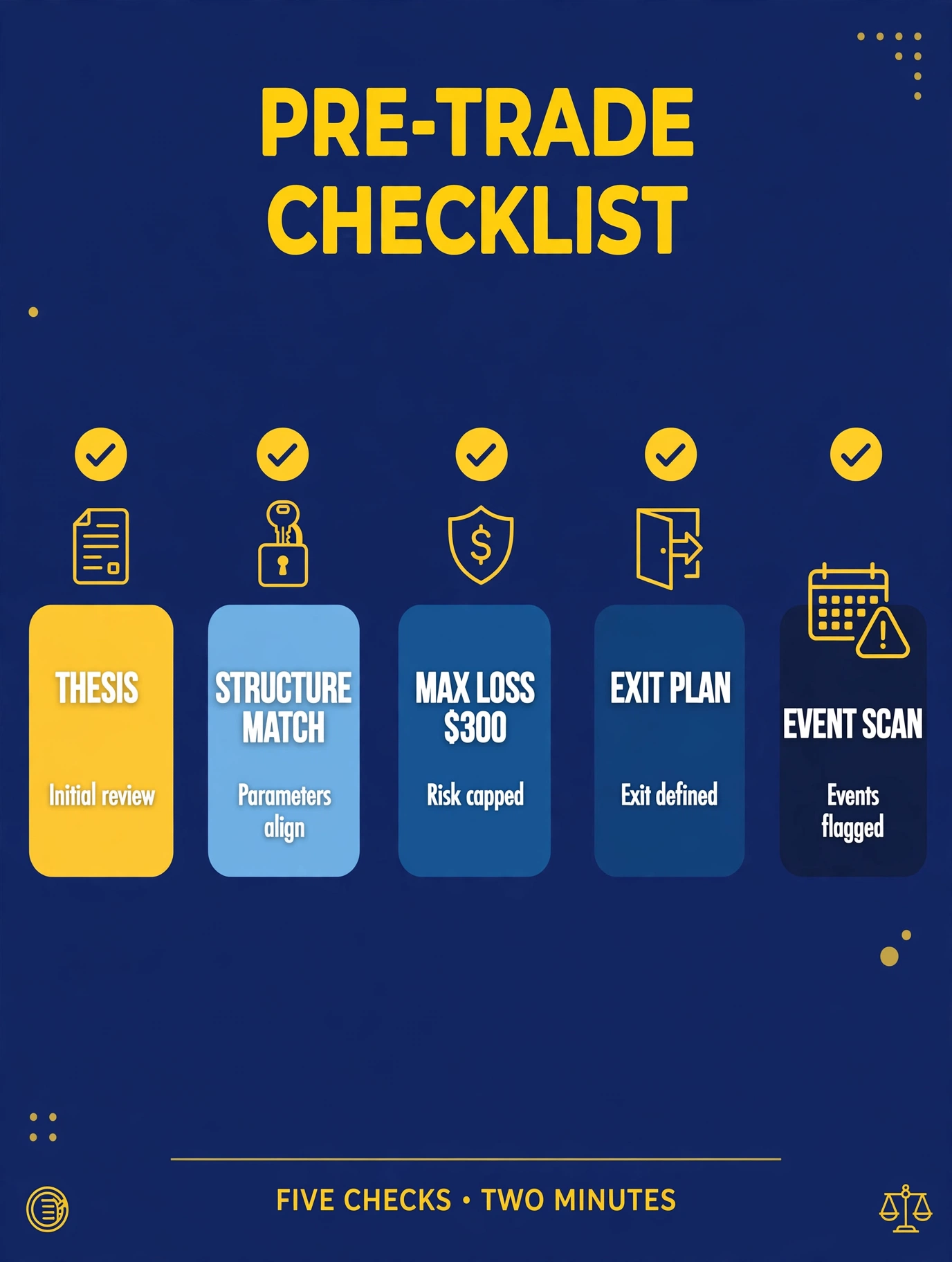
Professionals do not "feel" a trade — they check it. The pre-trade checklist is a short list you run through before every order, and it takes two minutes. Write it down, keep it next to your trading screen, and never skip it — skipping is how beginners pay tuition.
Five checks, in order. One: what is my thesis, in one sentence? If you cannot say it, you do not have one. Two: does the structure match that thesis (see above)? Three: what is my max loss, and does it fit my risk budget? Our example spread's max loss is $300 — inside the $500 per-trade limit on our $50,000 account. Four: what is my exit plan — when do I take profit, and what price action kills the trade? Five: are there events before expiration — earnings, a Fed announcement, a dividend — that could crush volatility (OD-103) or gap the stock past your strike?
A checklist does not make a trade win. It makes your losses planned instead of surprising — and in options, where a position can expire worthless, a surprise loss is the expensive kind. No blank boxes means no excuses at review time.
Paper Trades: Practice With Fake Money
A paper trade is a trade you log but never place — fake money, real lessons. Every broker offers a paper trading account, and every beginner should live in one for months before risking a dollar. It is the flight simulator of options: you can crash the plane as often as you like and walk away smarter each time.
Run paper trades exactly as you would real ones: write the thesis, run the checklist, log the entry price, the structure, the max loss and max gain. Track the result at expiration — not just "won" or "lost," but why. Did the thesis play out? Did time decay (theta) help or hurt? Would the exit plan have triggered? A paper journal of fifty trades teaches you your own patterns: maybe your bullish spreads work but your calendars bleed, or maybe you always enter too early.
Set a graduation rule before you start. Ours: thirty paper trades over at least two months, with a positive total P&L and no single trade risking more than the $500 budget allows. The rule matters because it stops the two beginner traps — paper trading forever (fear) and going live after three lucky wins (overconfidence). When you graduate, start real trading at the same size you paper-traded. Size does not upgrade you; experience does.
Post-Trade Review: The Journal That Pays You
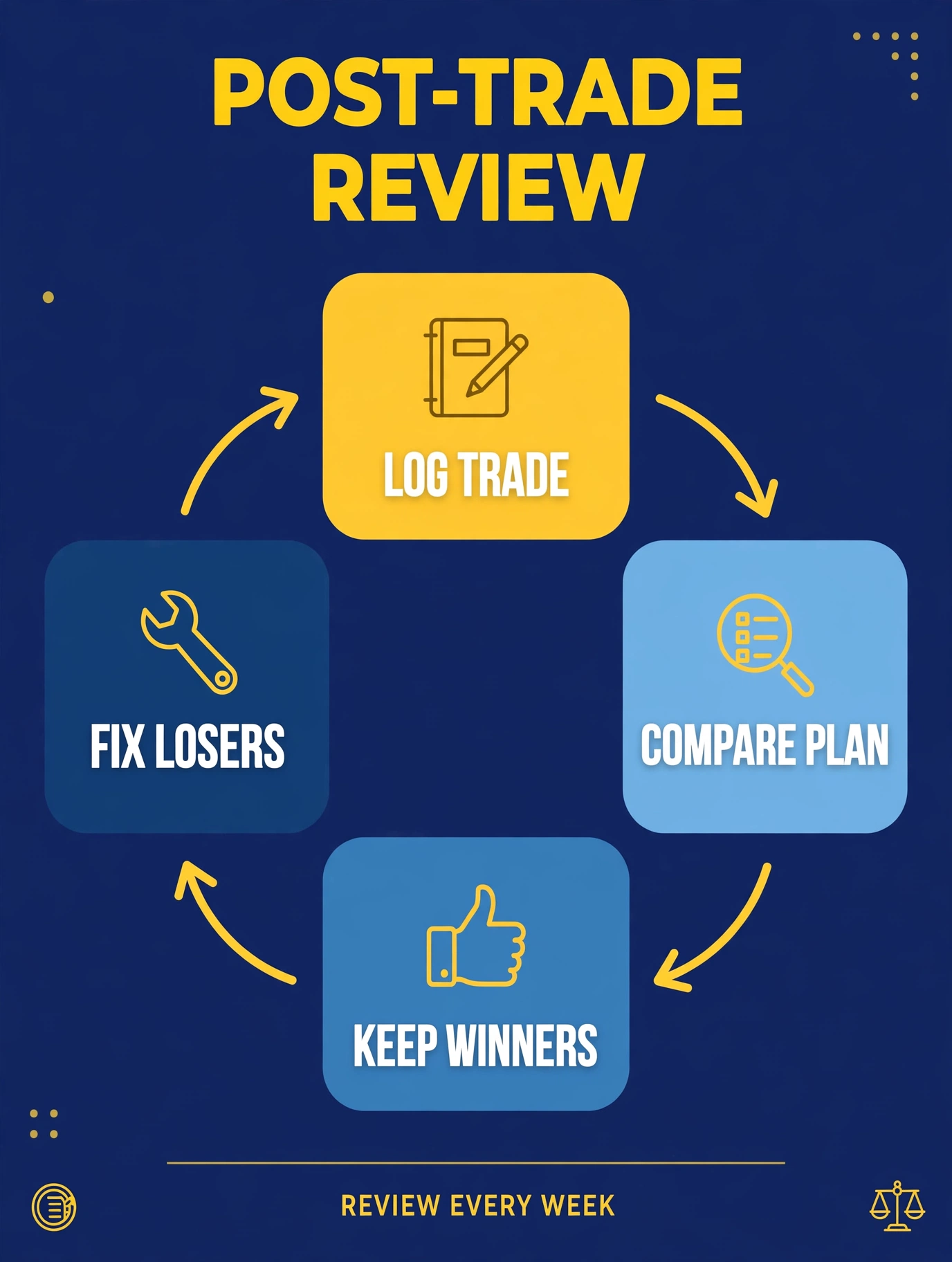
Every trade, win or lose, ends in the trade journal — your log of thesis, structure, entry, exit, and outcome. But logging is not reviewing. A post-trade review is the honest conversation you have with the log afterward: did I follow my plan? What did the market actually do? What would I repeat, and what would I change?
Review on a schedule, not when you feel like it. Weekly, pull up your closed trades and ask four questions. Did the outcome match the plan — and if not, was it the market's fault or mine? Did I follow the checklist, or skip a box? Which structures earned money this week and which leaked it? What is one rule I will add or change? Ten minutes a week turns a pile of trades into an education.
The goal is not to be right every time — even great traders win barely more than half their trades. The goal is a process that gets better: thesis sharper, structure matched tighter, checklist followed cleaner, sizes respected. Professionals are not people who never lose; they are people whose losses are planned ($300, not a surprise), whose reviews are scheduled, and whose rules get updated. The journal is the tuition receipt — the review is where you cash it in.
Key terms
- Thesis
- a plain-English statement of what you think will happen; the lock that every options structure must fit.
- Structure
- the options combination you trade (spread, calendar, straddle); the key chosen to fit the thesis.
- Risk-per-trade
- the maximum you allow yourself to lose on one idea; here, 1% of a $50,000 account, or $500.
- Max loss
- the most a trade can lose; in our example spread, the $300 debit.
- Max gain
- the most a trade can win; in our example spread, the $700 capped profit.
- Pre-trade checklist
- the short list run before every order: thesis, structure match, max loss, exit plan, events.
- Exit plan
- your take-profit and stop-out rules, decided before entry while thinking is clear.
- Paper trade
- a logged-but-never-placed trade; fake money, real lessons.
- Paper trading
- practicing in a broker's simulated account before risking real dollars.
- Trade journal
- your log of thesis, structure, entry, exit, and outcome for every trade.
- Post-trade review
- the scheduled, honest review of closed trades: did I follow the plan, and what changes?
- Volatility crush
- the post-event collapse in implied volatility (OD-103) that flattens long-premium trades.
What's next
With School 9 complete, BON-101 "Rental Property Analysis" opens the Bonds and Fixed Income school with the numbers behind rental property.
The quiz
Options Strategy Lab — Quiz
4 questions · pass with 3 correct
1.Why should you match the options structure to your thesis before trading?
2.Which pre-trade checklist check keeps your risk inside your budget?
3.What is paper trading?
4.What is the point of a post-trade review?
Recommended Tools
Hand-picked resources that fit this lesson — a short list, and only when they're genuinely useful.
- Learn more
TradingView
The charting platform used throughout this program — build watchlists and mark up price structure as you learn it here.
- Learn more
TraderSync
A trading journal that records every trade, so your review sessions run on real numbers instead of memory.
Some links above are affiliate links, which means The Prosper Academy may earn a commission at no extra cost to you.