
Volatility and Pricing
School 09 — Options and Derivatives
School 9 · Options and Derivatives · About 15 minutes
Option prices are really prices of expectations. A stock option is worth more when the market expects big swings and less when it expects calm — because the chance of a big move is exactly what the buyer is paying for. The word for expected swing size is volatility, and it is the single biggest input to an option's price. We will now teach you the difference between implied and realized volatility, the skew, the term structure, and what event risk does to prices.
Implied vs. Realized Volatility
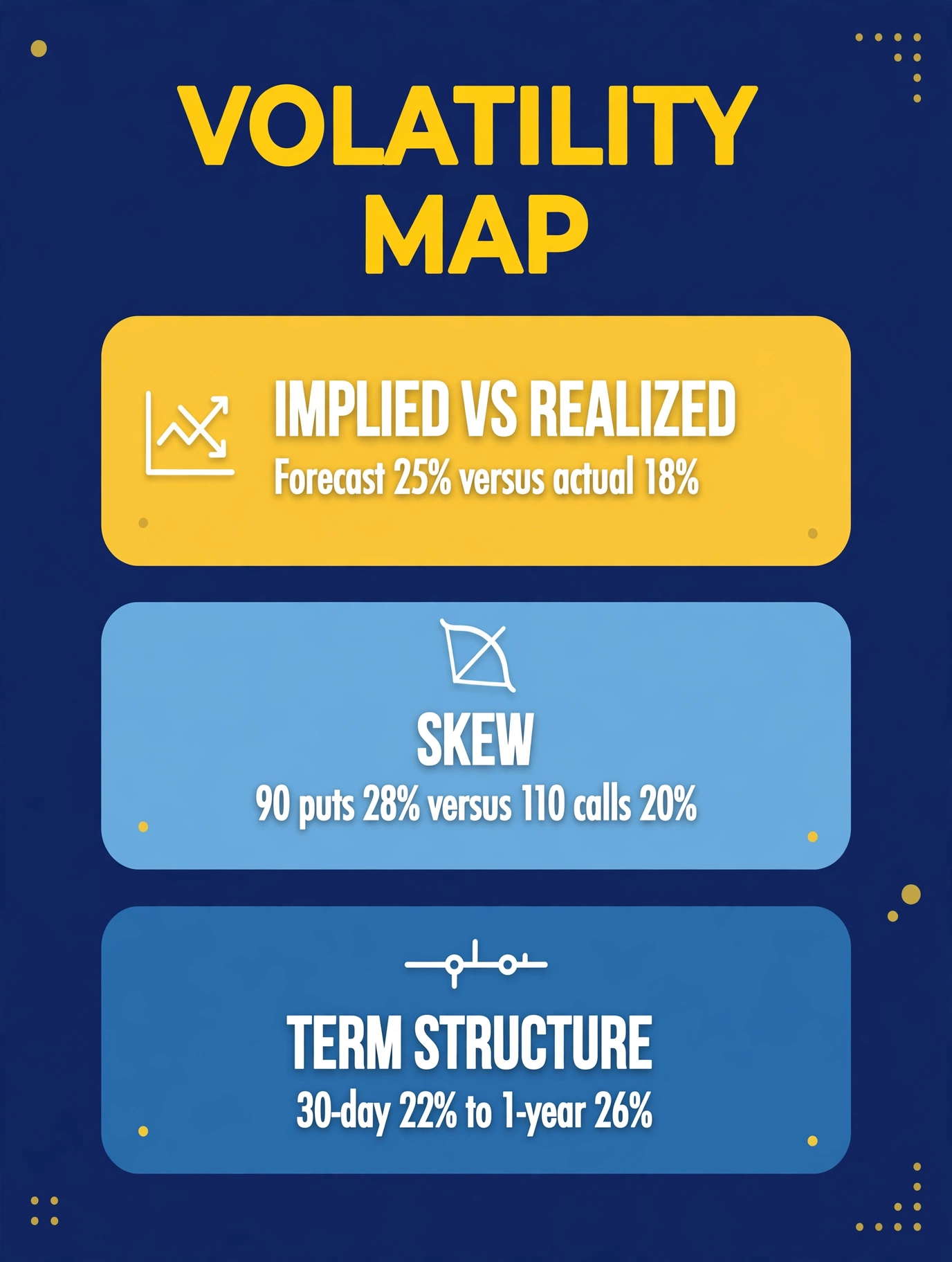
Realized volatility is what actually happened: how much the stock swung around in the past. Implied volatility (IV) is what the market expects to happen, read backward out of current option prices. If our $100 stock swung about 18% a year lately, realized volatility is 18%. But if its options are priced as though 25% swings are coming, implied volatility is 25% — the market is charging for more drama than history shows.
The gap between them is where money is made or lost. Option buyers want realized volatility to exceed implied: they paid for 25% but got 30% worth of movement, so their options gain. Option sellers want the reverse: they collected premium priced at 25% while the stock delivered a sleepy 18%, and they keep the difference. Neither side needs a market forecast — they need a volatility forecast. Before every options trade, ask: is this option cheap or expensive relative to what will likely happen?
Skew: Not All Strikes Are Priced Equally
If volatility were one number, every strike's options would carry the same implied volatility. They don't — and the pattern has a name: skew. On our $100 stock, the 90-strike puts might trade at 28% IV while the 110-strike calls trade at 20%. The market charges more for downside protection than upside participation, because crashes are sudden and rallies are gradual.
That tilt exists because of who is buying. Institutions buy downside puts as portfolio insurance and will pay up for it; nobody buys upside calls as insurance with the same desperation. The practical read: when puts are much pricier than equidistant calls, the market is nervous. Skew also warns buyers — that cheap-looking upside call is cheap because the market doubts the upside, not because you found a bargain.
Term Structure: Volatility Has a Calendar
Volatility also varies by expiration — the term structure. On our $100 stock, 30-day options might imply 22% while 1-year options imply 26%. Usually the curve slopes upward: more time means more chances for something wild, so longer-dated options carry higher implied volatility.
The curve inverts when trouble is near. If 30-day IV spikes above 1-year IV, the market is saying the storm is now, not later — think a looming election, a court ruling, or a central bank meeting. Reading the term structure is like reading a weather map across time: normal days slope gently up; inverted days mean take cover this month.
Event Risk: Earnings Week
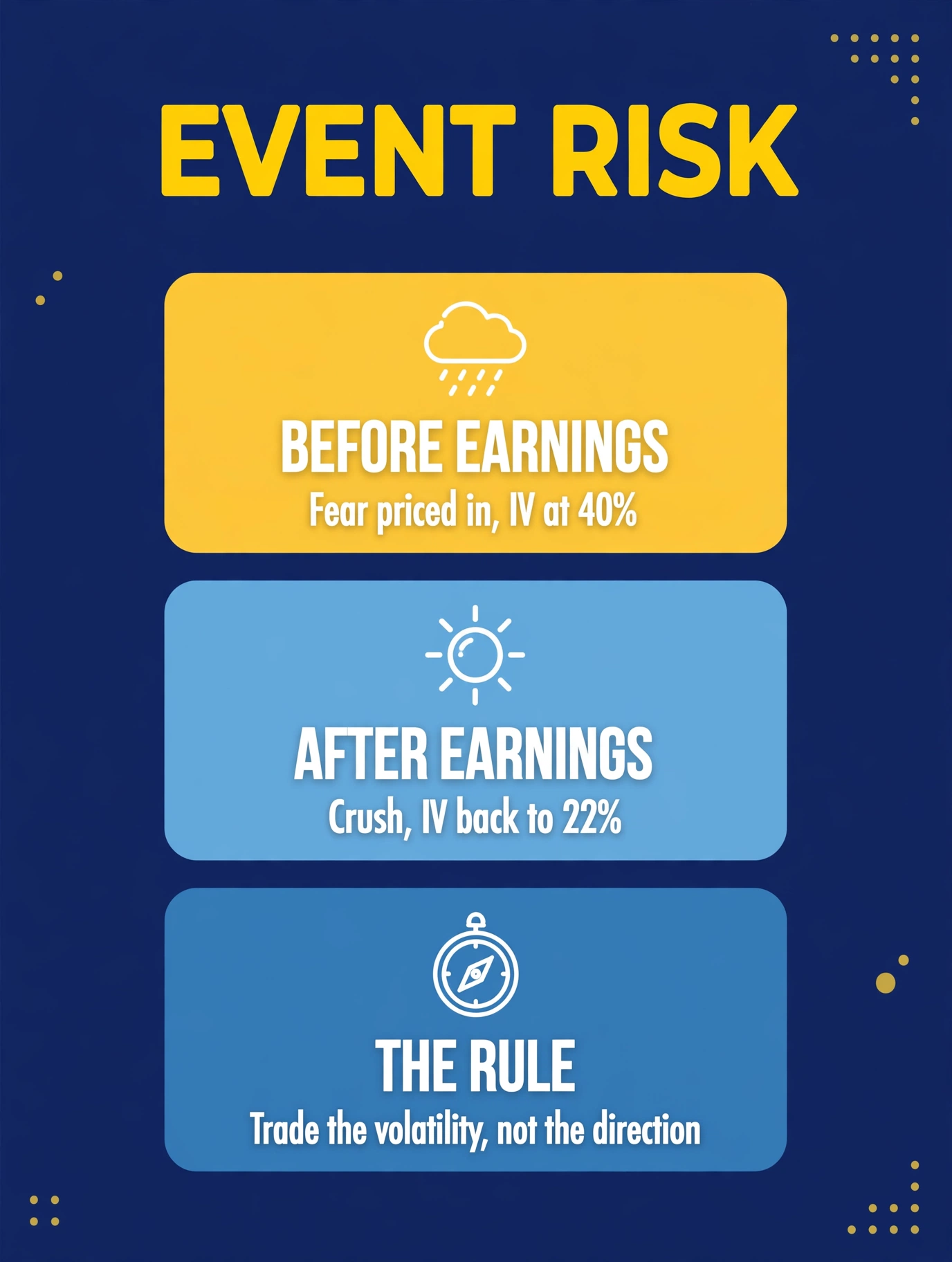
Event risk is volatility with a date on it. Our $100 stock reports earnings in two weeks, and the 30-day options imply 40% — far above the usual 22%. The market knows a 5–8% gap is possible overnight and prices it in before the announcement. This is why buying options right before earnings often disappoints: you are paying peak prices for the move everyone sees coming.
Then comes the volatility crush. The moment earnings are out — good or bad — the uncertainty is gone, and that 40% IV collapses back toward 22%. Option buyers can be right about the direction and still lose, because the post-announcement move was smaller than the priced-in one. Sellers love event weeks for exactly this reason: they sell the fear at 40% and buy it back at 22% after the news. If you trade around events, trade the volatility, not just the direction.
Key terms
- Volatility
- the size of a stock's price swings, usually quoted as an annualized percentage.
- Realized volatility
- how much the stock actually swung in the past.
- Implied volatility (IV)
- how much swing the market expects, read out of current option prices.
- Skew
- the pattern of different implied volatilities across strikes (downside puts usually pricier than upside calls).
- Term structure
- how implied volatility varies across expirations.
- Event risk
- a scheduled event (like earnings) that inflates near-term implied volatility.
- Volatility crush
- the collapse of implied volatility right after the scheduled event passes.
What's next
You understand what drives option prices; OD-104 "Covered Calls and Cash-Secured Puts" puts that knowledge to work in the two most popular income strategies — and their real costs.
The quiz
Volatility and Pricing — Quiz
3 questions · pass with 3 correct
1.What is the difference between implied and realized volatility?
2.On a $100 stock, 90-strike puts trade at 28% implied volatility while 110-strike calls trade at 20%. What does that tell you?
3.What is the volatility crush?
Recommended Tools
Hand-picked resources that fit this lesson — a short list, and only when they're genuinely useful.
- Learn more
TradingView
The charting platform used throughout this program — build watchlists and mark up price structure as you learn it here.
- Learn more
TraderSync
A trading journal that records every trade, so your review sessions run on real numbers instead of memory.
Some links above are affiliate links, which means The Prosper Academy may earn a commission at no extra cost to you.