
Covered Calls and Cash-Secured Puts
School 09 — Options and Derivatives
School 9 · Options and Derivatives · About 15 minutes
Most beginners meet options as lottery tickets. Professionals more often meet them as paychecks: selling options to collect premium from other people's hopes and fears. The two entry-level income strategies are the covered call and the cash-secured put. Both are calmer than buying options outright, but neither is free money — each trades away something real. We will now teach you the income intent, the opportunity cost, assignment, downside exposure, and the tax angle.
Income Intent: Renting Out What You Own
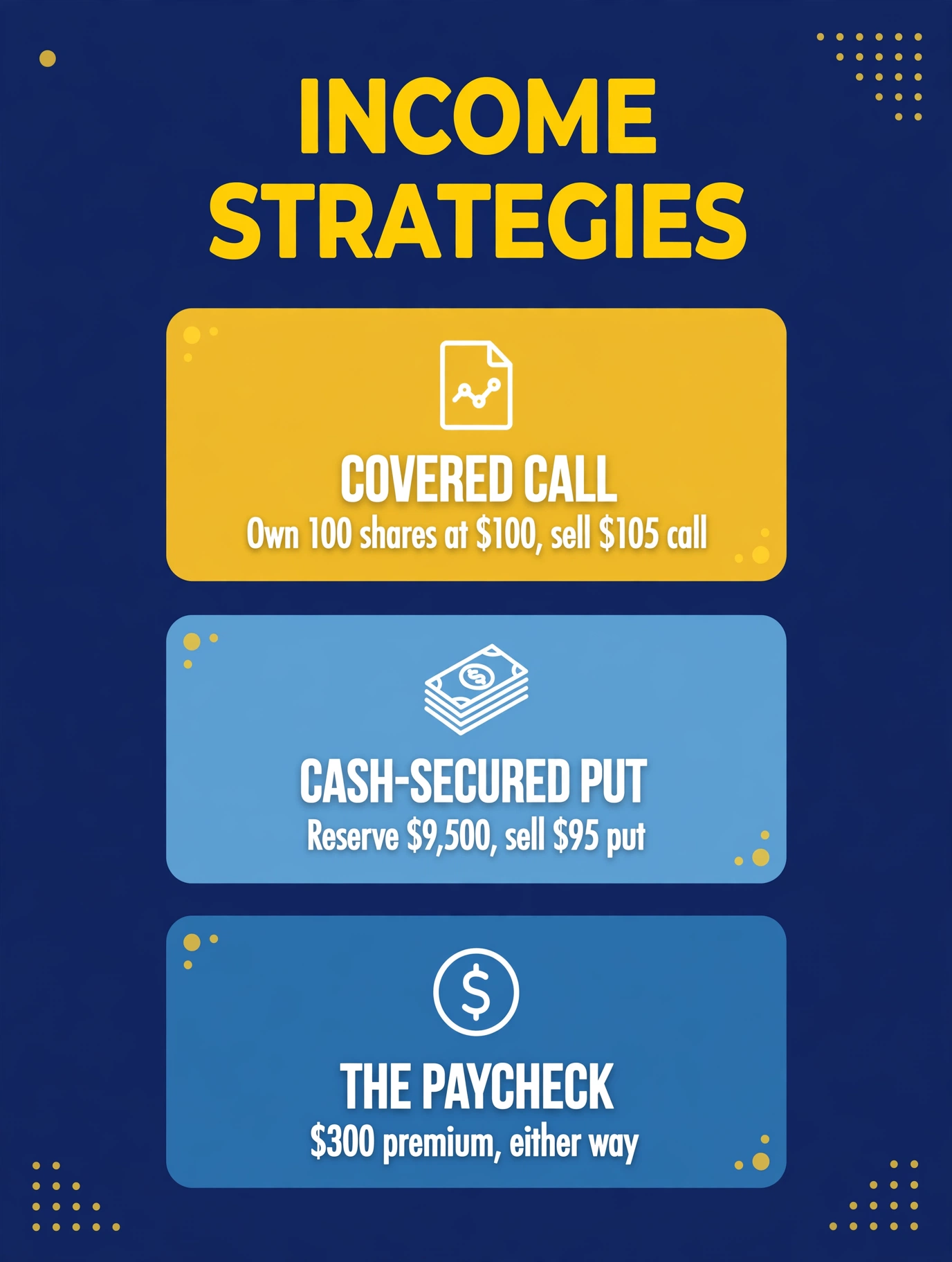
A covered call means you own 100 shares of a stock and sell a call against them. Example: you own 100 shares at $100 ($10,000 invested). You sell a $105-strike call expiring in 60 days and collect a $3 premium — $300 in your pocket today. If the stock stays below $105, the call expires worthless and you keep the $300 plus your shares. You have rented out your upside for income.
A cash-secured put is the mirror image for cash instead of shares. You sell a $95-strike put for a $3 premium ($300 income) and set aside $9,500 in cash — enough to buy the 100 shares if you must. If the stock stays above $95, the put expires and you keep the $300. If it falls below, you buy the stock at $95 with the cash you reserved — which is buying a dip you were happy to buy anyway. Both strategies share one intent: steady income from premium, not home runs.
Opportunity Cost and Assignment
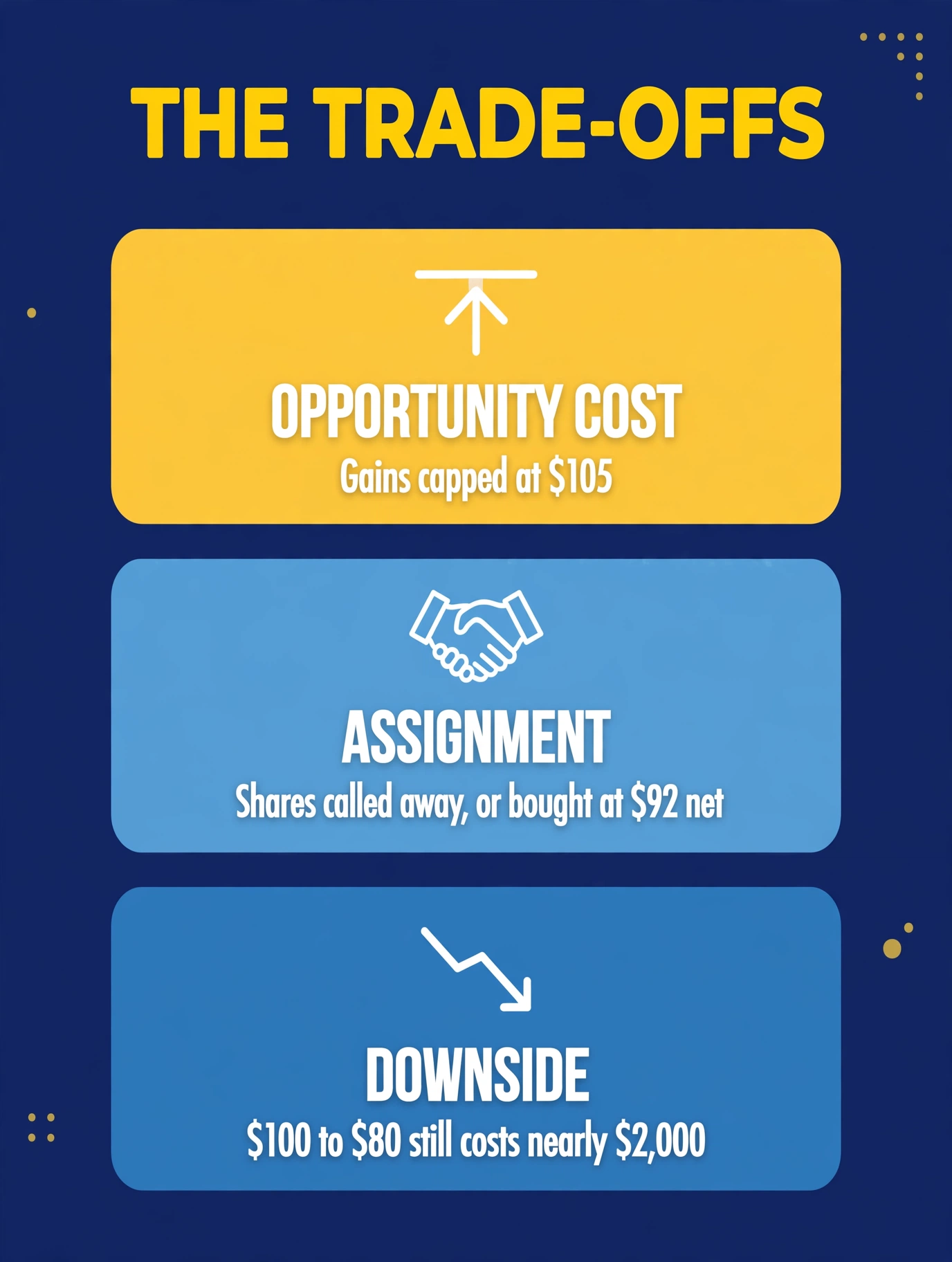
The covered call's price is opportunity cost — what you give up. Our $105-strike call caps your gain: if the stock rockets to $130, your shares get called away at $105 and you miss the extra $25 per share. You still profit ($5 of stock gain plus the $3 premium), but you sold the dream for $300. Covered calls shine in flat or gently rising markets and sting in roaring ones. Never sell a covered call on a stock you would be heartbroken to sell — because you might have to.
That "might have to" is assignment: the option buyer exercises, and you are on the other side. On our covered call, assignment means your 100 shares are sold at $105 — the broker handles it overnight and you wake up with cash instead of shares. On our cash-secured put, assignment means you wake up owning 100 shares at $95, bought with your reserved cash — your effective price is $92 after the $3 premium you kept. Assignment is not a disaster; it is the deal working as designed. But it is only fine if you wanted the outcome before it happened.
Downside Exposure and Taxes
Here is the honest part: neither strategy protects you much on the way down. Our covered-call seller still owns the stock — if it falls from $100 to $80, the $300 of premium softens a $2,000 loss, nothing more. The cash-secured-put seller who gets assigned at $95 owns a stock that may keep falling. Selling premium collects rent; it does not buy insurance. Size these positions so a bad outcome is an annoyance, not a crisis.
Then the taxman. Option premiums are generally taxed as short-term capital gains — taxed at your ordinary income rate, not the lower long-term rate — and the clock is short: most of these trades open and close within months. Covered-call assignment can also complicate the holding period of your shares, and frequent selling can turn a long-term stock gain into a short-term one in some cases. The rules have nuances, so check with a tax professional before you scale up. The lesson stands regardless: income strategies pay you now and bill you at tax time.
Key terms
- Covered call
- owning 100 shares and selling a call against them to collect premium income.
- Cash-secured put
- selling a put while holding enough cash to buy the shares if assigned.
- Income intent
- using options to collect steady premium rather than chase big directional wins.
- Opportunity cost
- what you give up: the covered call caps your upside if the stock soars.
- Assignment
- the option buyer exercises, forcing the seller to honor the contract (sell shares on a call, buy shares on a put).
- Downside exposure
- the losses you still face when the stock falls despite the premium collected.
- Short-term capital gains
- profits on assets held a year or less, taxed at ordinary income rates; how most option premium is taxed.
What's next
You can collect income and name its costs; OD-105 "Vertical Spreads" builds your first defined-risk structures — debit and credit spreads with capped gains and losses.
The quiz
Covered Calls and Cash-Secured Puts — Quiz
4 questions · pass with 4 correct
1.You own 100 shares at $100 and sell a $105-strike call for $3. What is the trade-off?
2.You sell a $95-strike cash-secured put. How much cash must you set aside?
3.The stock falls below $95 and your cash-secured put is assigned. What happens?
4.How is the premium you collect from selling options generally taxed?
Recommended Tools
Hand-picked resources that fit this lesson — a short list, and only when they're genuinely useful.
- Learn more
TradingView
The charting platform used throughout this program — build watchlists and mark up price structure as you learn it here.
- Learn more
TraderSync
A trading journal that records every trade, so your review sessions run on real numbers instead of memory.
Some links above are affiliate links, which means The Prosper Academy may earn a commission at no extra cost to you.