
Vertical Spreads
School 09 — Options and Derivatives
School 9 · Options and Derivatives · About 15 minutes
Buying a lone option is like buying a sports car with no brakes: thrilling, expensive, and the downside is the whole premium. A vertical spread adds the brakes. You buy one option and simultaneously sell another option of the same type, same expiration, at a different strike. The sold option pays for part of the bought one — and caps both your gain and your loss. The result is a trade with known boundaries before you ever enter. We will now teach you debit and credit spreads, max gain and loss, breakeven, and managing expiration.
Debit Spreads: Paying for Direction
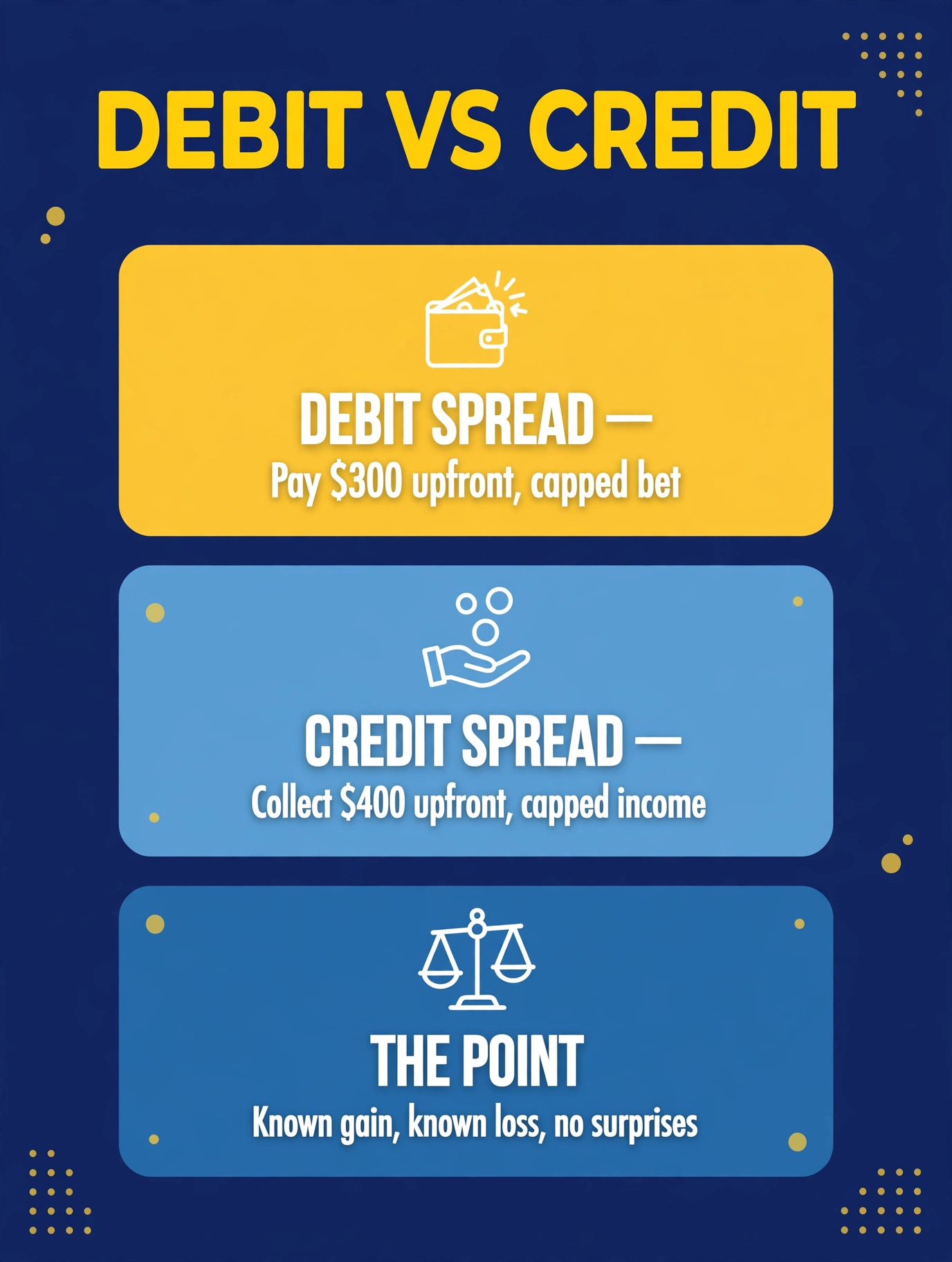
A debit spread costs money upfront — you pay a net debit. The classic is the bull call spread: our $100 stock, you buy the $100-strike call for $5 and sell the $110-strike call for $2. Net cost: $3 per share, or $300 for the contract. You are betting the stock rises, but you have sold off the gains above $110 to cut your entry price from $5 to $3.
Why accept a capped gain? Because the math gets friendlier. A lone $100-strike call needs the stock above $105 just to break even; the spread only needs $103. You risk less ($300 instead of $500), you need less movement to profit, and time decay hurts less because the option you sold also decays in your favor. Debit spreads are the beginner's directional trade: defined risk, lower cost, honest ceiling.
Credit Spreads: Getting Paid Upfront
A credit spread pays you upfront — you collect a net credit. The classic is the bear put spread: our $100 stock, you sell the $105-strike put for $6 and buy the $95-strike put for $2. Net credit: $4 per share, or $400 in your pocket today. You are betting the stock stays flat or falls, and the most you can ever make is that $400.
The bought $95 put is your safety net: it caps your loss if the stock crashes. Credit spreads are the cousin of the cash-secured put from OD-104, but with training wheels — the worst case is bounded no matter what. The trade-off mirrors the covered call's: you collect income, but a strong move against you (here, a rally above $105) leaves the full credit as your only profit while the position itself goes to zero. Know which outcome you are being paid for, and whether you believe it.
Max Gain, Max Loss, and Breakeven
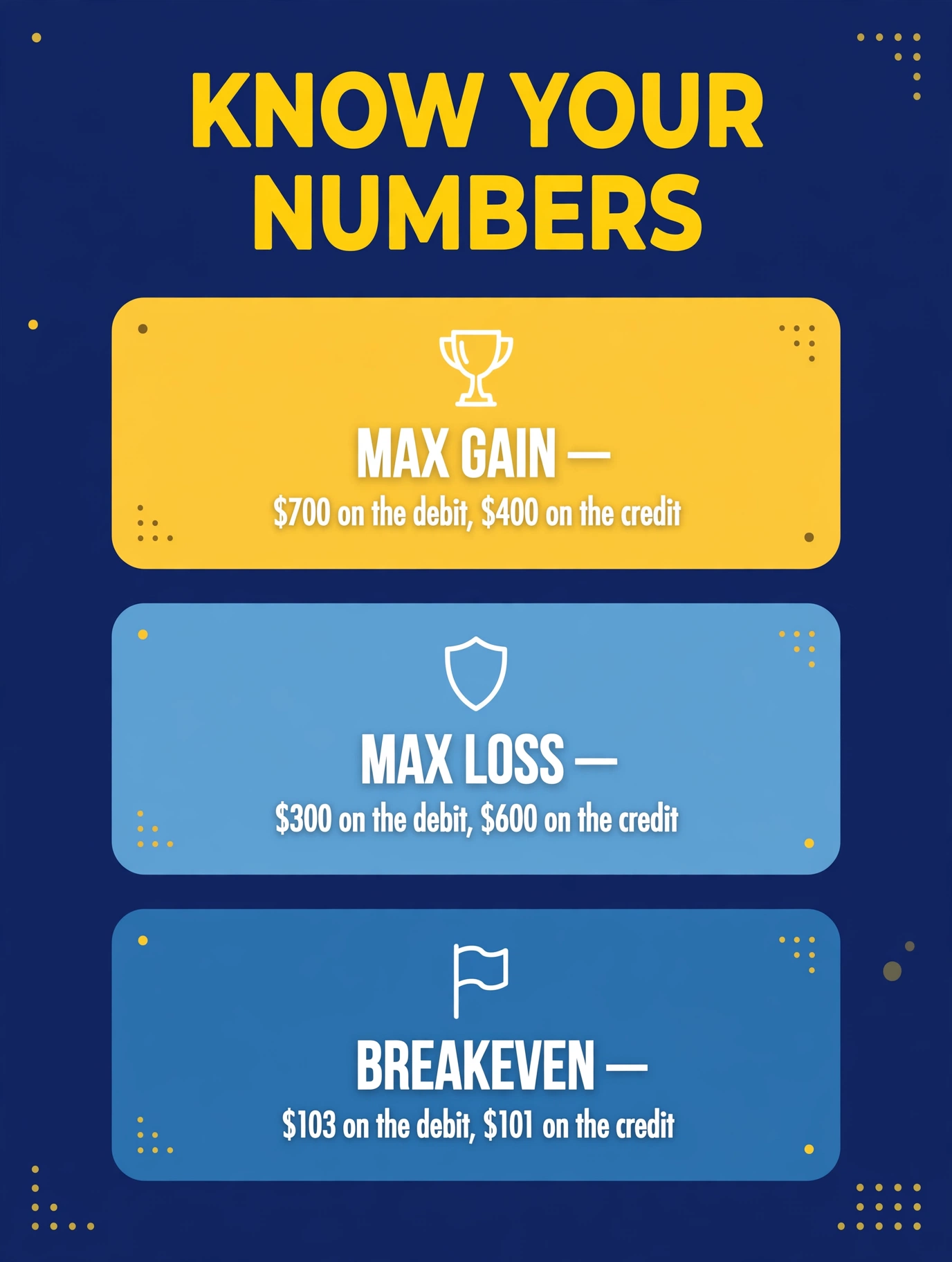
Every vertical spread has three numbers you can compute before entering. For our bull call debit spread ($3 cost, strikes $100 and $110): the max gain is the strike width minus the debit — ($110 − $100) − $3 = $7 per share, or $700, reached if the stock is at or above $110 at expiration. The max loss is simply the debit: $300, if the stock is at or below $100. The breakeven is the bought strike plus the debit: $100 + $3 = $103.
For our bear put credit spread ($4 credit, strikes $105 and $95): the max gain is the credit itself — $400, kept if the stock is at or below $95 at expiration. The max loss is the strike width minus the credit — ($105 − $95) − $4 = $6 per share, or $600, if the stock is at or above $105. The breakeven is the sold strike minus the credit: $105 − $4 = $101. Three numbers, no surprises — that certainty is the entire point of the structure.
Expiration Management: Don't Wing the Ending
Spreads have a clean ending only if you manage it. The textbook says hold to expiration for max gain — and the textbook ignores pin risk and gap risk. If our stock closes at $109.90 on expiration day, the $110-strike short call's fate hangs on pennies, and an after-hours headline can flip it. Professionals rarely hold short options into the final day for the last few dollars.
The working rule: decide your exit before you enter. Many traders close debit spreads at 50–70% of max gain (our $700 max → exit near $350–$490 of profit) and close credit spreads when most of the credit is captured. If expiration is a week out and the position is a small winner or small loser, closing early turns uncertainty into a known result. A spread held with a plan beats a spread held with hope.
Key terms
- Vertical spread
- buying one option and selling another of the same type and expiration at a different strike.
- Debit spread
- a spread you pay for upfront (net debit); e.g. the bull call spread.
- Credit spread
- a spread that pays you upfront (net credit); e.g. the bear put spread.
- Bull call spread
- buy a lower-strike call, sell a higher-strike call; profits if the stock rises, capped.
- Bear put spread
- sell a higher-strike put, buy a lower-strike put; profits if the stock falls or stalls, capped.
- Max gain
- the most the spread can make (strike width minus debit; or the credit collected).
- Max loss
- the most the spread can lose (the debit paid; or strike width minus credit).
- Breakeven
- the stock price at expiration where the spread neither gains nor loses.
What's next
You can build capped-risk direction trades; OD-106 "Calendars and Diagonals" trades time instead of direction — spreads across expirations and their path-dependent quirks.
The quiz
Vertical Spreads — Quiz
3 questions · pass with 3 correct
1.What is the maximum loss on the bull call spread that cost a $3 debit ($300)?
2.What is the breakeven of the bear put credit spread (sold $105 put, bought $95 put, $4 credit)?
3.Why do many traders close vertical spreads before the final day of expiration?
Recommended Tools
Hand-picked resources that fit this lesson — a short list, and only when they're genuinely useful.
- Learn more
TradingView
The charting platform used throughout this program — build watchlists and mark up price structure as you learn it here.
- Learn more
TraderSync
A trading journal that records every trade, so your review sessions run on real numbers instead of memory.
Some links above are affiliate links, which means The Prosper Academy may earn a commission at no extra cost to you.