
Calendars and Diagonals
School 09 — Options and Derivatives
School 9 · Options and Derivatives · About 15 minutes
Vertical spreads trade across strikes. Calendar spreads trade across time: you sell a near-term option and buy a longer-term option at the same strike. Instead of betting on direction, you are betting on the calendar itself — that time will melt the option you sold faster than the one you own. Add a different strike to the long leg and you get a diagonal spread, which blends a time bet with a directional lean. We will now teach you time spreads, their volatility exposure, rolling, and path dependency.
Time Spreads: Selling Fast Time, Owning Slow Time
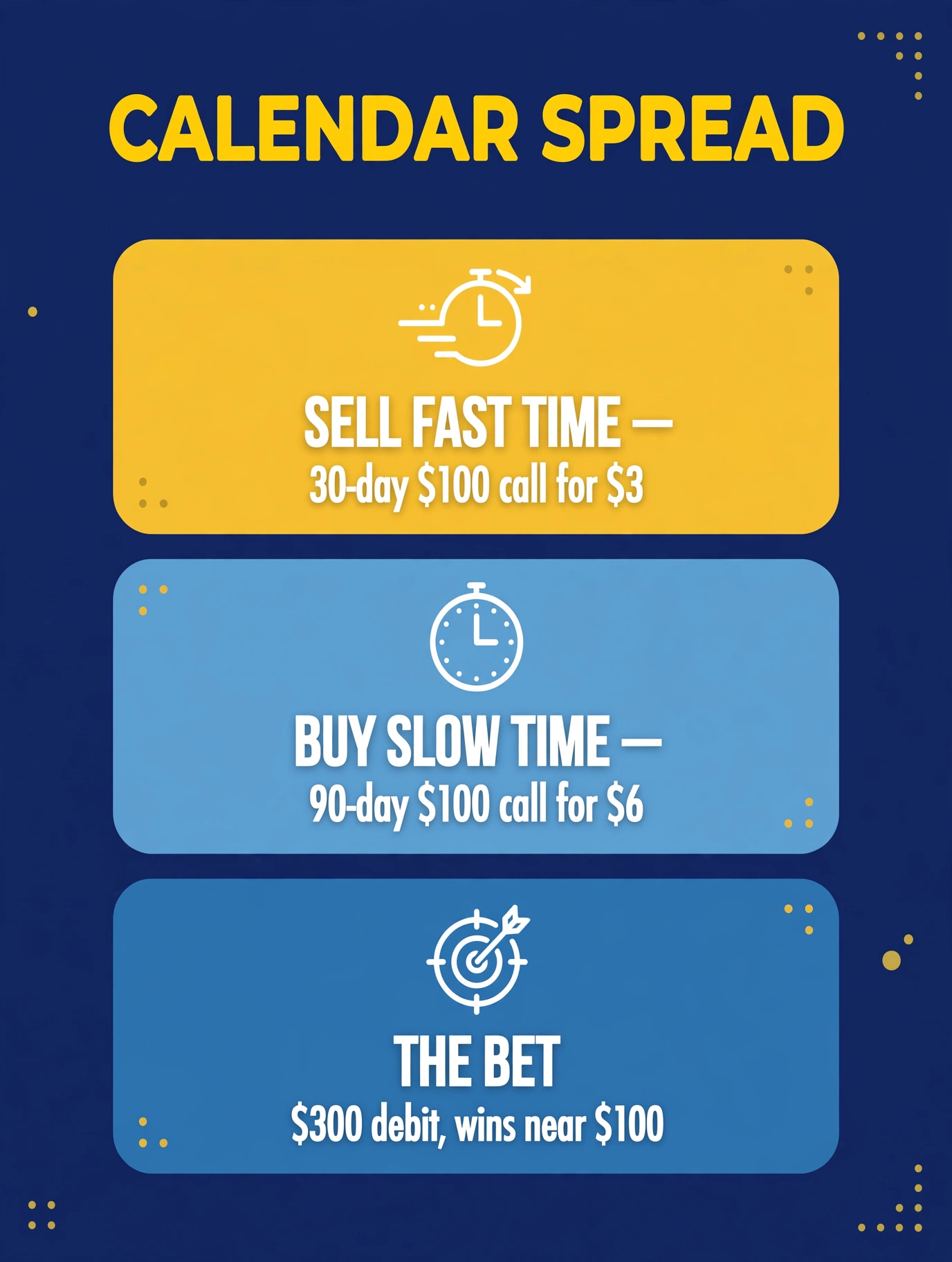
A calendar spread (also called a time spread) sells an option that expires soon and buys the same-strike option expiring later. Example on our $100 stock: sell the 30-day $100-strike call for $3, buy the 90-day $100-strike call for $6. Net debit: $3 per share, or $300. Both options share the strike; only the clocks differ.
The trade wins when the stock sits near $100 at the 30-day expiration. Why? The short 30-day call melts to nearly zero (theta hits short-dated options hardest — remember OD-102), while the 90-day call you own still carries 60 days of time value. Your best outcome is a stock that goes nowhere fast, then moves later. The max loss is the $300 debit — if the stock rockets to $130 or crashes to $70, both options move together and the spread collapses. Calendars are the market-neutral trade for the patient: you profit from stillness, not motion.
Volatility Exposure: The Hidden Engine
Calendars are secretly volatility trades. Remember vega from OD-102: longer-dated options have more vega than short-dated ones. Our 90-day call might have a vega of 0.45 while the 30-day call's is 0.20 — so the spread is net long volatility. If implied volatility rises across the board, the long leg gains more than the short leg loses, and the calendar profits even if the stock never moves.
That cuts both ways. A volatility crush (OD-103) after earnings can flatten a calendar: the long leg's extra time value evaporates faster than the short leg's. So before entering a calendar, check two things: is implied volatility low or falling (good for buyers of time), and is there an event between now and the short expiration that could crush it (bad)? Calendars want calm, cheap volatility and a boring stock — excitement is the enemy.
Rolling: Extending the Trade
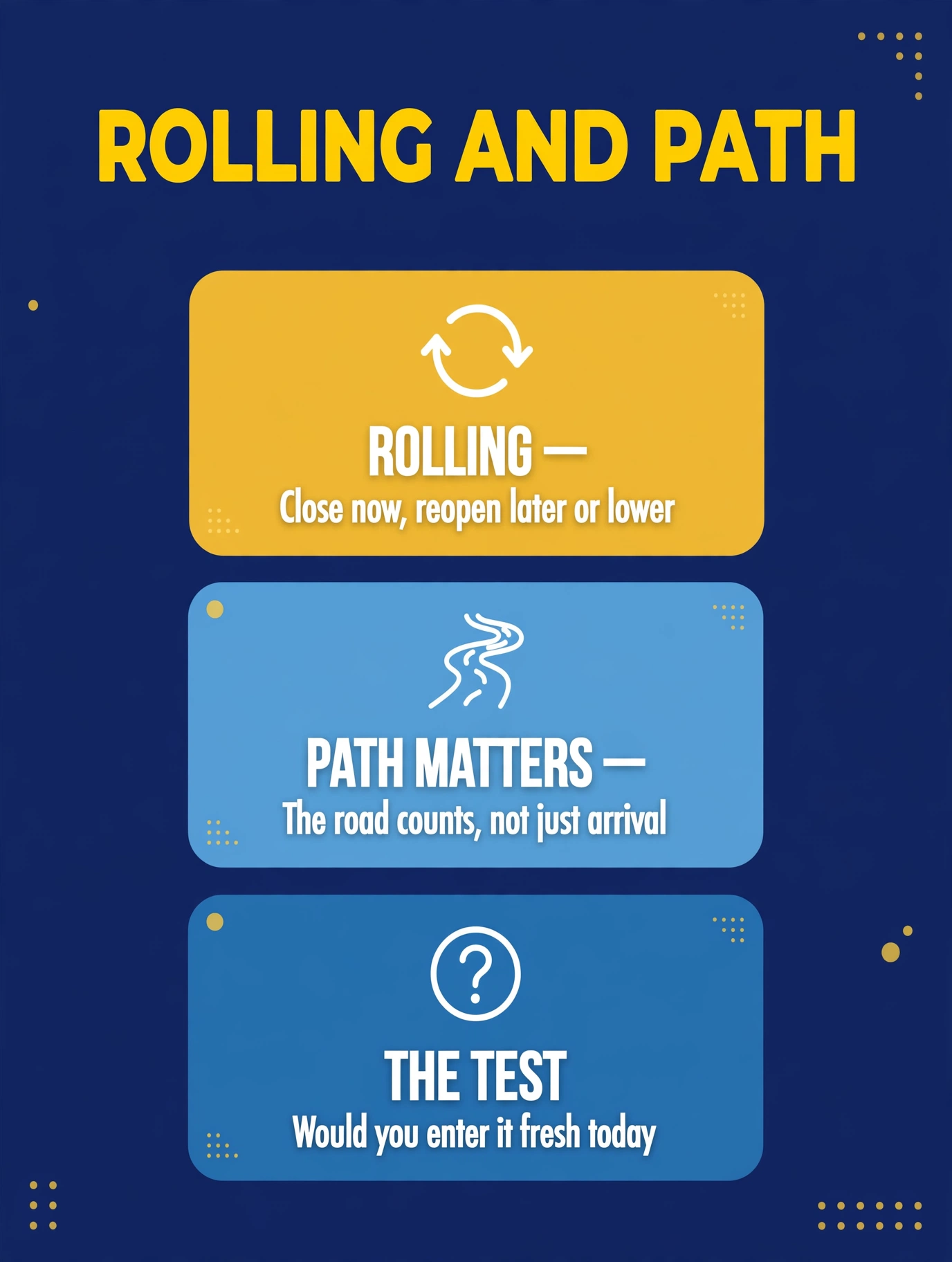
Rolling means closing your current option position and opening a similar one further out in time (and optionally at a different strike). It is how traders refuse to accept a deadline. Suppose our calendar's stock drifted to $104 with a week left on the short call — the trade is off-plan. Instead of taking the loss, you could roll: buy back the 30-day $100 call and sell a new 60-day $105 call against your 90-day long call, collecting fresh premium and re-centering the trade.
Rolling is not free money — it is a new trade with its own debit, credit, and outlook. The honest question before any roll is: would I enter this position fresh today? If yes, roll. If you are rolling just to avoid admitting the loss, you are paying good money to postpone a decision. Professionals roll to adjust a thesis; amateurs roll to hide from one.
Path Dependency: The Road Matters
Here is the quirk that separates calendars from verticals: path dependency. A bull call spread only cares where the stock ends up at expiration. A calendar cares how it got there. If our $100 stock spikes to $120 in week one and drifts back to $100 by the 30-day expiration, the calendar still ends near its best case — but along the way, the position showed a scary loss when the stock was at $120. The road, not just the destination, determined your stress and your margin calls.
Diagonal spreads lean into this deliberately. A diagonal changes the long leg's strike too: sell the 30-day $100 call, buy the 90-day $110 call. Now you have a time spread plus a bullish tilt — it profits from stillness near $100 early, but also gains if the stock grinds upward toward $110 over the 90 days. The diagonal is the calendar's worldly cousin: part clock trade, part direction trade. Master the calendar first, then let the diagonal add the lean.
Key terms
- Calendar spread (time spread)
- sell a near-term option, buy a longer-term option at the same strike; profits from time decay and stillness.
- Diagonal spread
- a calendar with a different strike on the long leg, blending a time bet with a directional lean.
- Volatility exposure
- calendars are net long vega: they gain when implied volatility rises, suffer in a volatility crush.
- Rolling
- closing a current option and opening a similar one further out (or at a new strike) to extend or adjust the trade.
- Path dependency
- the outcome depends on the stock's route, not just its final price; the road matters as much as the destination.
What's next
Time spreads complete your foundation; OD-107 "Protective Puts and Collars" turns options into insurance — hedging what you own instead of betting on what might happen.
The quiz
Calendars and Diagonals — Quiz
4 questions · pass with 4 correct
1.When does the calendar spread (short 30-day $100 call, long 90-day $100 call) reach its best outcome?
2.What is the maximum loss on the $300-debit calendar spread?
3.What does rolling an option position mean?
4.How does a diagonal spread differ from a plain calendar spread?
Recommended Tools
Hand-picked resources that fit this lesson — a short list, and only when they're genuinely useful.
- Learn more
TradingView
The charting platform used throughout this program — build watchlists and mark up price structure as you learn it here.
- Learn more
TraderSync
A trading journal that records every trade, so your review sessions run on real numbers instead of memory.
Some links above are affiliate links, which means The Prosper Academy may earn a commission at no extra cost to you.