
Protective Puts and Collars
School 09 — Options and Derivatives
School 9 · Options and Derivatives · About 15 minutes
You have learned what options are, what puts and calls do, and how their prices behave. Now comes the reason most everyday investors ever touch an option: protection. A protective put is insurance for stock you already own — it sets a floor under how far your position can fall. A collar goes one step further: it pays for that insurance by giving up some of your upside. We will now teach you about hedging objectives, the cost of protection, strike and duration choices, collars, and basis risk.
Hedging Objectives: Decide What "Protected" Means First
A hedge is not a trade — it is a decision about what you refuse to lose. Before you buy any protection, answer three questions in plain words.
First: what are you protecting? One stock you love? Your whole portfolio? A specific dollar amount you cannot afford to lose? Second: how much loss is unacceptable? A 5% dip you can shrug off — but a 25% crash would wreck your plans. Third: how long do you need the protection? A nervous month around an election, or the whole scary year ahead?
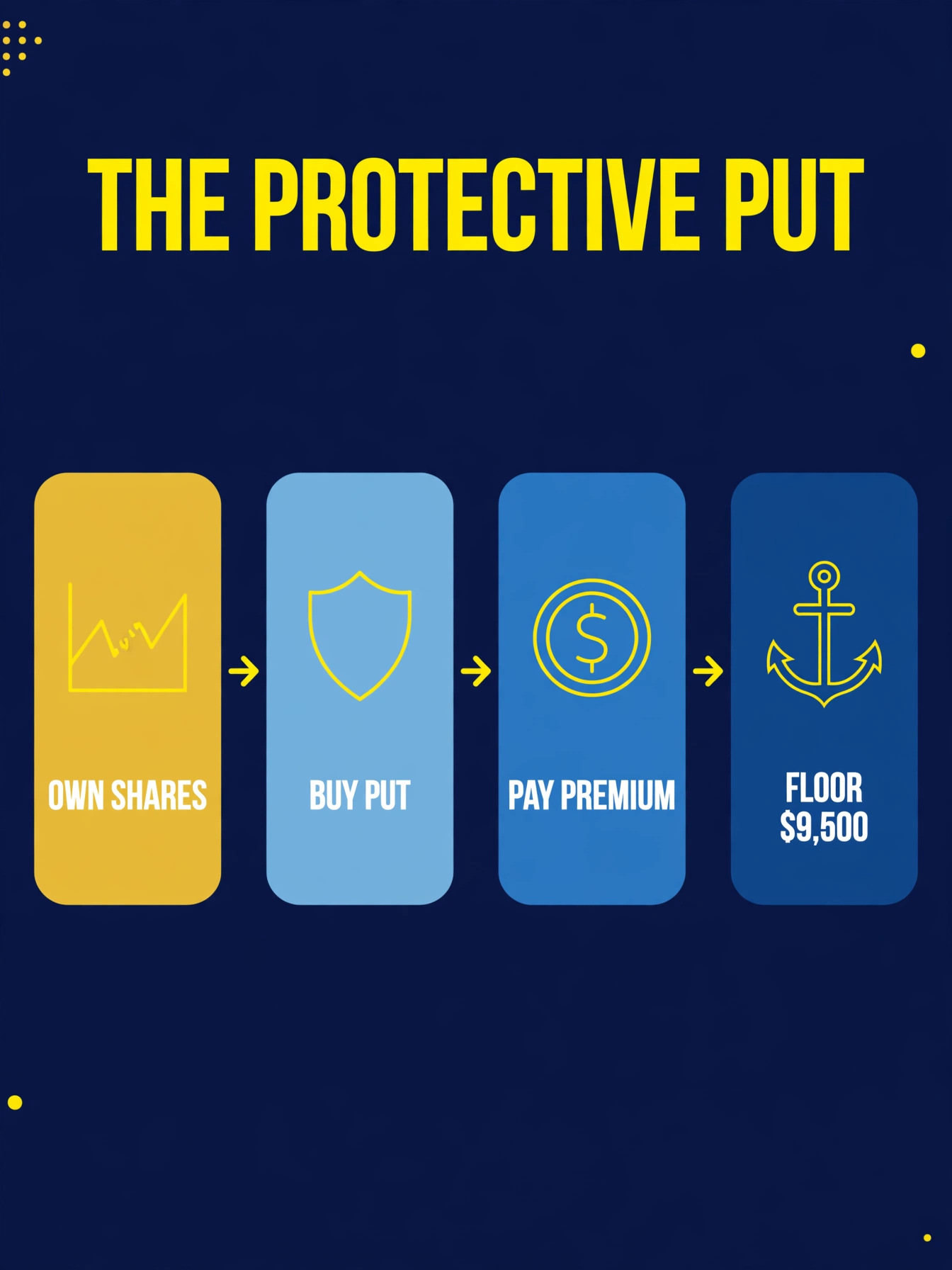
Think of it like homeowner's insurance. You do not buy fire insurance because you want a payout — you buy it so a fire cannot wipe you out. Here is the investing version: you own 100 shares of a stock at $100 each, a $10,000 position. You buy a put option with a $95 strike. That put is your insurance policy: if the stock falls below $95, the put lets you sell your shares at $95 anyway. Your position cannot be worth less than $9,500 (before the cost of the put itself, which we will cover next).
A hedging objective is simply that decision written down: "I own $10,000 of this stock, and I refuse to lose more than about 8% over the next six months." Write it before you spend a dollar. Without it, you are not hedging — you are just buying options and hoping.
The Cost of Protection: Insurance Is Never Free
Protection has a price, and it is called the premium — the amount you pay for the option. In our example, the $95 put costs $3 per share. One option contract covers 100 shares, so the premium is $300. That is the cost of your insurance.
Now the full worst case: if the stock crashes, you sell at $95 for $9,500, minus the $300 premium you paid. Your worst-case value is $9,200. Your maximum loss is $10,000 − $9,200 = $800, about 8% of your position. The floor held — exactly as planned.
Two honest truths about the cost. First: if the stock goes up, the $300 is gone — spent, like a fire-insurance premium in a year with no fire. You do not get it back. Second: protection is most expensive exactly when you want it most. In scary, volatile markets, everyone wants puts, and put prices soar. Buying puts every month forever is a slow leak on your returns. Hedge deliberately — for a reason, and for a season — not as a permanent habit.
Choosing Your Strike and Duration
Every protective put asks you to make two choices, and both cost money.
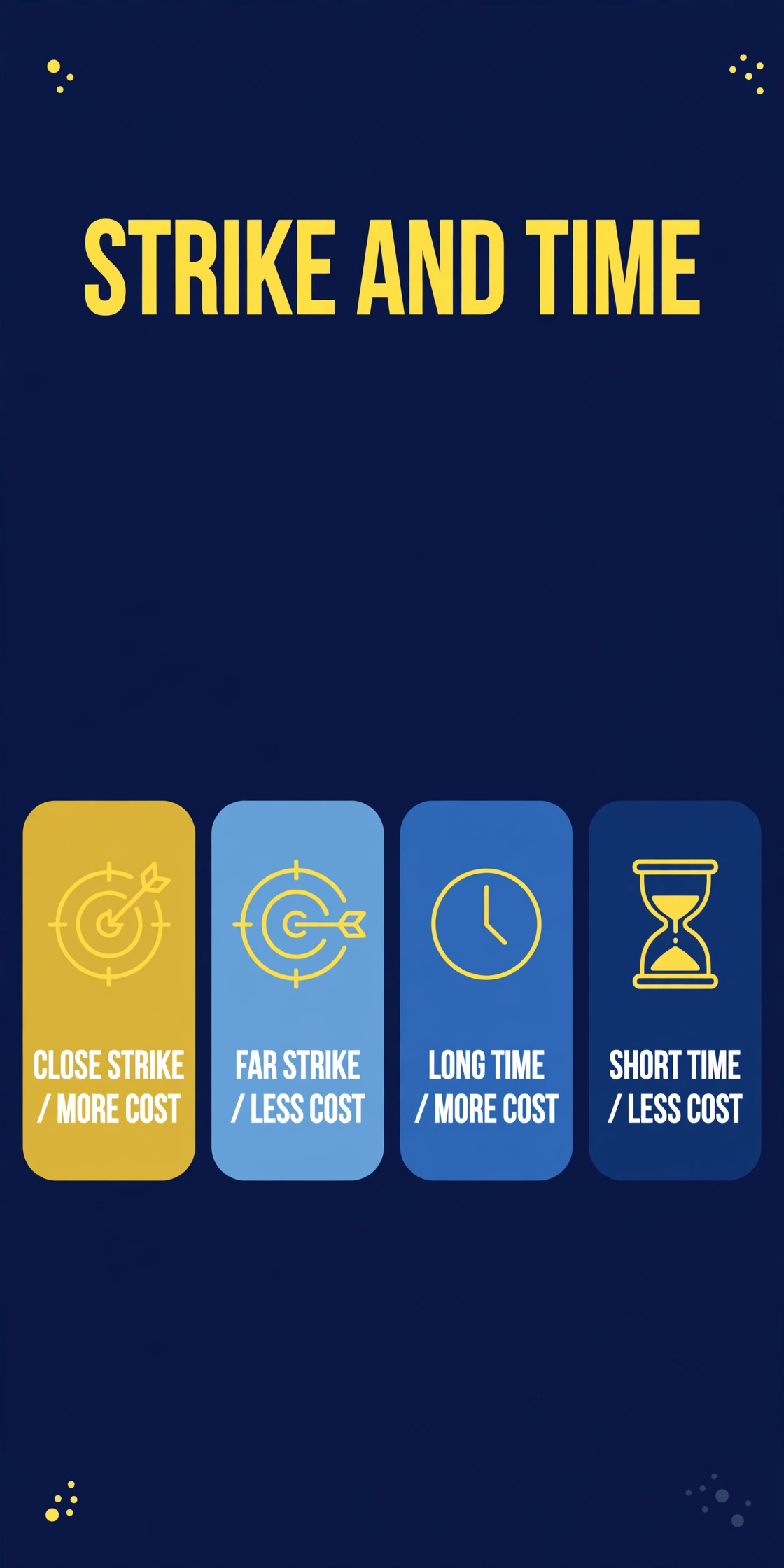
The strike is where your protection kicks in. A strike close to the current price — say $98 on a $100 stock — means protection starts almost immediately, so it costs more. A strike far below the price — say $90 — means you absorb the first $10 of the fall yourself, so it costs less. Choose by your objective: "I cannot stomach more than a 5% drop" points to a closer strike; "I only fear a real crash" points to a farther, cheaper one.
Duration is how long the protection lasts. Longer time costs more, because more time means more chances for something bad to happen. Match the duration to the actual worry: hedging one earnings report? Buy a put that expires after the announcement. Nervous about the next year? Buy a longer-dated put. Do not buy three years of insurance for a three-month worry — you will overpay for protection you never needed.
The rule of thumb: the strike sets where protection starts, the duration sets how long it lasts, and both choices move the price. Cheaper is not better — cheaper just means less protection.
Collars: A Floor Below, a Cap Above
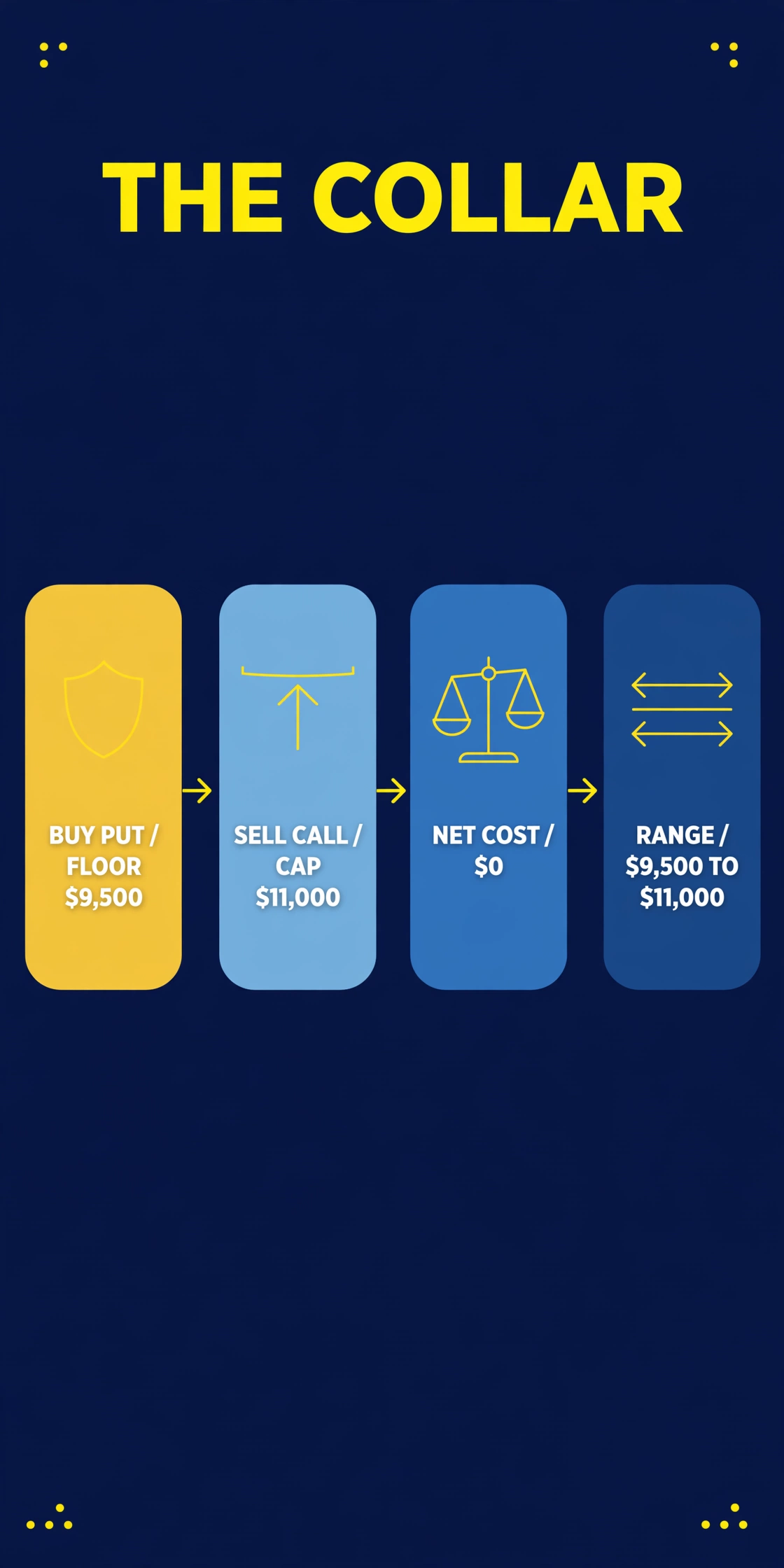
What if the put you want feels too expensive? There is a classic answer: the collar. You keep your 100 shares, buy the protective put — and then sell a call option above the current price to help pay for it.
Selling a call means you give someone else the right to buy your shares at the call's strike. Say you sell a call with a $110 strike and collect $300 for it. That $300 exactly offsets the $300 you paid for the $95 put. Your net cost is $0 — traders call this a zero-cost collar.
The trade you made: your floor is $9,500 (the put protects you below $95), and your cap is $11,000 (if the stock rockets past $110, your shares get called away at $110 — you keep the gains up to there, but not beyond). Free protection, in exchange for giving up the moonshot.
Collars fit a specific mindset: "I want to hold this stock, I do not want to ride it down, and I am fine missing the rocket." If you believe the stock could double, a collar is the wrong tool — that sold call will haunt you. Match the strategy to the objective, always.
Basis Risk: When the Hedge Doesn't Quite Fit
Sometimes you cannot buy a put on exactly what you own. Maybe your stock has no options traded on it, or the options are too thin and pricey. So you hedge with something similar instead — and that mismatch has a name: basis risk.
Here is how it bites. You own $50,000 of small-company stocks. No good puts exist on them, so you buy puts on the S&P 500 index instead. Then small caps fall 10% — you lose $5,000. But the S&P 500 only falls 4%, so your puts pay out as if the drop were 4%. Your hedge covered less than half your actual loss. The hedge and the holding moved differently, and the gap landed on you.
The rule: the best hedge matches exactly what you own — puts on your stock, not its cousin. Every step away (an index instead of your stock, a similar sector instead of your company) adds basis risk. Before you hedge, ask one question: "When my thing falls, does my hedge actually fall with it?" If the answer is "sort of," you are paying for an umbrella that only covers half your head.
Key terms
- Protective put
- a put option bought on stock you already own; sets a floor under how far the position can fall.
- Premium
- the price you pay for an option; the cost of the insurance.
- Strike price
- the price at which an option lets you buy or sell; in a hedge, it is where protection kicks in.
- Duration
- how long until the option expires; longer protection costs more.
- Hedging objective
- a plain written statement of what you are protecting and how much loss is unacceptable.
- Collar
- owning shares, buying a protective put below, and selling a call above; a floor under you and a cap over you.
- Covered call
- selling a call option on stock you own; it is the "sell" half of a collar and caps your upside.
- Zero-cost collar
- a collar where the premium collected from the sold call fully offsets the put's premium.
- Floor
- the lowest your protected position can be worth (strike times shares, minus the premium paid).
- Cap
- the highest your collared position can be worth (the sold call's strike times shares).
- Basis risk
- the risk that your hedge's value moves differently than the thing you are protecting.
What's next
OD-108 "Exercise and Assignment" shows what happens when options are actually used — who ends up with the stock, and what it means for you.
The quiz
Protective Puts and Collars — Quiz
3 questions · pass with 3 correct
1.What is a protective put?
2.In the lesson's example you own 100 shares at $100, buy a $95 put for $300, and sell a $110 call for $300. What are the net cost, the floor, and the cap?
3.What is basis risk?
Recommended Tools
Hand-picked resources that fit this lesson — a short list, and only when they're genuinely useful.
- Learn more
TradingView
The charting platform used throughout this program — build watchlists and mark up price structure as you learn it here.
- Learn more
TraderSync
A trading journal that records every trade, so your review sessions run on real numbers instead of memory.
Some links above are affiliate links, which means The Prosper Academy may earn a commission at no extra cost to you.