
Exercise and Assignment
School 09 — Options and Derivatives
School 9 · Options and Derivatives · About 15 minutes
You now know what an option contract is and what can happen to its price. But there is one event every option trader must understand cold: the moment the contract turns into actual stock changing hands. That moment has two names depending on which side you are on — exercise when you choose it, assignment when it happens to you. Along the way we will cover the single biggest reason options get exercised early (dividends), how settlement works, the sneaky risk that lives at expiration, and what your brokerage account looks like after it all happens.
Exercise and Assignment: Two Sides of One Event
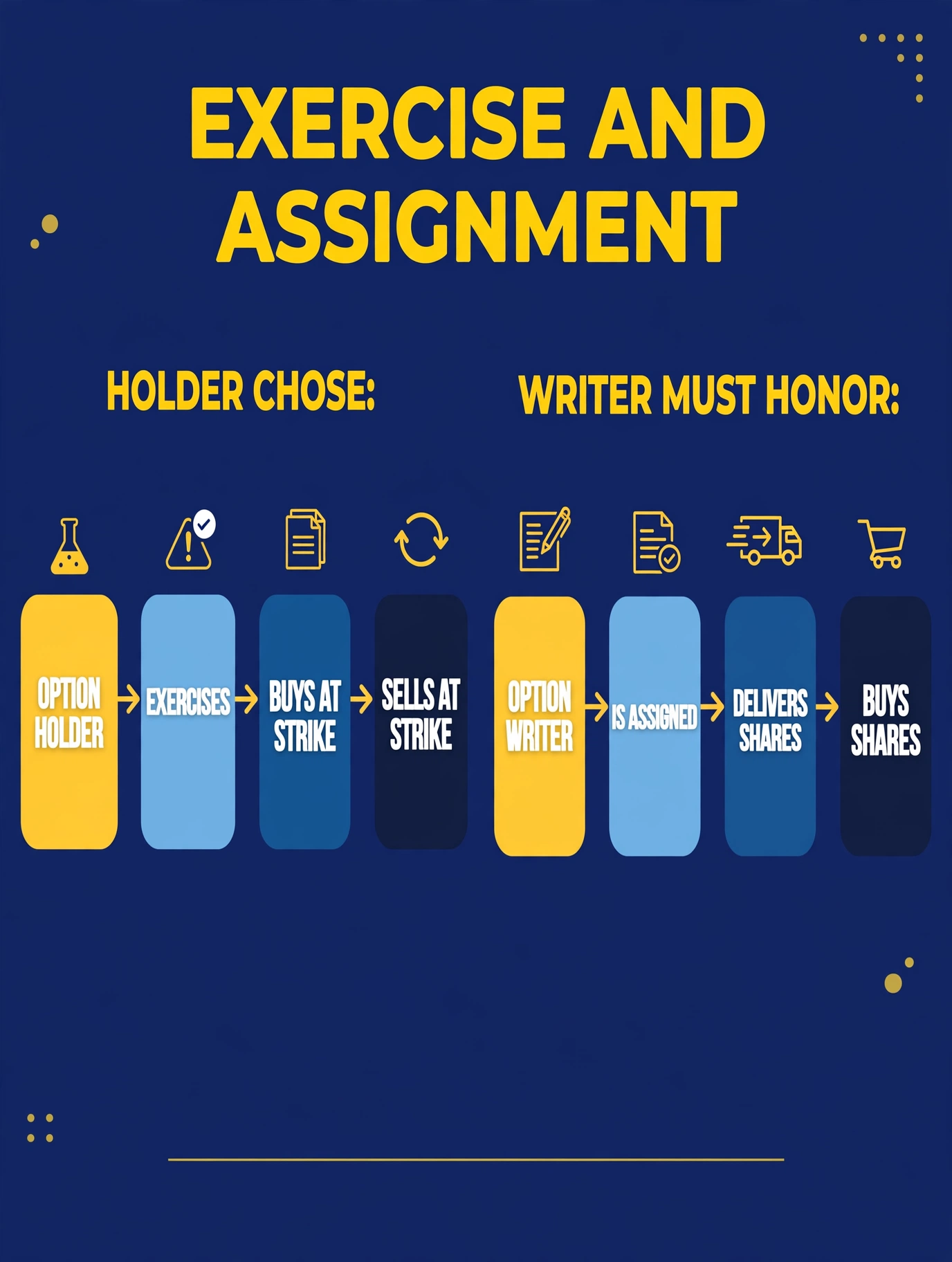
An option gives its holder a choice. Exercising is when the option holder uses that choice: the call holder buys the stock at the strike price, the put holder sells the stock at the strike price. The holder decides, the holder calls the broker, the holder starts the process.
Assignment is the other side of the same event — what the option writer experiences. When you sell (write) an option, you are promising to honor that choice if the holder makes it. If the holder exercises, the clearing system picks a writer at random and assigns the obligation to them. You do not get to refuse. The assigned call writer must deliver 100 shares at the strike price; the assigned put writer must buy 100 shares at the strike price.
Think of it like a standing bet. The buyer holds the ticket and decides whether to collect. The seller wrote the ticket and must pay up if the buyer collects. Most option buyers never exercise — they simply sell their contract before expiration, the way most people would rather sell a lottery ticket than wait for the drawing. But you must trade as if exercise could happen any day, because with American-style options it can.
Early Assignment: The Dividend Story
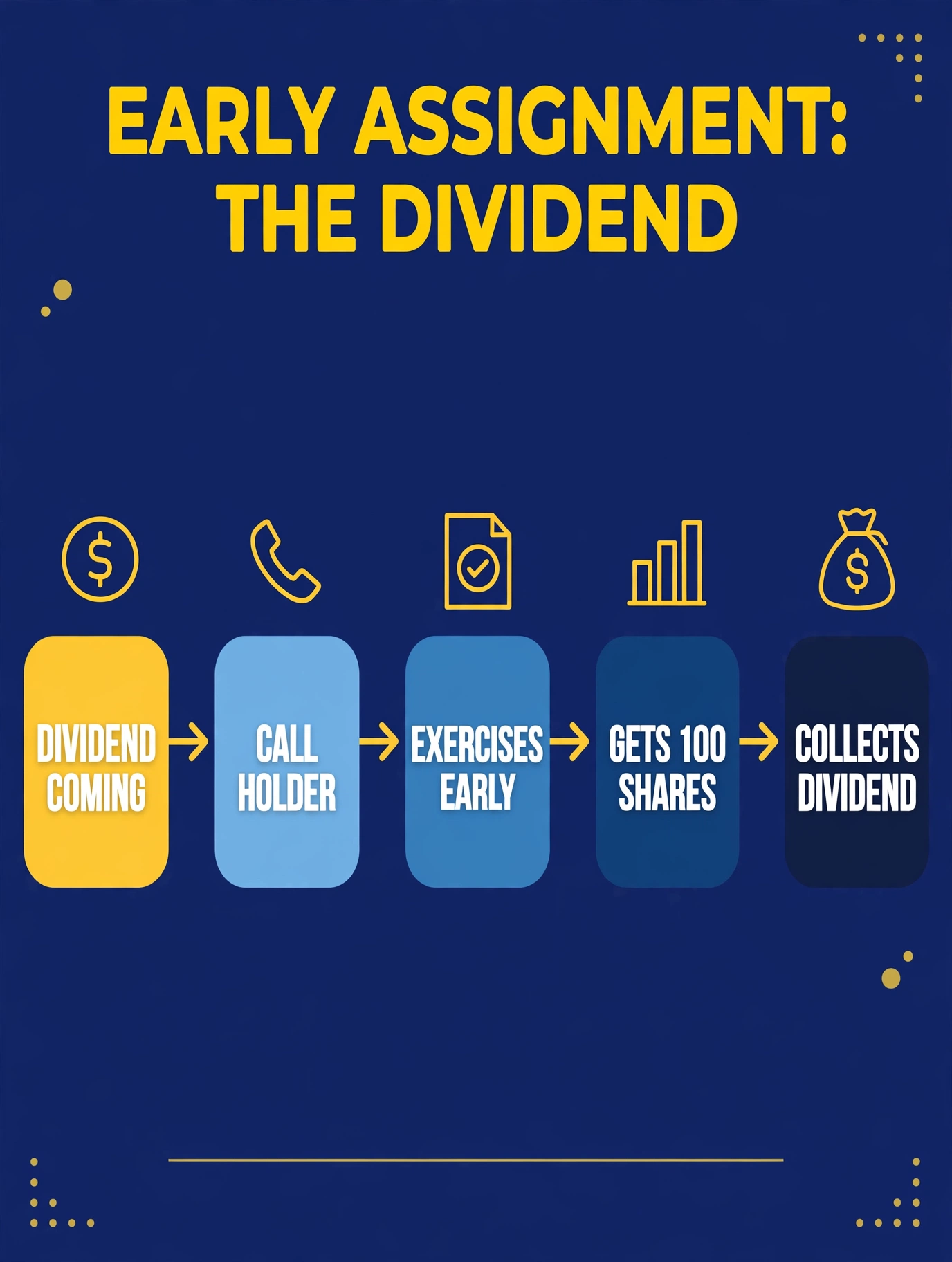
Here is the scenario that surprises new option sellers. You sold a call on a stock, and weeks before expiration the phone rings — figuratively — and your call is assigned early. Why would anyone exercise before expiration, giving up the time value still on the option? Because of the dividend.
Stock owners get paid a cash dividend on the ex-dividend date — the cutoff that decides who owns the stock in time to receive the payment. An option holder gets no dividend. So a call holder who wants the dividend can exercise just before the ex-dividend date, take the 100 shares into their account, and collect the payout.
This makes early assignment a dividend story, and almost always a short call story. Short puts can be assigned early too, but it is rare and usually tied to a different reason (deep in-the-money puts when interest-rate math favors it — just know it is uncommon). The practical lesson: if you sold calls on a stock that pays dividends, check the ex-dividend date before expiration. When the dividend is large relative to the option's remaining time value, early assignment is not a freak event — it is the likely outcome.
What should you do about it? If you are happy to sell your shares at the strike price anyway, early assignment is harmless — it just happens sooner than you planned. If you wanted to keep the stock, you can usually roll the call: buy back the short call and sell a later-dated one, moving the obligation out past the dividend. Either way, never be surprised by it. The dividend calendar is public; the assignment should not catch you flat-footed.
Settlement: How Exercise Becomes Actual Shares
When an exercise or assignment happens, shares must actually change hands. That process is called settlement. For stock options, settlement is physical delivery: the call holder pays the strike price and receives 100 shares per contract; the put holder delivers 100 shares and receives the strike price. These days your broker handles every step electronically — you wake up and the shares are simply there (or gone), and the cash has moved.
Settlement takes one business day, known as T+1 (trade date plus one). Exercise on Monday, shares land on Tuesday. Index options work differently: there is no stock to deliver, so they settle in cash — the in-the-money amount is simply credited or debited to your account. You cannot be assigned shares of the S&P 500, because the S&P 500 is not a stock you can hold.
One more detail worth knowing: the clearinghouse that stands behind every option contract is the OCC (Options Clearing Corporation). It guarantees both sides of the trade, so you never have to wonder whether the other party will actually deliver. When your account shows an assignment, the shares and cash arrive because the OCC makes it so — not because some stranger kept a promise.
Expiration Risk: The Friday Problem
Expiration is the deadline printed on every option contract — usually the third Friday of the month. When that day arrives, everything resolves at once, and this is where careless traders get hurt. Two facts matter.
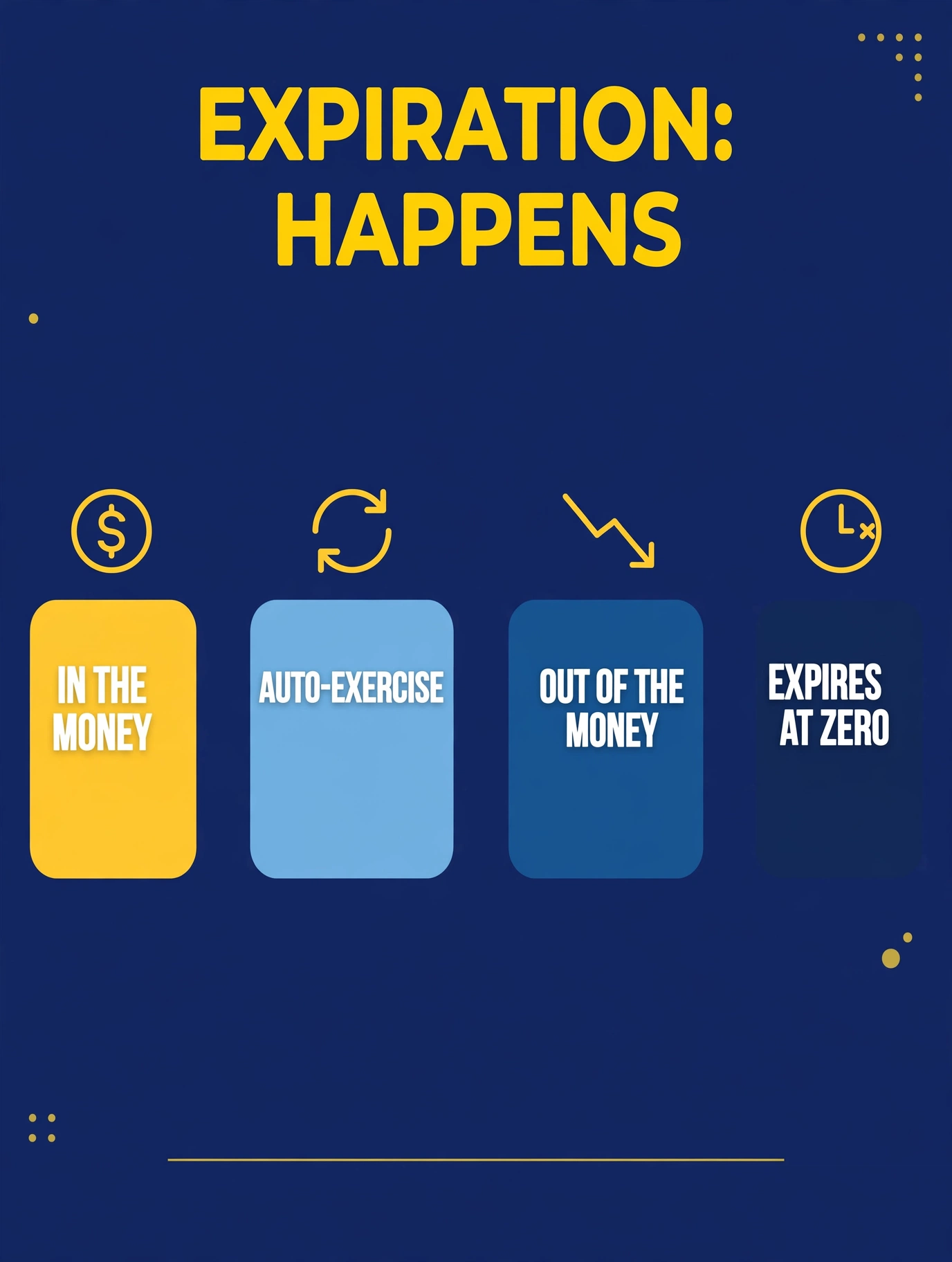
First, options that finish even slightly in the money are automatically exercised by the OCC — anything $0.01 or more in the money. You do not click anything. If your long call finishes with the stock above the strike, you will wake up Monday owning 100 shares per contract. That sounds fine until you realize a position you thought cost a few hundred dollars can turn into thousands of dollars of stock — and the margin requirement that comes with it.
Second, trading does not fully stop at Friday's closing bell. After-hours trading continues, and stock prices can move after the market closes. The nightmare scenario has a name: pin risk. Your short option finishes Friday a hair out of the money, so you assume it expires worthless — but an after-hours move pushes it into the money, and the OCC auto-exercises it. Monday morning you wake up to an unexpected stock position you never planned for.
The defense is simple and non-negotiable: never hold short options into expiration by accident. Close them, roll them, or be fully prepared to take the stock. If you deliberately hold through expiration, know exactly which of your options are near the strike and have a plan for waking up long or short 100 shares per contract. Surprises at expiration are expensive; plans at expiration are cheap.
Your Account After Exercise or Assignment
So what does your brokerage account actually look like the morning after? Walk through it once and it stops being mysterious.
You are assigned on a short call. Say you sold a call with a $50 strike and the stock sits at $54 on expiration Friday. You wake up Monday having sold 100 shares at $50 — that is $5,000 in cash landing in your account. But the stock is worth $54 a share, or $5,400. You sold for less than the market price, and the $400 difference is value you handed to the option holder. If you did not already own those shares, your account now shows a short stock position: you owe 100 shares, which you must buy back in the market — at whatever price they trade for now.
You are assigned on a short put. The mirror image: you bought 100 shares at the strike price. Cash leaves your account, shares arrive. You now own stock you may not have wanted, at a price set weeks ago.
Your long option is exercised. Your call turns into 100 shares at the strike (cash leaves, shares arrive); your put turns into a sale of 100 shares (shares leave, cash arrives).
In every case, check three things the next morning: your cash balance (did the expected money move?), your stock positions (do you own or owe shares you did not plan on?), and your margin (does the new position require more buying power than you have?). Brokers will liquidate positions that violate margin, on their schedule, not yours — so confirm the account is where you expect it to be. Exercise and assignment are not disasters. They are the contract working exactly as written. The only disaster is not knowing they were coming.
Key terms
- Exercise
- when the option holder uses the contract's choice: a call holder buys the stock at the strike, a put holder sells it.
- Assignment
- when the option writer is chosen to honor an exercised contract; the writer must deliver or buy 100 shares at the strike.
- American-style option
- an option that can be exercised any day up to expiration (the standard for stock options).
- Early assignment
- being assigned before expiration, most commonly on short calls just before a dividend.
- Dividend
- a cash payment a company makes to its shareholders; option holders receive none, which drives early exercise.
- Ex-dividend date
- the cutoff date that decides who owns the stock in time to receive the dividend.
- Settlement
- the process by which exercise becomes actual shares and cash changing hands.
- T+1
- settlement one business day after the trade or exercise date.
- Cash settlement
- how index options settle: the in-the-money amount is credited or debited, since no stock can be delivered.
- OCC (Options Clearing Corporation)
- the clearinghouse that guarantees both sides of every option contract.
- Expiration
- the deadline on an option contract, usually the third Friday of the month, when everything resolves.
- Pin risk
- the danger of an option finishing near the strike at expiration, then moving in or out of the money after hours.
- Margin
- the buying power your broker requires you to hold against stock positions; unexpected assignments can violate it.
What's next
Exercise and assignment show you what happens when contracts become stock — OD-109 "Options Risk Management" teaches you how to size positions and set limits so no single trade can hurt you.
The quiz
Exercise and Assignment — Quiz
4 questions · pass with 3 correct
1.What does assignment mean for an option writer?
2.Why do call holders most often exercise early?
3.What happens at expiration to an option that finishes slightly in the money?
4.You are assigned on a short $50-strike call with the stock at $54 on expiration Friday. What shows in your account Monday morning?
Recommended Tools
Hand-picked resources that fit this lesson — a short list, and only when they're genuinely useful.
- Learn more
TradingView
The charting platform used throughout this program — build watchlists and mark up price structure as you learn it here.
- Learn more
TraderSync
A trading journal that records every trade, so your review sessions run on real numbers instead of memory.
Some links above are affiliate links, which means The Prosper Academy may earn a commission at no extra cost to you.