
Options Risk Management
School 09 — Options and Derivatives
School 9 · Options and Derivatives · About 15 minutes
Options can be one of the safest tools in investing — or one of the most dangerous. The difference is almost never the market; it is the trader. Risk management is the set of habits that keep a bad trade from becoming a bad month: knowing your worst loss before you enter, understanding what margin really does, keeping any one trade small, trading only what you can get out of, and rehearsing the bad day in advance. We will now teach you about defined vs. undefined risk, margin, concentration, liquidity, and stress testing.
Defined vs. Undefined Risk: Know Your Worst Day
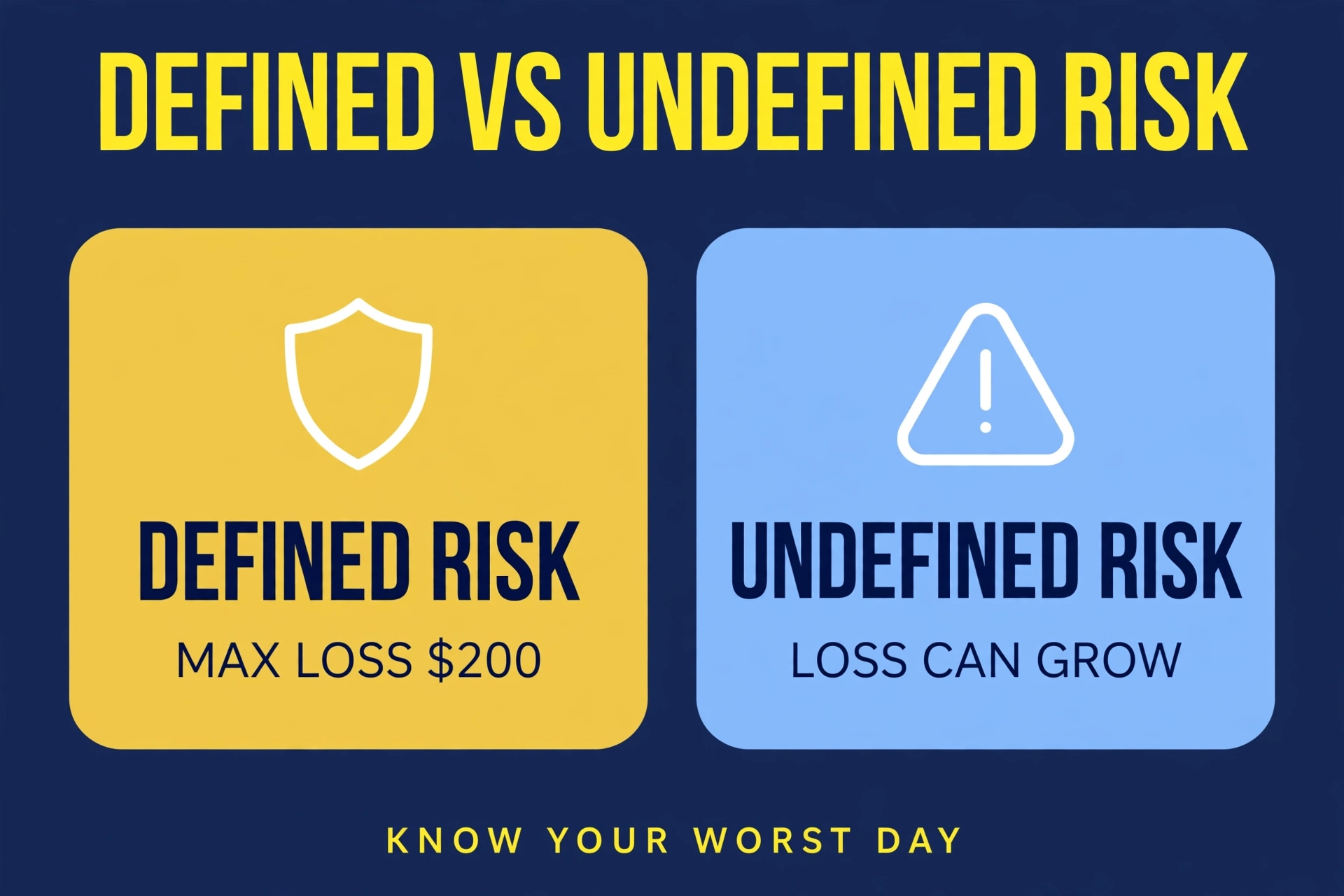
Every options trade belongs in one of two buckets, and you should know which bucket you are in before you click anything. Defined risk means the worst possible loss is capped and known in advance. A simple example: you buy a call spread for $200. The most you can ever lose on that trade is $200 — the amount you paid. No matter what the market does, your loss has a ceiling.
Undefined risk is the opposite: the loss can keep growing. Selling a naked call is the classic example — if the stock rockets upward, there is no limit to how much the option can cost you, and your loss keeps climbing. Beginners should live almost entirely in the defined-risk bucket: spreads, where one option caps what another option can cost you.
Why does this matter so much? Because emotions lie. In a calm moment, an undefined-risk trade looks like easy money. In a panic, you discover what "unlimited" really feels like. Always answer one question before any trade: what is my worst day on this trade? If you cannot state the number — $200, or whatever it is — you are not ready to take the trade.
Margin: Borrowed Power, Borrowed Trouble
Margin is money your broker lets you borrow against your account to take bigger positions. When you sell certain options, your broker requires a margin deposit — a cash cushion set aside in case the trade goes against you. If losses eat into that cushion, you can get a margin call: a demand to deposit more money immediately, often with a tight deadline.
The danger is speed. Options move fast, and on margin they move faster. A trade that would be a small dent in a cash account can trigger a margin call when it is leveraged. And a forced sale is always the worst sale — your broker closes your positions at whatever price is available, usually at the worst moment, locking in the loss.
Two rules keep margin safe. First, keep a margin buffer: never let your positions use more than a fraction of your buying power, so a bad day leaves breathing room. Second, never borrow money to buy a trade you do not fully understand. Margin multiplies whatever you already do — good decisions get better, bad ones get catastrophic.
Concentration: Keep Positions Small
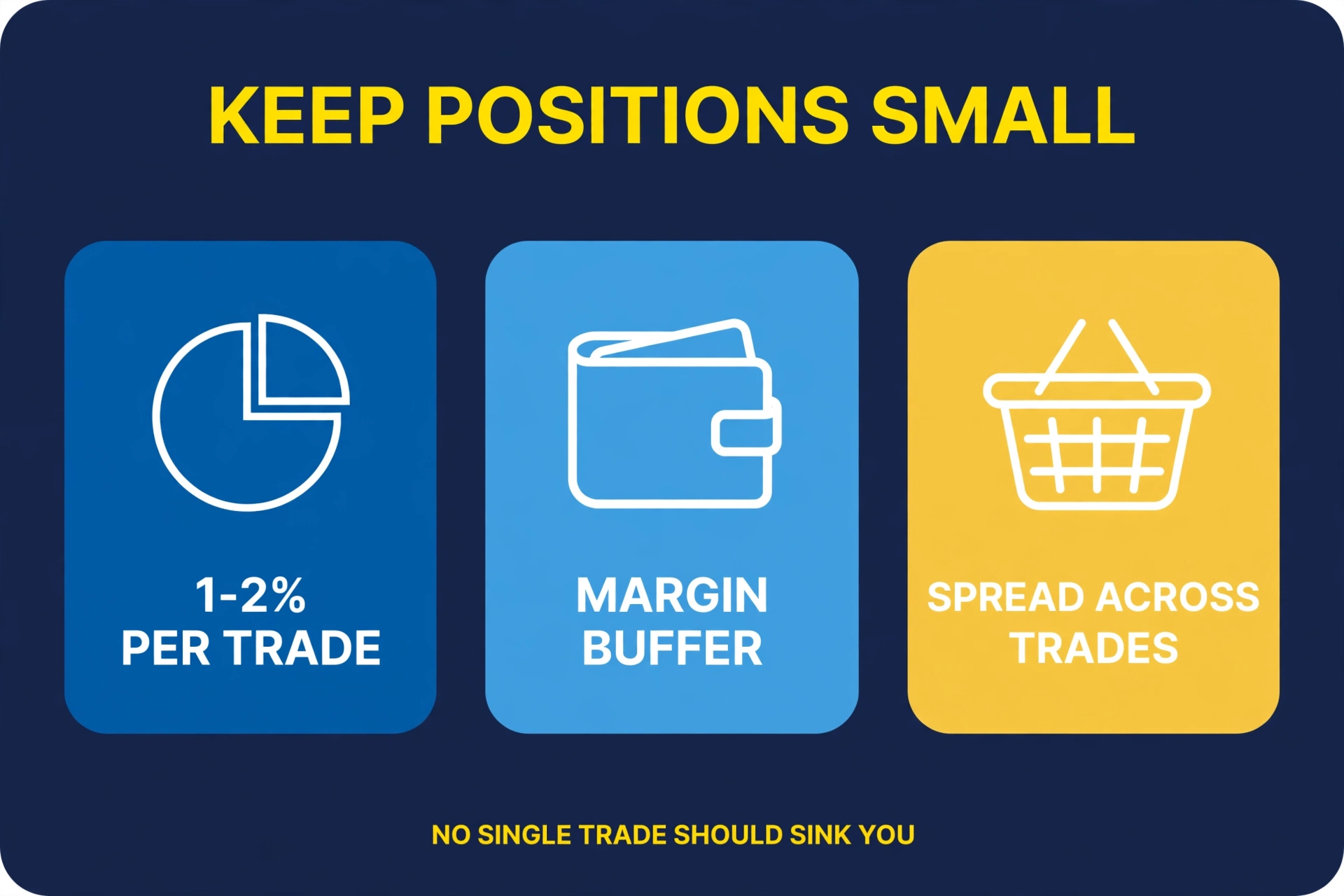
Concentration risk is putting too much of your account into one trade, one stock, or one idea. It feels bold; it is actually the fastest way to ruin an account. Options can move 50% or more in a single day — that is the nature of the instrument. A trade that is half your account can become a catastrophe by lunchtime.
The fix is position sizing: decide in advance how much of your account any single trade is allowed to risk. A common guideline is 1–2% per trade — small enough that a full loss stings but does not sink you. That means even ten losing trades in a row would only cost about a tenth to a fifth of your account, and you are still in the game with your capital and your confidence intact.
Concentration also applies to ideas. Ten trades that all bet "the market goes up" are one big bet wearing a disguise. Spread your trades across different trades, different time frames, and different directions so no single outcome decides your month.
Liquidity: Make Sure You Can Get Out
Liquidity is how easily you can buy or sell without the price moving against you. A liquid option has many buyers and sellers competing, so the bid-ask spread — the gap between what buyers offer and sellers ask — is tight. You can enter and exit near a fair price.
An illiquid option is a trap with a welcome sign. The bid-ask spread is wide, so you lose money the moment you enter, and lose more when you exit. Worse, in a fast market there may be almost no buyers at all — you watch your position drop and cannot get out at any reasonable price. The profit you thought you had existed only on paper.
Before you trade any option, check its volume and open interest — how many contracts trade per day and how many are outstanding. High numbers mean real buyers and sellers. Stick to heavily traded options on major stocks and indexes, and avoid exotic or far-dated contracts with thin trading. The golden rule: never enter a trade you cannot exit cleanly.
Stress Testing: Rehearse the Bad Day
Stress testing means asking "what if the worst happens?" before it happens — and having an answer ready. Professional traders do this constantly; beginners almost never do, which is why beginners panic.
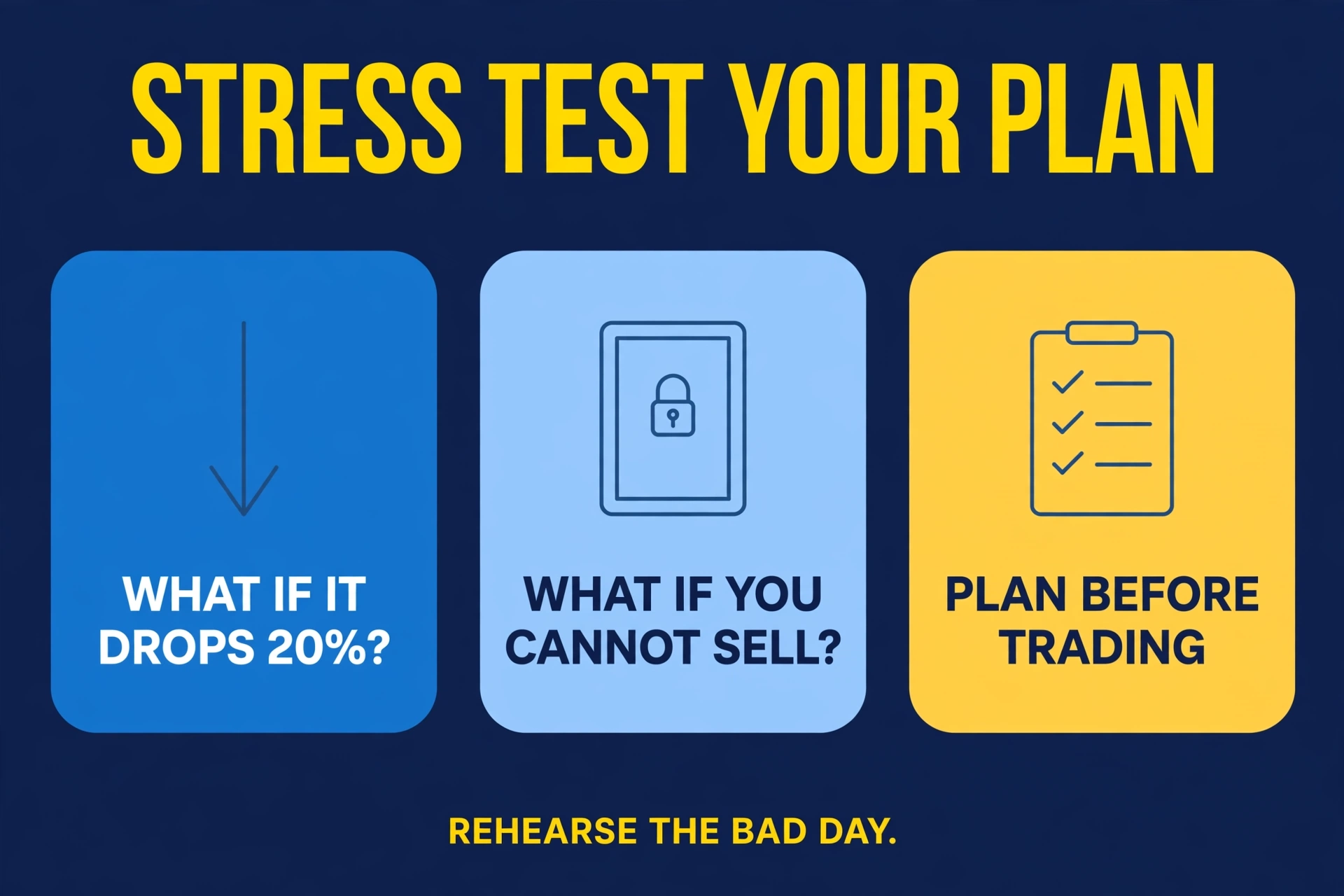
Run three scenarios before every trade. One: the underlying drops 20% overnight — what is my loss, and what do I do? (If it is a defined-risk trade, you already know the number: your maximum loss.) Two: the market crashes and liquidity dries up — can I still get out, or am I trapped? Three: I am wrong and the trade never works — at what point do I admit it and close, rather than hope?
Then write down your exit plan: the price or condition at which you will close the trade, win or lose. An exit plan made in a calm moment is worth ten times the improvisation you will invent in a panic. Rehearse the bad day, write the plan, and when trouble actually arrives, you are executing — not deciding.
Key terms
- Defined risk
- a trade whose worst possible loss is capped and known before you enter, like a spread bought for $200.
- Undefined risk
- a trade whose loss can keep growing, like a naked short call with no cap.
- Spread
- a defined-risk options trade combining two options, where one caps what the other can cost you.
- Margin
- money borrowed from your broker to take larger positions; it multiplies gains and losses alike.
- Margin deposit
- the cash cushion your broker requires you to set aside when you sell options.
- Margin call
- a demand to deposit more money immediately when losses eat into your margin cushion.
- Concentration risk
- putting too much of your account into one trade, one stock, or one idea.
- Position sizing
- deciding in advance how much of your account one trade may risk, commonly 1–2% per trade.
- Liquidity
- how easily you can buy or sell without the price moving against you.
- Bid-ask spread
- the gap between what buyers offer and sellers ask; wide gaps signal illiquidity.
- Stress test
- asking "what if the worst happens?" before trading, and planning your response in advance.
- Exit plan
- the price or condition at which you will close a trade, decided calmly before you enter.
What's next
You now speak the language of options risk; OD-110 "Options Strategy Lab" puts it all together — matching the right strategy to the right market.
The quiz
Options Risk Management — Quiz
3 questions · pass with 3 correct
1.You buy an options spread for $200. What is the most you can lose on this trade?
2.How much of your account should a single options trade risk?
3.What does it mean to stress test a trade?
Recommended Tools
Hand-picked resources that fit this lesson — a short list, and only when they're genuinely useful.
- Learn more
TradingView
The charting platform used throughout this program — build watchlists and mark up price structure as you learn it here.
- Learn more
TraderSync
A trading journal that records every trade, so your review sessions run on real numbers instead of memory.
Some links above are affiliate links, which means The Prosper Academy may earn a commission at no extra cost to you.